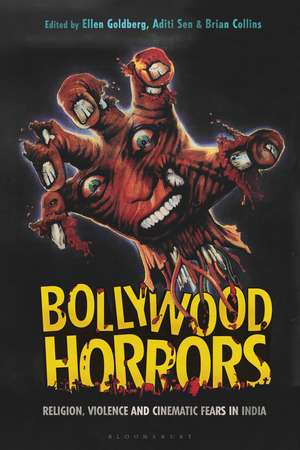
Bollywood Horrors: Religion, Violence and Cinematic Fears in India
Editat de Ellen Goldberg, Dr Aditi Sen, Professor Brian Collinsen Limba Engleză Paperback – 19 mai 2022
Part one, "Material Cultures and Prehistories of Horror in South Asia" looks at horror movie posters and song booklets and the surprising role of religion in the importation of Gothic tropes into Indian films, told through the little-known story of Sir Devendra Prasad Varma. Part two, "Cinematic Horror, Iconography and Aesthetics" examines the stereotype of the tantric magician found in Indian literature beginning in the medieval period, cinematic representations of the myth of the fearsome goddess Durga's slaying of the Buffalo Demon, and the influence of epic mythology and Hollywood thrillers on the 2002 film Raaz. The final part, "Cultural Horror," analyzes elements of horror in Indian cinema's depiction of human trafficking, shifting gender roles, the rape-revenge cycle, and communal violence. This book also features images (colour in the hardback, black and white in the paperback).
Preț: 219.47 lei
Preț vechi: 293.54 lei
-25%
Puncte Express: 329
Carte tipărită la comandă
Livrare economică 27 noiembrie-11 decembrie
Livrare prin curier în România Termenul estimat este afișat lângă disponibilitate.
Transport gratuit de la 400.00 lei Plată online sau ramburs, în funcție de opțiunile comenzii.
Retur gratuit în 14 zile Comandă securizată și suport în română.
Specificații
ISBN-13: 9781350191754
ISBN-10: 1350191752
Pagini: 264
Ilustrații: 40 bw illus
Dimensiuni: 152 x 232 x 18 mm
Greutate: 0.37 kg
Editura: Bloomsbury Publishing
Colecția Bloomsbury Academic
Locul publicării:London, United Kingdom
ISBN-10: 1350191752
Pagini: 264
Ilustrații: 40 bw illus
Dimensiuni: 152 x 232 x 18 mm
Greutate: 0.37 kg
Editura: Bloomsbury Publishing
Colecția Bloomsbury Academic
Locul publicării:London, United Kingdom
Cuprins
Preface, Brian Collins (Ohio University, USA)
Introduction, Ellen Goldberg (Queen's University, Canada), Aditi Sen (Queen's University, Canada), and Brian Collins (Ohio University, USA)
Part I: Material Cultures and Prehistories of Horror in South Asia
1. Monsters, Masala, and Materiality: Close Encounters with Hindi Horror Movie Ephemera, Brian Collins (Ohio University, USA)
2. Vampire Man Varma: The Untold Story of the "Hindu Mystic" Who Decolonized Dracula, Brian Collins (Ohio University, USA)
Part II: Religion
3. Divine Horror and the Avenging Goddess in Bollywood, Kathleen Erndl (Florida State University, USA)
4. Horrifying and Sinister Tantriks, Hugh B. Urban (Ohio State University, USA)
5. Do you want to know the Raaz?: Tropes of Madness and Immorality in Bollywood Horror, Aditi Sen (Queen's University, Canada)
Part III: Cinematic Fears
6. Cutural Horror In Dev : Man is the Cruelest Animal, Ellen Goldberg (Queens University, Canada)
7. Bandit Queen, Rape-Revenge, and Cultural Horror, Morgan Oddie (Queen's University, Canada)
8. Mardaani and the Trafficking of Women in India, Beth Watkins (Allegheny College, USA)
Bibliography
Index
Introduction, Ellen Goldberg (Queen's University, Canada), Aditi Sen (Queen's University, Canada), and Brian Collins (Ohio University, USA)
Part I: Material Cultures and Prehistories of Horror in South Asia
1. Monsters, Masala, and Materiality: Close Encounters with Hindi Horror Movie Ephemera, Brian Collins (Ohio University, USA)
2. Vampire Man Varma: The Untold Story of the "Hindu Mystic" Who Decolonized Dracula, Brian Collins (Ohio University, USA)
Part II: Religion
3. Divine Horror and the Avenging Goddess in Bollywood, Kathleen Erndl (Florida State University, USA)
4. Horrifying and Sinister Tantriks, Hugh B. Urban (Ohio State University, USA)
5. Do you want to know the Raaz?: Tropes of Madness and Immorality in Bollywood Horror, Aditi Sen (Queen's University, Canada)
Part III: Cinematic Fears
6. Cutural Horror In Dev : Man is the Cruelest Animal, Ellen Goldberg (Queens University, Canada)
7. Bandit Queen, Rape-Revenge, and Cultural Horror, Morgan Oddie (Queen's University, Canada)
8. Mardaani and the Trafficking of Women in India, Beth Watkins (Allegheny College, USA)
Bibliography
Index
Recenzii
All told Bollywood Horrors is a welcome treatment of an underdiscussed topic within South Asian studies, media studies, and religious studies. The volume treats a variety of topics and perspectives, setting the standard for further exploration into a rich and largely untapped field. The volume is sure to interest scholars in the above-mentioned disciplines, as well as Bollywood and horror enthusiasts as well.
[T]he collection marks a promising start of critical discussions of the connections between Indian religion, myth, and Bollywood horror films. Apart from helping the global horror enthusiast take a notable step toward exploring the wide variety of Bollywood horrors, these essays will aid scholars of religious studies by drawing attention to the notable afterlives of the avenging female goddess of Hindu religion as well as the vilification of tantraand its followers across cultures. Most importantly, the collection caters to the cross-cultural approach of religious studies when it explains the notable similarities between the male viewers of Bollywood horrors and American slasher films.
[T]his anthology's breadth is also its strength: Bollywood Horrors is not principally a book for horror film scholars, but its wide range of texts and approaches opens it up to a much broader audience and readership.
This phenomenal collection explores a complex cinematic genre through the lenses of religious studies, aesthetics, and socio-political issues in India. Each chapter is illuminating on its own, and the book, as a whole, richly theorizes the horror genre within the cultural context of South Asia. The book will be of great interest to anyone in the fields of Religious Studies, Cinema Studies, South Asian Studies, and Critical Theory.
Provocative and wide-ranging, the essays in Bollywood Horrors contribute to the small but growing literature on Indian horror cinema, while interrogating the notion of "horror" itself as both entertainment genre and aesthetic-cultural category. The authors highlight neglected religious and folkloric themes in "cult" films and examine the "cultural horrors" of post-Liberalization India and the global capitalist economy in which it is enmeshed.
This book persuasively complicates classic distinctions in Film Studies between art-horror and natural-horror by attending to Indian folklore, religious iconography, demonology, myth and ritual. The collection demonstrates Indian horror cinema's generic hybridity, the enduring relevance of classical Rasa aesthetics in understanding its affective range, and the horror genre's function in figuring everyday violence and trauma in India.
This captivating book provides several insightful perspectives on an overlooked topic of Bollywood horror movies.
[T]he collection marks a promising start of critical discussions of the connections between Indian religion, myth, and Bollywood horror films. Apart from helping the global horror enthusiast take a notable step toward exploring the wide variety of Bollywood horrors, these essays will aid scholars of religious studies by drawing attention to the notable afterlives of the avenging female goddess of Hindu religion as well as the vilification of tantraand its followers across cultures. Most importantly, the collection caters to the cross-cultural approach of religious studies when it explains the notable similarities between the male viewers of Bollywood horrors and American slasher films.
[T]his anthology's breadth is also its strength: Bollywood Horrors is not principally a book for horror film scholars, but its wide range of texts and approaches opens it up to a much broader audience and readership.
This phenomenal collection explores a complex cinematic genre through the lenses of religious studies, aesthetics, and socio-political issues in India. Each chapter is illuminating on its own, and the book, as a whole, richly theorizes the horror genre within the cultural context of South Asia. The book will be of great interest to anyone in the fields of Religious Studies, Cinema Studies, South Asian Studies, and Critical Theory.
Provocative and wide-ranging, the essays in Bollywood Horrors contribute to the small but growing literature on Indian horror cinema, while interrogating the notion of "horror" itself as both entertainment genre and aesthetic-cultural category. The authors highlight neglected religious and folkloric themes in "cult" films and examine the "cultural horrors" of post-Liberalization India and the global capitalist economy in which it is enmeshed.
This book persuasively complicates classic distinctions in Film Studies between art-horror and natural-horror by attending to Indian folklore, religious iconography, demonology, myth and ritual. The collection demonstrates Indian horror cinema's generic hybridity, the enduring relevance of classical Rasa aesthetics in understanding its affective range, and the horror genre's function in figuring everyday violence and trauma in India.
This captivating book provides several insightful perspectives on an overlooked topic of Bollywood horror movies.