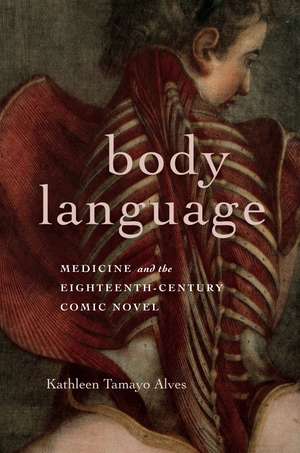
Body Language: Medicine and the Eighteenth-Century Comic Novel: Transits: Literature, Thought & Culture, 1650-1850
Autor Kathleen Tamayo Alvesen Limba Engleză Paperback – 11 noi 2025 – vârsta ani
Published by Bucknell University Press. Distributed worldwide by Rutgers University Press.
Din seria Transits: Literature, Thought & Culture, 1650-1850
-
 Preț: 302.57 lei
 -
 Preț: 301.15 lei
 -
 Preț: 268.76 lei
 -
 Preț: 321.63 lei
 -
 Preț: 234.65 lei
 -
 Preț: 370.48 lei
 -
 Preț: 351.58 lei
 -
 Preț: 319.96 lei
 - 23%
 Preț: 864.06 lei
 -
 Preț: 355.93 lei
 - 13%
 Preț: 984.05 lei
 - 13%
 Preț: 986.71 lei
 - 25%
 Preț: 855.28 lei
 - 13%
 Preț: 984.31 lei
 - 30%
 Preț: 785.19 lei
 - 24%
 Preț: 854.70 lei
 -
 Preț: 314.56 lei
 -
 Preț: 359.76 lei
 - 24%
 Preț: 854.43 lei
 - 13%
 Preț: 985.16 lei
 - nou
 Preț: 1097.40 lei
 -
 Preț: 422.02 lei
 -
 Preț: 268.08 lei
 -
 Preț: 235.61 lei
 -
 Preț: 331.93 lei
 - nou
 Preț: 336.59 lei
 - nou
 Preț: 311.64 lei
Preț: 289.17 lei
Puncte Express: 434
Carte disponibilă
Livrare economică 16-30 noiembrie
Livrare express 30 octombrie-05 noiembrie pentru 26.77 lei
Livrare prin curier în România Termenul estimat este afișat lângă disponibilitate.
Transport gratuit de la 400.00 lei Plată online sau ramburs, în funcție de opțiunile comenzii.
Retur gratuit în 14 zile Comandă securizată și suport în română.
Specificații
ISBN-13: 9781684485703
ISBN-10: 1684485703
Pagini: 214
Dimensiuni: 156 x 235 x 18 mm
Greutate: 0.34 kg
Editura: Bucknell University Press
Colecția Bucknell University Press
Seria Transits: Literature, Thought & Culture, 1650-1850
ISBN-10: 1684485703
Pagini: 214
Dimensiuni: 156 x 235 x 18 mm
Greutate: 0.34 kg
Editura: Bucknell University Press
Colecția Bucknell University Press
Seria Transits: Literature, Thought & Culture, 1650-1850
Notă biografică
KATHLEEN TAMAYO ALVES is an associate professor of English at Queensborough Community College of The City University of New York. Her research centers on eighteenth-century literature and culture, medicine, and literary history, and she has recently published in Studies in Eighteenth-Century Culture, Eighteenth-Century Fiction, Eighteenth-Century Studies, and The Eighteenth Century: Theory and Interpretation.
Cuprins
Introduction: Eighteenth-Century Medicine and Comic Representations of Women 1
1 Leaky Writings and Leaky Bodies in Henry Fielding’s Shamela (1741) and Tobias Smollett’s Humphry Clinker (1771) 17
2 Hysterical Language and Desiring Women in Henry Fielding’s Joseph Andrews (1742) and Tom Jones (1749) 44
3 The Maternal Body and Obstetric Authority in Laurence Sterne’s Tristram Shandy (1759) and Tobias Smollett’s Peregrine Pickle (1751) 72
4 Romantic (Mis)Readings and Nervous Sympathy in Charlotte Lennox’s The Female Quixote (1752) 108
Coda: Surgical Violence as a Tool of Masculine Dominance in Poor Things (2023) 140
Acknowledgments 149
Notes 153
Bibliography 175
Index 191
1 Leaky Writings and Leaky Bodies in Henry Fielding’s Shamela (1741) and Tobias Smollett’s Humphry Clinker (1771) 17
2 Hysterical Language and Desiring Women in Henry Fielding’s Joseph Andrews (1742) and Tom Jones (1749) 44
3 The Maternal Body and Obstetric Authority in Laurence Sterne’s Tristram Shandy (1759) and Tobias Smollett’s Peregrine Pickle (1751) 72
4 Romantic (Mis)Readings and Nervous Sympathy in Charlotte Lennox’s The Female Quixote (1752) 108
Coda: Surgical Violence as a Tool of Masculine Dominance in Poor Things (2023) 140
Acknowledgments 149
Notes 153
Bibliography 175
Index 191
Recenzii
"An erudite, engaging account of how eighteenth-century comic novels refigure, in fascinating and unexpected ways, misogynistic medical theories about ciswomen's embodiment. Through meticulous excavation of eighteenth-century medical treatises and highly original close readings of canonical novels by Smollett, Sterne, Fielding, and Lennox, Alves offers compelling new dimensions to the literary histories of medicine, gender, and sexuality. A must-read for specialists and non-specialists alike!"
"A rich exploration of the interrelation of eighteenth-century literature and medicine, Body Language deftly connects the formal constraints on fictional characters to those medical discourse places on living women. Alves's lucid and often deeply funny readings show that a patriarchal medical establishment can find little harder to account for than the ways that women escape efforts to define and constrain them."
"Body Language artfully weaves an interdisciplinary web of science, sexuality, and reading practices to reveal the feminist potential of comic modes. This incredibly detailed work on the overlooked area of female bodies in comic texts makes a unique and important contribution to scholarship on literature and medicine.”
"Offering deft and stimulating comparisons of eighteenth-century comic fiction and scientific writing, Body Language adds a vital chapter to the study of medicine, literature, and gender in the period. Alves's insightful analysis of seven novels alongside a range of medical texts shows how the female body, as a cultural signifier, can tell new stories."
"A rich exploration of the interrelation of eighteenth-century literature and medicine, Body Language deftly connects the formal constraints on fictional characters to those medical discourse places on living women. Alves's lucid and often deeply funny readings show that a patriarchal medical establishment can find little harder to account for than the ways that women escape efforts to define and constrain them."
"Body Language artfully weaves an interdisciplinary web of science, sexuality, and reading practices to reveal the feminist potential of comic modes. This incredibly detailed work on the overlooked area of female bodies in comic texts makes a unique and important contribution to scholarship on literature and medicine.”
"Offering deft and stimulating comparisons of eighteenth-century comic fiction and scientific writing, Body Language adds a vital chapter to the study of medicine, literature, and gender in the period. Alves's insightful analysis of seven novels alongside a range of medical texts shows how the female body, as a cultural signifier, can tell new stories."
Descriere
Body Language examines how eighteenth-century medical discourse informed the comic novel. Through comic representations of “leaky” female physical, psychological, and emotional embodiment, novels by Henry Fielding, Tobias Smollett, Laurence Sterne, and Charlotte Lennox engage political and social anxieties caused by women’s sexuality.