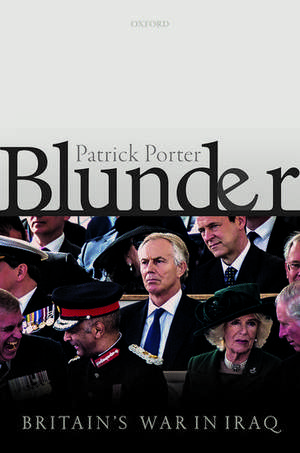
Blunder: Britain's War in Iraq
Autor Patrick Porteren Limba Engleză Hardback – 8 noi 2018
Preț: 369.99 lei
Preț vechi: 415.82 lei
-11%
Puncte Express: 555
Carte tipărită la comandă
Livrare economică 27 noiembrie-02 decembrie
Livrare prin curier în România Termenul estimat este afișat lângă disponibilitate.
Transport gratuit de la 400.00 lei Plată online sau ramburs, în funcție de opțiunile comenzii.
Retur gratuit în 14 zile Comandă securizată și suport în română.
Specificații
ISBN-13: 9780198807964
ISBN-10: 0198807961
Pagini: 256
Dimensiuni: 164 x 241 x 21 mm
Greutate: 0.53 kg
Editura: OUP OXFORD
Colecția OUP Oxford
Locul publicării:Oxford, United Kingdom
ISBN-10: 0198807961
Pagini: 256
Dimensiuni: 164 x 241 x 21 mm
Greutate: 0.53 kg
Editura: OUP OXFORD
Colecția OUP Oxford
Locul publicării:Oxford, United Kingdom
Recenzii
Blunder is an important book and a must-read for those looking for a meticulous and fair-minded account of the most controversial strategic decision of the post-9/11 period.
One of the best books of the year
Blunder concludes that bad ideas, sincerely and widely held, bear primary responsibility for what went wrong. This is now fifteen year old history and rarely receives a mention but is important for decision makers today.
A wide-ranging study of Britain's decision to go to war in Iraq and the unintended consequences.
Well-researched, elegant and succinctly written.
Breath-taking and ground-breaking.
Blunder is to be commended. Porter has meticulously constructed a rigorous interrogation of Britain's intellectual path to the Iraq War. The history of the Iraq War will continue to be written as additional information becomes available and as its consequences are fully explicated. But Blunder is an important waystation along that path, one readers will want to return to repeatedly.
A brilliant discussion of Britain's road to war. Concise but elegant and full of great insight. Porter doesnt traffic in conspiracies but rather explains how Britain's commitment to the Iraq war issued from bad or exaggerated ideas, starting with liberal interventionist commitments to ideas like overturning rogue regimes. Engaging, insightful, essential to understand future foreign policy choices.
A great achievement.
In the welter of critiques of Tony Blair's leading the UK into the war in Iraq, Patrick Porter's stands out for its honesty, deep research, and conclusion that bad ideas, sincerely and widely held, bear primary responsibility. The beliefs that regime change was a moral imperative and required for world security and also that a better government could be readily established produced a combination of fear and confidence that proved lethal.
Patrick Porter's important book identifies and anatomizes the remarkable stew of ideology and fear that drove the United Kingdom to join the United States in invading and occupying Iraq in 2003. The book is a passionate, indeed a morally based cry for greater consideration of the possibility that bad outcomes can and often do grow from good intentions. In Blunder: Britains War in Iraq, Porter focuses on British elites decision for war. He dissects the muddled thinking of supporters of the war and presents a persuasive counterfactual argument for the lesser evil of leaving Saddam Hussein in power. At the heart of his story is the belligerent liberalism that joins so-called neocons and progressives in the belief that democracy grows from the barrel of a gun. Porter also wisely identifies the UK's concern to retain some influence with the last superpower.
Blunder offers by far the best account of the most complex and contentious strategic decisions of our time, providing a vital textbook for future decision makers. It is deeply researched, theoretically nuanced, morally engaged, and scrupulously fair. A model of how scholarship can contribute vitally to urgent contemporary questions.
One of the best books of the year
Blunder concludes that bad ideas, sincerely and widely held, bear primary responsibility for what went wrong. This is now fifteen year old history and rarely receives a mention but is important for decision makers today.
A wide-ranging study of Britain's decision to go to war in Iraq and the unintended consequences.
Well-researched, elegant and succinctly written.
Breath-taking and ground-breaking.
Blunder is to be commended. Porter has meticulously constructed a rigorous interrogation of Britain's intellectual path to the Iraq War. The history of the Iraq War will continue to be written as additional information becomes available and as its consequences are fully explicated. But Blunder is an important waystation along that path, one readers will want to return to repeatedly.
A brilliant discussion of Britain's road to war. Concise but elegant and full of great insight. Porter doesnt traffic in conspiracies but rather explains how Britain's commitment to the Iraq war issued from bad or exaggerated ideas, starting with liberal interventionist commitments to ideas like overturning rogue regimes. Engaging, insightful, essential to understand future foreign policy choices.
A great achievement.
In the welter of critiques of Tony Blair's leading the UK into the war in Iraq, Patrick Porter's stands out for its honesty, deep research, and conclusion that bad ideas, sincerely and widely held, bear primary responsibility. The beliefs that regime change was a moral imperative and required for world security and also that a better government could be readily established produced a combination of fear and confidence that proved lethal.
Patrick Porter's important book identifies and anatomizes the remarkable stew of ideology and fear that drove the United Kingdom to join the United States in invading and occupying Iraq in 2003. The book is a passionate, indeed a morally based cry for greater consideration of the possibility that bad outcomes can and often do grow from good intentions. In Blunder: Britains War in Iraq, Porter focuses on British elites decision for war. He dissects the muddled thinking of supporters of the war and presents a persuasive counterfactual argument for the lesser evil of leaving Saddam Hussein in power. At the heart of his story is the belligerent liberalism that joins so-called neocons and progressives in the belief that democracy grows from the barrel of a gun. Porter also wisely identifies the UK's concern to retain some influence with the last superpower.
Blunder offers by far the best account of the most complex and contentious strategic decisions of our time, providing a vital textbook for future decision makers. It is deeply researched, theoretically nuanced, morally engaged, and scrupulously fair. A model of how scholarship can contribute vitally to urgent contemporary questions.
Notă biografică
Patrick Porter is Professor of International Security and Strategy at the University of Birmingham. He is Senior Associate Fellow at the Royal United Services Institute (RUSI). His main research interests are U.S. and British grand strategy, the interaction of power and ideas in international relations, and diplomatic and military history. He has published in International Security, War in History and The Journal of Strategic Studies. He grew up in Melbourne, Australia, before completing his doctorate at the University of Oxford. He enjoys ancient history, cricket and cigars.