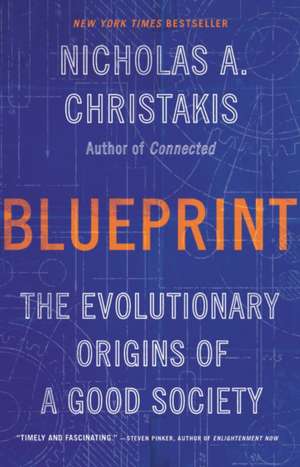
Blueprint
Autor Nicholas A Christakisen Limba Engleză Paperback – 10 mar 2020
În ediția de față a lucrării Blueprint, Nicholas A Christakis propune o schimbare de paradigmă în biologia evoluționistă, mutând accentul de la agresivitate și interes personal către trăsăturile sociale benefice care ne definesc specia. Această ediție în format paperback integrează o sinteză vastă de date, susținută vizual de 34 de ilustrații și un insert special color, oferind o perspectivă interdisciplinară asupra modului în care selecția naturală a favorizat dragostea, prietenia și învățarea. Observăm cum autorul își extinde cercetările anterioare din Connected, unde analiza rețelele sociale, către o bază genetică mult mai profundă. Dacă în lucrările sale trecute se concentra pe modul în care ne influențăm reciproc sănătatea sau fericirea, în Blueprint Christakis demonstrează că purtăm în codul nostru genetic instrucțiunile pentru a crea societăți bune. Argumentația sa este susținută de exemple fascinante, de la micro-societățile formate spontan în urma naufragiilor, până la interacțiunile complexe din comunitățile de cetacee. Acoperă aceeași arie tematică precum Minds Make Societies de Pascal Boyer, dar cu o abordare mult mai optimistă și orientată spre fundamentele biologice ale binelui social, față de analiza mai tehnică a modelelor psihologice oferită de Boyer. De asemenea, în timp ce Genesis de Edward O. Wilson folosește exemple din lumea non-umană pentru a explica evoluția darwinistă, Christakis face pasul suplimentar de a lega aceste observații direct de structurile politice și economice contemporane. Remarcăm o structură narativă fluidă care transformă datele statistice și epidemiologice într-o pledoarie convingătoare pentru umanitate, într-o perioadă marcată de polarizare socială.
Preț: 129.97 lei
Carte disponibilă
Livrare economică 14-28 noiembrie
Specificații
ISBN-10: 0316230049
Pagini: 544
Ilustrații: 34 b/w illus. run w/ text, 8 -pp 4/c insert
Dimensiuni: 209 x 138 x 41 mm
Greutate: 0.45 kg
Editura: Little, Brown and Company
V-ar putea interesa
-
![Sapiens [Tenth Anniversary Edition]](https://i0.books-express.ro/bt/9780063422001/sapiens-tenth-anniversary-edition.jpg) Sapiens [Tenth Anniversary Edition]Yuval Noah HarariPreț: 183.68 lei
Sapiens [Tenth Anniversary Edition]Yuval Noah HarariPreț: 183.68 lei -
 Social IntelligenceDaniel Goleman-18%Preț: 76.90 lei93.99 lei
 -
 The Origins of VirtueMatt Ridley-19%Preț: 75.49 lei93.16 lei
 -
 Genesis: The Deep Origin of SocietiesEdward O. Wilson-22%Preț: 59.97 lei76.65 lei
 -
 Selfish Genes to Social Beings: A Cooperative History of LifeJonathan Silvertown-17%Preț: 119.39 lei144.62 lei
 -
 Mutual AidPeter Kropotkin-25%Preț: 59.73 lei79.22 lei
 -
 When Everyone Knows That Everyone Knows...Steven PinkerPreț: 137.96 lei
 -
 Shared WisdomAlex PentlandPreț: 153.35 lei
 -
 -15%Preț: 106.02 lei124.73 lei
 -
 Secret of Our SuccessJoseph HenrichPreț: 134.20 lei
 -
 -23%Preț: 62.48 lei81.32 lei
 -
 Lineages of ModernityEmmanuel ToddPreț: 160.94 lei
 -
 The Social InstinctNichola Raihani-17%Preț: 60.14 lei72.53 lei
 -
 Preț: 122.07 lei
 -
 Being HumanLewis Dartnell-30%Preț: 65.23 lei93.54 lei
 -
 Preț: 193.55 lei
 -
 The Other Side of ChangeMaya ShankarPreț: 122.07 lei
De ce să citești această carte
Recomandăm această carte cititorilor interesați de sociobiologie și antropologie care caută o contrapondere la teoriile despre natura umană violentă. Veți câștiga o înțelegere profundă a modului în care genele ne predispun la cooperare și formarea de legături sociale durabile. Este o lectură esențială pentru a înțelege că, dincolo de diferențele culturale, suntem uniți de un „proiect” genetic comun orientat spre binele colectiv.
Descriere scurtă
For too long, scientists have focused on the dark side of our biological heritage: our capacity for aggression, cruelty, prejudice, and self-interest. But natural selection has given us a suite of beneficial social features, including our capacity for love, friendship, cooperation, and learning. Beneath all of our inventions -- our tools, farms, machines, cities, nations -- we carry with us innate proclivities to make a good society.
In Blueprint, Nicholas A. Christakis introduces the compelling idea that our genes affect not only our bodies and behaviors, but also the ways in which we make societies, ones that are surprisingly similar worldwide.
With many vivid examples -- including diverse historical and contemporary cultures, communities formed in the wake of shipwrecks, commune dwellers seeking utopia, online groups thrown together by design or involving artificially intelligent bots, and even the tender and complex social arrangements of elephants and dolphins that so resemble our own -- Christakis shows that, despite a human history replete with violence, we cannot escape our social blueprint for goodness.
In a world of increasing political and economic polarization, it's tempting to ignore the positive role of our evolutionary past. But by exploring the ancient roots of goodness in civilization, Blueprint shows that our genes have shaped societies for our welfare and that, in a feedback loop stretching back many thousands of years, societies are still shaping our genes today.