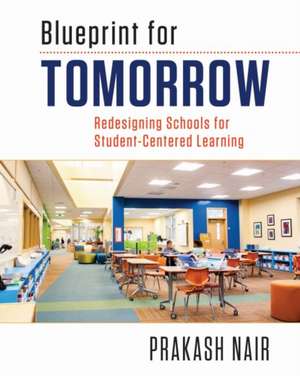
Blueprint for Tomorrow
Autor Prakash Nairen Limba Engleză Paperback – oct 2014
În volumul Blueprint for Tomorrow, Prakash Nair abordează o problemă critică a sistemului educațional contemporan: decalajul dintre pedagogia secolului XXI și infrastructura fizică învechită. Putem afirma că miza centrală a lucrării nu este simpla construcție de clădiri noi, ci optimizarea celor 12 miliarde de dolari cheltuite anual pentru întreținerea spațiilor existente, care adesea perpetuează modele de învățare depășite. Autorul propune o aliniere strategică a designului arhitectural cu obiectivele educaționale moderne, oferind soluții versatile și accesibile pentru transformarea mediului de învățare. Structura cărții este remarcabil de practică, fiind organizată pe zone specifice, de la săli de clasă la spații comune precum cafenelele. Reținem utilizarea eficientă a studiilor de caz vizuale, cu ilustrații „înainte și după” și sugestii de tip „do now”, care permit implementarea unor schimbări imediate fără bugete colosale. Cititorii familiarizați cu The Design of Learning Spaces de Dr Pamela Woolner vor aprecia aici accentul pus pe rentabilitatea investiției și pe instrumentele concrete de evaluare puse la dispoziția administratorilor școlari. Această lucrare reprezintă o evoluție firească față de titlul anterior al autorului, The Language of School Design. Dacă în volumul precedent Nair stabilea un vocabular grafic pentru noile tipare de design, în Blueprint for Tomorrow el rafinează aceste concepte într-un ghid de implementare tactică. Experiența sa vastă în consultanță globală și managementul construcțiilor în New York conferă textului o autoritate pragmatică, transformând arhitectura școlară dintr-un fundal pasiv într-un participant activ la procesul de predare.
Preț: 214.96 lei
Carte disponibilă
Livrare economică 31 octombrie-14 noiembrie
Livrare express 20-24 octombrie pentru 26.70 lei
Specificații
ISBN-10: 1612507042
Pagini: 216
Dimensiuni: 187 x 233 x 15 mm
Greutate: 0.39 kg
Editura: HARVARD EDUCATION PR
V-ar putea interesa
-
 Children's SpacesMark Dudek-15%Preț: 526.64 lei619.58 lei
 -
 How to Stop Common Core 2nd EditionMrs Marian ArmstrongPreț: 87.45 lei
 -
 Preț: 70.54 lei
 -
 Surviving & ThrivingNadine Andrea KingPreț: 199.07 lei
 -
 Preț: 205.99 lei
 -
 Preț: 125.57 lei
 -
 On the EdgeDaniel HornPreț: 79.80 lei
 -
 Ideal y Realidad de La Reforma UniversitariaMaria Del Refugio Navarro HernandezPreț: 95.12 lei
 -
 La Gestion EscolarMarco Aurelio Navarro LealPreț: 119.09 lei
 -
 Preț: 200.21 lei
 -
 Qualities of Sound Christian EducationKevin F. BrownleePreț: 119.47 lei
 -
 Church Planting Made EasySamuel Ukomadu PhdPreț: 60.88 lei
 -
 ConscienceTerry Merz BryantPreț: 87.83 lei
 -
 The Woman's WorthKenya Richardson-WilbertPreț: 86.46 lei
 -
 The Shadow of Our Education SystemMarise Joas M. a. in EducationPreț: 88.66 lei
 -
 Scandal of Admissions in Secondary SchoolsStephen TaylorPreț: 128.67 lei
 -
 Cyberbullying: Causes, Consequences, and Coping StrategiesNicole L. Weber-15%Preț: 447.09 lei525.98 lei
 -
 Standing on the WordFinn LaursenPreț: 93.22 lei
 -
 Yale & the Ivy League Cartel - How a College Lost Its Soul and Became a Hedge FundRockefeller, Edwin S.Preț: 70.25 lei
 -
 Preț: 407.27 lei
 -
 Achieving Coherence in District ImprovementSusan Moore JohnsonPreț: 244.85 lei
 -
 Preț: 456.24 lei
 -
 Only the Curious Shall ThrivePant, AtulPreț: 59.72 lei
De ce să citești această carte
Recomandăm această carte liderilor școlari și arhitecților care doresc să maximizeze impactul mediului fizic asupra rezultatelor elevilor. Veți câștiga o metodologie clară pentru a transforma sălile de clasă tradiționale în spații dinamice, centrate pe colaborare, folosind resursele financiare deja disponibile. Este un ghid esențial pentru a înțelege cum designul spațiului poate stimula sau, dimpotrivă, inhiba inovația pedagogică.
Despre autor
Prakash Nair este președintele fondator al Fielding Nair International, o firmă de planificare și design școlar premiată la nivel internațional, cu proiecte în peste patruzeci și trei de țări. Expertiza sa este ancorată în experiența practică de amploare, ocupând anterior funcția de director de operațiuni pentru cel mai mare program de construcții școlare din lume, în New York City. Prin activitatea sa, Nair a devenit o voce influentă în domeniul arhitecturii educaționale, militând pentru spații care să reflecte nevoile reale ale elevilor și profesorilor în era digitală.
Textul de pe ultima copertă
Prakash Nair is the first person to whom I turn for inspiration and guidance about the design of powerful learning environments for children and adults. His message is straightforward: the physical environment in which learning occurs should be designed and constructed around powerful theories of learning, rather than requiring that our theories of learning be adapted to fit into obsolete structures. In his work as an architect, and now in this book, he has transformed our ideas about the relationship between learning and physical space. Richard F. Elmore, professor emeritus of educational leadership, Harvard Graduate School of Education
Blueprint for Tomorrow demonstrates why and how school buildings influence pedagogy, curriculum and learning, and provides clear, practical and simple solutions that will enable schools to finally bring teaching and learning into the 21st century. Anne Shaw, founder and director, 21st Century Schools
The quest for great schools begins with Prakash Nair s Blueprint for Tomorrow. From modest 'do now improvements to complete transformations, readers will find the tools needed to rethink and reimagine everything from the playground to the teacher s lounge. A must-read! Bruce Rockstroh, CEO, Educational Resource Center, Inc.
In Blueprint for Tomorrow, Prakash shows educators how to create productive contexts for learning where students want to be and where their gifts may take flight. This is an important book by one of today s strongest voices for reinventing education. Gary S. Stager, executive director, Constructing Modern Knowledge
Prakash Nair is the president and founding partner of Fielding Nair International, an award-winning school planning and architectural firm with consultations in forty-three countries. Prior to establishing Fielding Nair International, Nair worked as the director of operations for a multibillion-dollar school construction program in New York City."
Descriere scurtă
In "Blueprint for Tomorrow," Prakash Nair one of the world s leading school designers explores the hidden messages that our school facilities and classrooms convey and advocates for the alignment of the design of places in which we teach and learn with twenty-first-century learning goals.
"Blueprint for Tomorrow" provides simple, affordable, and versatile ideas for adapting or redesigning school spaces to support student-centered learning. In particular, the author focuses on ways to use current spending to modify existing spaces, and explains which kinds of adaptations offer the biggest return in terms of student learning. The book is organized by area from classrooms to cafeterias and is richly illustrated throughout, including before and after features, smart idea sidebars, and do now suggestions for practical first steps. It outlines key principles for designing spaces that support today s learning needs and includes tools to help educators evaluate the educational effectiveness of their own spaces.
"Blueprint for Tomorrow" will open educators eyes to the ways that architecture and learning are entwined and will challenge them to rethink the ways they teach and work together."