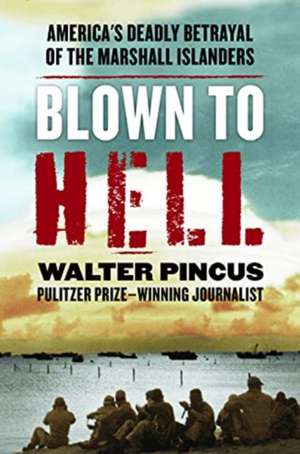
Blown to Hell
Autor Walter Pincusen Limba Engleză Hardback – 2 noi 2021
Considerăm Blown to Hell o lucrare de referință profesională și academică, esențială pentru studiile de licență și masterat în istoria secolului XX, relații internaționale și etica științei. Jurnalistul Walter Pincus, laureat al premiului Pulitzer, reconstruiește cu o rigoare documentară remarcabilă perioada 1946-1958, în care Insulele Marshall au servit drept poligon pentru 67 de teste nucleare americane. Remarcăm aici capacitatea autorului de a alterna între macro-istoria Războiului Rece și micro-istoria tragică a locuitorilor de pe atolul Rongelap, transformați fără voia lor în subiecți de studiu pentru efectele radiațiilor. Textul analizează în detaliu momentul de cotitură reprezentat de testul Castle Bravo din 1954, a cărui putere a depășit de o mie de ori bomba de la Hiroshima, declanșând o criză umanitară și ecologică ale cărei efecte persistă și astăzi. Descoperim o narațiune stratificată care include perspectivele brokerilor de putere din Washington, eforturile medicului Robert Conard și suferința echipajului japonez de pe nava Lucky Dragon. Stilul este precis, factual, evitând senzaționalismul în favoarea unei analize meticuloase a mecanismelor de mușamalizare politică. Această lucrare completează perspectiva oferită de Bombing the Marshall Islands de Keith M Parsons. În timp ce Parsons se concentrează pe dezvoltarea tehnologică a armelor termonucleare și impactul lor cultural larg, Walter Pincus aduce în prim-plan dimensiunea umană și politică, oferind detalii inedite despre deciziile administrative care au dus la strămutarea forțată a triburilor native. Este o lectură care transformă datele tehnice ale fizicii nucleare într-o cronică a responsabilității morale.
Preț: 175.91 lei
Carte disponibilă
Livrare economică 17-31 octombrie
Specificații
ISBN-10: 1635768012
Pagini: 416
Dimensiuni: 158 x 232 x 30 mm
Greutate: 0.72 kg
Editura: Diversion Publishing - Ips
V-ar putea interesa
-
 Der Deutsche BundWolf D. GrunerPreț: 60.48 lei
 -
 Preț: 87.50 lei
 -
 -19%Preț: 474.09 lei585.30 lei
 -
 -19%Preț: 396.85 lei489.93 lei
 -
 Ein Beitrag zur Geschichte der Armee mit Bezug auf die Befreiungskriege 1813, 1814 und 1815Carl Friedrich Wilhelm Von ReyherPreț: 468.51 lei
 -
 Sir Francis DrakeE. F. BensonPreț: 474.25 lei
 -
 Einst war ich ein GroßfürstAlexander von RusslandPreț: 473.43 lei
 -
 Bismarcks RedenOhne AutorPreț: 340.59 lei
 -
 Bilder aus den FreiheitskriegenFerdinand SchmidtPreț: 185.13 lei
 -
 Der Krieg in Deutsch-Südwestafrika 1904-1906R. Schwabe-19%Preț: 597.16 lei737.23 lei
 -
 Die Vergangenheit des Krieges und die Zukunft des FriedensCharles Richet-19%Preț: 477.16 lei589.08 lei
 -
 U-Boote am FeindWerner von LangsdorffPreț: 397.49 lei
 -
 Deutschlands Seemacht einst und jetztGeorg Wislicenus-19%Preț: 368.11 lei454.46 lei
 -
 Der Krieg in der Ostsee (1914-1915)Rudolph FirlePreț: 262.43 lei
 -
 Die kommerzielle Bedeutung des SuezkanalsWilhelm ZenkerPreț: 322.36 lei
De ce să citești această carte
Această carte este indispensabilă pentru cei care doresc să înțeleagă costul uman ascuns al supremației nucleare. Cititorul câștigă o perspectivă documentată asupra modului în care politica externă și experimentele militare pot devasta culturi milenare. Este un caz de studiu esențial despre transparența guvernamentală și etica medicală, scris cu acuratețea unui jurnalist de investigație premiat, oferind un context vital pentru dezbaterile contemporane despre armamentul atomic.
Despre autor
Walter Pincus este un reputat jurnalist american, cunoscut pentru cariera sa îndelungată la Washington Post, unde a acoperit subiecte legate de securitate națională, servicii de informații și armament nuclear. Expertiza sa în domeniu i-a adus numeroase distincții, inclusiv Premiul Pulitzer pentru raportare națională și un premiu Emmy. În Blown to Hell, Pincus utilizează decenii de experiență în investigarea arhivelor guvernamentale pentru a scoate la lumină detalii anterior clasificate despre programul nuclear din Pacific, consolidându-și reputația de fin observator al mecanismelor puterii de la Washington.
Descriere scurtă
The most important place in American nuclear history are the Marshall Islands—an idyllic Pacific paradise that served as the staging ground for over sixty US nuclear tests. It was here, from 1946 to 1958, that America perfected the weapon that preserved the peace of the post-war years. It was here—with the 1954 Castle Bravo test over Bikini Atoll—that America executed its largest nuclear detonation, a thousand times more powerful than Hiroshima. And it was here that a native people became unwilling test subjects in the first large scale study of nuclear radiation fallout when the ashes rained down on powerless villagers, contaminating the land they loved and forever changing a way of life.
In Blown to Hell, Pulitzer Prize-winning journalist Walter Pincus tells for the first time the tragic story of the Marshallese people caught in the crosshairs of American nuclear testing. From John Anjain, a local magistrate of Rongelap Atoll who loses more than most; to the radiation-exposed crew of the Japanese fishing boat the Lucky Dragon; to Dr. Robert Conard, a Navy physician who realized the dangers facing the islanders and attempted to help them; to the Washington power brokers trying to keep the unthinkable fallout from public view . . . Blown to Hell tells the human story of America’s nuclear testing program.
Displaced from the only homes they had known, the native tribes that inhabited the serene Pacific atolls for millennia before they became ground zero for America’s first thermonuclear detonations returned to homes despoiled by radiation—if they were lucky enough to return at all. Others were ripped from their ancestral lands and shuttled to new islands with little regard for how the new environment supported their way of life and little acknowledgement of all they left behind. But not even the disruptive relocations allowed the islanders to escape the fallout.
Notă biografică
Recenzii
—Washington Post
Pulitzer Prize-winning journalist Walter Pincus's scathing exposé of how our nation's nuclear pioneers devastated the people of the Marshall Islands is a tour de force. Using previously undiscovered declassified intelligence, Pincus's ground-breaking reporting rewrites the history of the birth of the Atomic Age, revealing America's complicity in an astounding cover-up on an unimaginable scale. Blown to Hell is a spell-binding scientific detective story, must reading for anyone who wants to learn about one of the worst governmental abuses in US history.
—Andrea Mitchell, NBC News Chief Washington Correspondent and Chief Foreign Affairs Correspondent/Anchor
In riveting detail, Walter Pincus recounts the tragic encounter of a pre-modern people with history's most powerful nation. He pierces the secrecy that shrouded America's nuclear weapons tests and reveals the huge risks and outright deceptions officials willingly embraced. For those exposed, it was an awful reality. For us, it should be a timely and chilling warning.
—Jerry Brown, former California governor and executive chairman of The Bulletin of Atomic Scientists
Every voter should read this revelatory book. After all, we're all responsible for our government!
—Gloria Steinem
Walter Pincus has taken on the vital and largely ignored subject of our nuclear weapons testing in the Pacific. Long overdue, this work will find its place on the bookshelves of policy makers, historians, and military planners. I certainly wish it had been available to me as I took over US Strategic Command. It would have provided a perspective not otherwise available.
—General Eugene E. Habiger, USAF (Ret.), former Commander in Chief of United States Strategic Command
For more than half a century, Walter Pincus has been among our greatest reporters and most persistent truth-tellers. Blown to Hell is a story worthy of his talents—infuriating, heart-breaking, and utterly riveting.
—Rick Atkinson, Pulitzer Prize-winning author of The Liberation Trilogy
The final lesson of Blown To Hell is clear—only by banning nuclear testing forever will we reduce the threat of nuclear proliferation and nuclear war, and achieve the goal of a more peaceful world free of nuclear weapons.
—Senator Edward J. Markey, Co-chair of the Congressional Working Group on Nuclear Weapons and Arms Control
Pulitzer winner Pincus, a former national security reporter at the Washington Post, debuts with a shocking account of the destruction wrought by atomic bomb testing in the Marshall Islands from 1946 to 1958.... Pincus delves into the race with the Soviet Union to develop nuclear weapons and the selection of Bikini Atoll (which was evacuated) as a testing site, and shows that U.S. government officials were more concerned about the costs of relocating people from other inhabited atolls than the danger of nuclear fallout. As a result, adults and children living on Rongelap and Utirik atolls were exposed to radioactive ash and contaminated drinking water in the aftermath of the Castle Bravo test, and went on to suffer low white blood cell counts, thyroid tumors, and numerous cancers.... Pincus makes a persuasive case that in ‘seeking a more powerful weapon for warfare, the U.S. unleashed death in several forms on peaceful Marshall Island people.' Readers will be appalled.
—Publishers Weekly