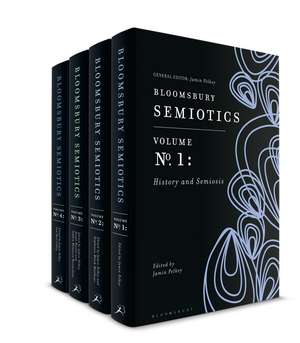
Bloomsbury Semiotics: Volumes 1-4
Editat de Jamin Pelkeyen Limba Engleză – 3 noi 2022
Sub coordonarea lui Jamin Pelkey, profesor de semiotică și antropologie lingvistică la Toronto Metropolitan University, Bloomsbury Semiotics reprezintă un efort academic monumental de a cartografia întregul domeniu al semioticii contemporane. Remarcăm autoritatea editorială a lui Pelkey, a cărui expertiză în mecanismele imaginației umane — explorată anterior în Tropological Thought and Action — este acum extinsă la o scară globală și interdisciplinară. Această lucrare în patru volume nu se limitează la o simplă trecere în revistă, ci propune un cadru teoretic unificat pentru discipline fragmentate.
Structura lucrării reflectă o progresie riguroasă: primul volum, Bloomsbury Semiotics Volume 1: History and Semiosis, analizează fundamentele istorice și filosofice, de la pragmatism la poststructuralism. Cel de-al doilea volum, Bloomsbury Semiotics Volume 2: Semiotics in the Natural and Technical Sciences, face pasul spre logică și matematică, în timp ce volumele următoare, Bloomsbury Semiotics Volume 3: Semiotics in the Arts and Social Sciences și Bloomsbury Semiotics Volume 4: Semiotic Movements, explorează aplicațiile în cultură, societate și curentele de gândire emergente. Apreciem prezența unor nume de referință precum Paul Cobley sau Marcel Danesi, care aduc claritate unor concepte complexe precum iconicitatea, ideologia sau semioza evolutivă.
Remarcăm faptul că fiecare capitol este construit pentru a evidenția dezbaterile actuale, oferind totodată o viziune asupra priorităților de cercetare viitoare. Tonul este unul academic precis, facilitând descoperirea sensului în domenii aparent divergente, de la fizică la teoria literară. Este o resursă esențială pentru mediul universitar, reușind să integreze tradiția peirceană cu noile tehnologii și științe naturale.
Preț: 3368.68 lei
Preț vechi: 5316.32 lei
-37%
Disponibil
Livrare economică 18 mai-01 iunie
Specificații
ISBN-10: 1350139440
Dimensiuni: 178 x 254 x 96 mm
Greutate: 3 kg
Editura: Bloomsbury Publishing
Colecția Bloomsbury Academic
Locul publicării:London, United Kingdom
De ce să citești această carte
Această colecție este indispensabilă cercetătorilor și studenților care doresc o înțelegere profundă a modului în care semnele și sensul funcționează în toate sferele cunoașterii. Beneficiați de expertiza celor mai importanți semioticieni contemporani într-un format structurat, care acoperă totul de la istoria premodernă la științele tehnice, oferind un instrument teoretic unificat pentru orice proiect de cercetare interdisciplinară.
Descriere
Volume 1: History and Semiosis
Volume 2: Semiotics in the Natural and Technical Sciences
Volume 3: Semiotics in the Arts and Social Sciences
Volume 4: Semiotic Movements
Uniting fragmented disciplines under the framework of semiotic theory, this set emphasizes and strengthens common bonds shared across intellectual cultures, and facilitates the discovery and recovery of meaning across fields. Providing comprehensive overviews of the history and status of semiotic inquiry across a diverse range of traditions and disciplines, chapters are written by leading international experts. Together, they highlight key contemporary developments and debates before casting a vision for future research priorities, identifying unanswered questions and fresh openings for participation.
Providing the most comprehensive and united overview of the entire field for semioticians, Bloomsbury Semiotics enables anyone, from students to seasoned practitioners, to better understand and benefit from semiotic insight and how it relates to their own area of study or research.
Cuprins
Introduction, Jamin Pelkey
1. Global Semiotics, Paul Cobley
2. Pre-Modern Semiotics, Martin Svantner and Michal Karla
3. Early-Modern Semiotics, Michal Karla and Tuuli Pern
4. Pragmatist Semiotics, Winfried Nöth
5. Post/Structuralist Semiotics, Massimo Leone
6. Reality and Semiosis, Marc Champagne
7. Evolution and Semiosis, Alexei Sharov and Kalevi Kull
8. Consciousness and Semiosis, Jordan Zlatev and Piotr Konderak
9. Iconicity and Semiosis, Göran Sonesson
10. Opposition and Semiosis, Marcel Danesi
11. Habit and Semiosis, Donna West
12. Ideology and Semiosis, Susan Petrilli and Augusto Ponzio
13. Classifying Signs, Priscila Borges
14. Applying Signs, John Coletta and Didier Tsala Effa
Index
VOLUME 2: SEMIOTICS IN THE NATURAL AND TECHNICAL SCIENCES, edited by Jamin Pelkey and Stéphanie Walsh Matthews
Introduction, Stéphanie Walsh Matthews
1. Semiotics in Mathematics and Logic, Ahti-Veikko Pietarinen and Frederik Stjernfelt
2. Semiotics in General Biology, Kalevi Kull and Don Favareau
3. Semiotics in Ecology and Environmental Studies, Timo Maran
4. Semiotics in Ethology and Zoology, Morten Tønnessen
5. Semiotics in Evolutionary Linguistics, Jamin Pelkey and Prisca Augustyn
6. Semiotics in Health and Medicine, John Tredinnick-Rowe and Donald E. Stanley
7. Semiotics in Psychiatry and Psychology, Norbert Andersch
8. Semiotics in Neuroscience and Cognition, Kristian Tylén and Jijo Kandamkulathy
9. Semiotics in Computing and Information Systems, Martin Irvine
10. Semiotics in Economics and Finance, Todd Oakley
11. Semiotics in Law and Jurisprudence, Clara Chapdelaine-Feliciati
12. Semiotics in Architecture and Spatial Design, Gabriele Aroni
13. Semiotics in Graphic Design, Steven Skaggs
14. Semiotics in Marketing and Branding, Kristian Bankov and Dimitar Trendafilov
Index
VOLUME 3: SEMIOTICS IN THE ARTS AND SOCIAL SCIENCES, edited by Jamin Pelkey, Susan Petrilli and Sophia Melanson Ricciardone
Introduction, Susan Petrilli and Sophia Melanson Ricciardone
1. Semiotics in Philosophy and Critical Theory, Vincent Colapietro
2. Semiotics in Anthropology and Ethnography, Sally Ness and Steve Coleman
3. Semiotics in History and Archaeology, Marek Tamm and Robert Preucel
4. Semiotics in Theology and Religious Studies, Massimo Leone
5. Semiotics in Ethics and Caring, Susan Petrilli
6. Semiotics in Sociology and Political Science, Risto Heiskala and Peeter Selg
7. Semiotics in Learning and Education, Andrew Stables and Alin Olteanu
8. Semiotics in Picture and Image Studies, Sara Lenninger and Göran Sonesson
9. Semiotics in Film and Video Studies, Piero Polidoro and Adriano D'Aloia
10. Semiotics in Music and Musicology, William Dougherty and Esti Sheinberg
11. Semiotics in Performance and Dance, Nikoleta Popa Blanariu
12. Semiotics in Rhetoric and Poetics, Per Aage Brandt and Todd Oakely
13. Semiotics in Literature and Narratology, Stéphanie Walsh Matthews and Paul Perron
14. Semiotics in Structural Linguistics, Anne-Gaëlle Toutain and Ekaterina Velmezova
Index
VOLUME 4: SEMIOTICS MOVEMENTS, edited by Jamin Pelkey and Paul Cobley
Introduction, Paul Cobley
1. Communication Theory and Semiotics, Richard Lanigan
2. Media/Culture Studies and Semiotics, Sophia Melanson Ricciardone and Marcel Danesi
3. Digital Humanities and Semiotics, Alin Olteanu and Arianna Ciula
4. Systems Theory and Semiotics, Ricardo Gudwin and João Queiroz
5. Phenomenology and Semiotics, Peer F. Bundgaard
6. Hermeneutics and Semiotics, Ronald C. Arnett and Susan Mancino
7. Translation Studies and Semiotics, Evangelos Kourdis and Ritva Hartama-Heinonen
8. Pragmatics and Semiotics, Per Aage Brandt
9. Gesture Studies and Semiotics, Irene Mittelberg and Jennifer Hinnell
10. Multimodality and Semiotics, David Machin and Ariel Chen
11. Discourse Analysis and Semiotics, Kay O'Halloran and Sabine Tan
12. Integrational Linguistics and Semiotics, Adrian Pablé
13. Cognitive Linguistics and Semiotics, Jordan Zlatev and Möttönen Tapani
14. Cognitive Science and Semiotics, Göran Sonesson
Index
Recenzii
This is a much-needed reference that promises to provide a very solid general and historical introduction to a complex way of thinking, but also introduces a very wide range of interdisciplinary approaches to the field.
This is a state-of-the-art survey of semiotic inquiry. Recommended for researchers in the field.
Volume 2: Semiotics in the Natural and Technical Sciences delivers the contemporary state of the art, craft, and science of semiotic applications in math and logic, in biology and cognitive sciences, and in professional and technical fields from architecture to medicine and beyond, with expert contributions achieving prescient depth of coverage and cutting-edge comprehensive bibliographic documentation.
Volume 3: Semiotics in the Arts and Social Sciences testifies to the power of semiotics to innovate through the creation of new research paths, and to renovate by revisiting older paths and reshaping them through fundamental changes of perspectives. The result is an inspiring multidirectional and multidimensional programmatic chart that redraws boundaries and suggests uncharted territories in need of careful signage.
Peircean Semiotics offers some of the most interesting and insightful perspectives on the nature of communication as a crucial force in the universe, ranging from human language to physics. In Volume 4: Semiotic Movements Jamin Pelkey and Paul Cobley have brought together some of the leading semioticians from around the world on an exciting range of topics. This is an important volume that all readers, whether new to semiotics or long-term semioticians, will enjoy and learn a great deal from. I highly recommend it.