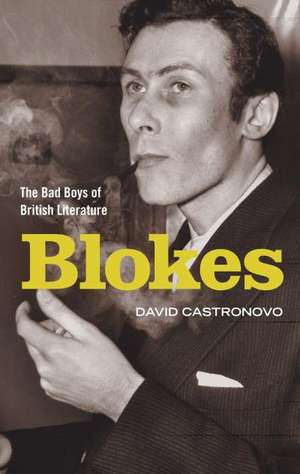
Blokes: The Bad Boys of British Literature
Autor David Castronovoen Limba Engleză Paperback – 8 iul 2010
This book is the story, told in a series of profiles and of New Britannia. The cast of characters includes playwrights John Osborne and Arnold Wesker, novelist Kingsley Amis, critic Kenneth Tynan, poet Philip Larkin, fiction writer Alan Sillitoe, plus lesser-known figures such as John Braine, David Storey, Stan Barstow, Keith Waterhouse, and Shelagh Delaney. Commentators customarily label them "angry young men" (from a remark by a British journalist), but actually anger is not quite right. Essentially, they were restless, bored with the same old British way of life, and eager to break with social conventions.
The central focus of this book is how these writers, and others, transformed the British literary world-how they worked with the materials of their own backgrounds-the class system, tradition, and artistic convention-to make new art.
Preț: 130.18 lei
Preț vechi: 222.33 lei
-41%
Puncte Express: 195
Carte tipărită la comandă
Livrare economică 27 noiembrie-11 decembrie
Livrare prin curier în România Termenul estimat este afișat lângă disponibilitate.
Transport gratuit de la 400.00 lei Plată online sau ramburs, în funcție de opțiunile comenzii.
Retur gratuit în 14 zile Comandă securizată și suport în română.
Specificații
ISBN-13: 9781441169815
ISBN-10: 1441169814
Pagini: 208
Dimensiuni: 141 x 221 x 25 mm
Greutate: 0.3 kg
Editura: Bloomsbury Publishing
Colecția Continuum
Locul publicării:New York, United States
ISBN-10: 1441169814
Pagini: 208
Dimensiuni: 141 x 221 x 25 mm
Greutate: 0.3 kg
Editura: Bloomsbury Publishing
Colecția Continuum
Locul publicării:New York, United States
Cuprins
Chapter One: The Bloke, A Very Short Literary History
Chapter Two: Philip Larkin
Chapter Three: Kingsley Amis
Chapter Four: John Osborne
Chapter Five: Kenneth Tynan
Chapter Six: Getting Their Own Back: Waine, Hinde, Sillitoe, Braine
Chapter Seven: Literary Love, Circa 1960: Waterhouse, Barstow, Storey
Chapter Eight: The Bloke's Progress: Hornby, Martin Amis, A.A. Gill
Author's Note
Chapter Two: Philip Larkin
Chapter Three: Kingsley Amis
Chapter Four: John Osborne
Chapter Five: Kenneth Tynan
Chapter Six: Getting Their Own Back: Waine, Hinde, Sillitoe, Braine
Chapter Seven: Literary Love, Circa 1960: Waterhouse, Barstow, Storey
Chapter Eight: The Bloke's Progress: Hornby, Martin Amis, A.A. Gill
Author's Note
Recenzii
"This stimulating study of the postwar generation of British writers who shook up their nation's literature so dramatically manages despite its brevity to be not only comprehensive but far-ranging. Its author, Professor David Castronovo of Pace University in New York, is not only superbly well-informed on his subject but has a flair for analyzing it in a uniquely revealing fashion. He is adept at putting these authors in context - politically, culturally, and philosophically - and the unusual thing about this process is that it results in a whole new way of seeing who these writers really were and how and why they evolved at this point in time."-Martin Rubin, The Washington Times
"The selfish, pleasure-seeking bloke has always been with us, but as we reach the 20th century and the rise of the working classes he becomes more important. Part of the book is given over to four giants of post-war English writing - Philip Larkin, Kingsley Amis, John Osbourne and Kenneth Tyan - all real blokes themselves and as entertaining as any fictional characters." --Good Book Guide, 01/08/09
"The stylistic flair of this accessible survey promotes an entertaining and suggestive discussion...Castronovo's lively exposition revitalizes fascinating figures and compelling texts." -Marlene Briggs, Journal of British Studies (University of Chicago, April 2010)
"David Castronovo...has set out to find a more satisfactory collective term for the writers of the Amis/Osbourne generation and their successors. The principle exhibits in his book are the works of Amis, Osbourne, the poet Philip Larkin and theatre critic Kenneth Tynan, as well as the writers themselves." The Wall Street Journal
For all of its careful structuring and well-developed argument, Castronovo's critical work owes as much in style as substance to the blokish writers examined. He eschews the conventions of contemporary literary critical work, returning to close and careful readings of his selected authors and their works. And this is indeed a good thing, reminding readers and critics alike of the importance and challenges of attempting to read these writers on their own terms. In the midst of postwar economic decline and the dissolution of Britain's formidable empire, Amis, Larkin, Tynan, Osborne, et al., insisted on just this approach to culture and society, saving nothing and brushing aside what they say as a deadening British sentimentality. If nothing else, Castronovo brilliantly captures this ethos in a way that informs and entertains in equal measure. --Post and Courier, Charleston, SC
"The selfish, pleasure-seeking bloke has always been with us, but as we reach the 20th century and the rise of the working classes he becomes more important. Part of the book is given over to four giants of post-war English writing - Philip Larkin, Kingsley Amis, John Osbourne and Kenneth Tyan - all real blokes themselves and as entertaining as any fictional characters." --Good Book Guide, 01/08/09
"The stylistic flair of this accessible survey promotes an entertaining and suggestive discussion...Castronovo's lively exposition revitalizes fascinating figures and compelling texts." -Marlene Briggs, Journal of British Studies (University of Chicago, April 2010)
"David Castronovo...has set out to find a more satisfactory collective term for the writers of the Amis/Osbourne generation and their successors. The principle exhibits in his book are the works of Amis, Osbourne, the poet Philip Larkin and theatre critic Kenneth Tynan, as well as the writers themselves." The Wall Street Journal
For all of its careful structuring and well-developed argument, Castronovo's critical work owes as much in style as substance to the blokish writers examined. He eschews the conventions of contemporary literary critical work, returning to close and careful readings of his selected authors and their works. And this is indeed a good thing, reminding readers and critics alike of the importance and challenges of attempting to read these writers on their own terms. In the midst of postwar economic decline and the dissolution of Britain's formidable empire, Amis, Larkin, Tynan, Osborne, et al., insisted on just this approach to culture and society, saving nothing and brushing aside what they say as a deadening British sentimentality. If nothing else, Castronovo brilliantly captures this ethos in a way that informs and entertains in equal measure. --Post and Courier, Charleston, SC