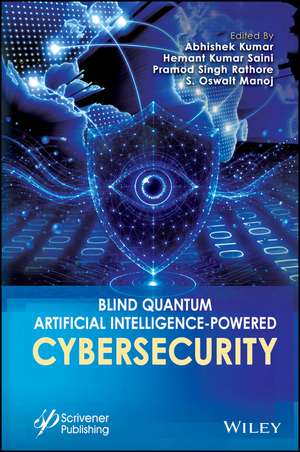
Blind Quantum Artificial Intelligence-Enabled Cybersecurity
Editat de Abhishek Kumar, Hemant Kumar Saini, Pramod Singh Rathore, S. Oswalt Manojen Limba Engleză Hardback – 21 ian 2027
Preț: 1229.25 lei
Preț vechi: 1536.56 lei
-20% Precomandă
Puncte Express: 1844
Carte nepublicată încă
Livrare prin curier în România Precomanda se expediază când titlul devine disponibil.
Transport gratuit pentru acest produs Plată online sau ramburs, în funcție de opțiunile comenzii.
Retur gratuit în 14 zile Comandă securizată și suport în română.
Doresc să fiu notificat când acest titlu va fi disponibil:
Se trimite...
Specificații
Notă biografică
Abhishek Kumar, PhD, is an Assistant Director and Associate Professor in the Computer Science and Engineering Department at Chandigarh University, Punjab, India. He has authored seven books, edited 51 books, and published more than 170 works in reputable, peer-reviewed national and international journals, books, and conference proceedings. His research areas include artificial intelligence, renewable energy, image processing, computer vision, data mining, and machine learning.
Hemant Kumar Saini, PhD, is a Postdoctoral Fellow at Lincoln University, Malaysia, and works in the Parul School of Engineering and Technology at Parul University, India. He has more than 12 years of teaching experience and has published six books and several articles in renowned journals and conference proceedings. His research interests include wireless networks, soft computing, deep learning, machine learning, the Internet of Things, Industry 4.0, and smart contracts.
Pramod Singh Rathore, PhD, is an Assistant Professor in the Department of Computer and Communication Engineering at Manipal University Jaipur. With more than 12 years of academic teaching experience, he has published more than 85 papers in reputable, peer-reviewed national and international journals, books, and conference proceedings. His research interests include NS2, computer networks, and mining.
S. Oswalt Manoj, PhD, is an Associate Professor in the Department of Computer Science and Engineering at Sri Krishna College of Engineering and Technology, Tamil Nadu, India. He has authored one book, edited two books, and published more than 100 works in reputable, peer-reviewed national and international journals, books, and conference proceedings. His research areas include big data analytics, artificial intelligence, computer vision, machine learning, deep learning, and cloud computing.
Cuprins
Preface xix
1 Blind Quantum AI in Security Digital Ecosystem 1
Shweta Solanki and Dasari Manasa
1.1 Introduction 2
1.2 Foundations of Blind Quantum AI 5
1.3 Security Digital Ecosystem: Challenges and Needs 8
1.4 Blind Quantum AI Architecture 11
1.5 Applications in Digital Security Ecosystem 15
1.6 Implementation Techniques and Algorithms 18
1.7 Ethical, Legal, and Societal Implications 21
1.8 Challenges and Limitations 23
1.9 Future Directions 25
1.10 Conclusion 26
2 Quantum Cryptography in Secured IoT Devices 29
Brijesh Kumar Bhardwaj, Kavita Srivastava, Rishi Shrivastav, Mohd Hasan, Shikhar Tiwari and Shashikant Soni
2.1 Introduction 30
2.2 Fundamentals of Quantum Cryptography 34Contents vii
2.3 Security Challenges in IoT Ecosystems 36
2.4 Integration of Quantum Cryptography with IoT Devices 39
2.5 Quantum Key Management in IoT 41
2.6 Post-Quantum Cryptographic Algorithms for IoT 43
2.7 Implementation Challenges and Constraints 45
2.8 Recent Developments and Pilot Projects 47
2.9 Conclusion 48
3 Enhancing Cybersecurity with Quantum AI in Industrial Systems via Neurocomputing Empirical Results 51
P. Balaji Srikaanth, Raja Kumar Kolli, K. Manikandan, Bijay Kishor Shishir Sekhar Pattanaik, Preshni Shrivastava and R. Senthamil Selvan
3.1 Introduction 52
3.2 Method of Dynamic Watermarking 54
3.3 Experimental Configuration 56
3.4 State of the Art (SOTA) 57
3.5 Experimental Outcomes and Conversation 58
3.6 Conclusion 63
4 Quantum AI-Based Deep Learning Model Optimisation for Real-Time Neurocomputing Techniques 67
Parimala Rajeshwari, T. Aditya Sai Srinivas, Venkateswara Raju Konduru, J. Balamurugan and R. Senthamil Selvan
4.1 Introduction 68
4.2 Antara NPU Infrastructure and Execution Flow 70
4.3 Antara NPU's Best Practice for Quickly Identifying Objects 71
4.4 Methodology 76
4.5 Discussion and Limitations 79
4.6 Conclusions 80
5 Quantum AI-Driven Cognitive Computing: Neurocomputing Models for Human-Machine Collaboration 83
R. Purushothaman, Jayanthi G., Aaluri Seenu, J. Balamurugan and R. Senthamil Selvan
5.1 Introduction 84
5.2 Methodology 86
5.3 Result Evaluation 88
5.4 Discussion 93
5.5 Conclusion 95
5.6 Future Work 95
6 Analysing the Effectiveness of Quantum AI-Enhanced Neurocomputing in Marketing Optimisation 99
Anandkumar K. Shelat, Chinmoy Kumar, Suresh Ranganathan, Shailavi Modi, Shweta Tewari and R. Senthamil Selvan
6.1 Introduction 100
6.2 Methodology 101
6.3 Results 105
6.4 Discussion 110x Contents
6.5 Limitations and Future Directions 113
6.6 Conclusion 113
7 Quantum-Enabled DoS Attacks in Cybersecurity of Robotics and Industrial Mechanical Systems 117
Harish Maurya, Mohit Mishra and Dharmendra Kumar Dubey
7.1 Overview of Denial-of-Service (DoS) Threats in Modern Cybersecurity 118
7.2 Robotics and Industrial Mechanical Systems (RIS) 120
7.3 Mechanics of Quantum-Enabled DoS Attacks 123
7.4 Attack Surface in Robotics and Industrial Mechanical Systems 125
7.5 Case Study: Quantum-Enabled DoS Attack on an Industrial Robotic Line 126
7.6 Detection Challenges: Why Traditional IDS/IPS Fail against Quantum-Enabled DoS 127
7.7 Defense Mechanisms and Quantum-Resilient Countermeasures 127Contents xi
7.8 Conclusion 129
8 Quantum AI and Autonomous Cybersecurity Systems 133
Arjit Tomar, Shardha Purohit and Jaswinder Singh
8.1 Introduction to Quantum AI in Cybersecurity 134
8.2 Fundamentals of Quantum Computing for Cybersecurity 137
8.3 Artificial Intelligence for Cybersecurity 140
8.4 Concept of Quantum Artificial Intelligence 142
8.5 Architecture of Autonomous Cybersecurity Systems 144
8.6 Quantum AI-Driven Threat Detection Mechanisms 146
8.7 Quantum Cryptography and Secure Communications 147
8.8 Conclusion and Future Outlook 150
9 Military Applications of Quantum AI in Autonomous Robotics and Advanced Mechanical Systems 153
Dharmendra Kumar Dubey, Surendra Kumar Maurya, Kamlesh Ashok Tripathi and Mahendra Pratap Yadav
9.1 Introduction 154
9.2 Evolution of Military Robotics and Mechanical Systems 157
9.3 Fundamentals of Quantum Computing for Military Applications 160
9.4 Quantum Artificial Intelligence: Concepts, Models, and Architectures 165
9.5 Integration of Quantum AI with Autonomous Robotics and Advanced Mechanical Systems 169
9.6 Military Use Cases of Quantum AI-Enabled Autonomous Systems 173
9.7 Architecture of Quantum AI-Driven Autonomous Military Systems 174
9.8 Challenges and Research Gaps in Quantum AI-Driven Military Autonomous Systems 175
9.9 Conclusion and Future Outlook 177
10 Real-Time Fraud Detection in Banking Systems Using a Quantum AI-Enabled Adaptive Neurocomputing Framework 181
B. Veerajyothi, L. Suresh Kumar, Pramoda Patro and R. Deepa
10.1 Introduction 182
10.2 Methodology 183
10.3 Results 188
10.4 Discussion 192
10.5 Conclusion 194
11 Enhancing Financial Fraud Detection through QuantumInspired Spiking Neural Networks and Deep Feature Learning 199
Sasanko Sekhar Gantayat and S. Swapna
11.1 Introduction 200
11.2 Methodology 201
11.3 Results 209
11.4 Discussion 213
11.5 Conclusion 215
12 Quantum AI-Driven Performance Optimization for Strategic Decision-Making and Business 217
Omprakash B., Kavitha S. Patil, Siva Surendra. Nandam and Y. Srinivasa Rao
12.1 Introduction 218
12.2 Methodology 220
12.3 Predictive Analytics 220
12.4 Experimental Evaluation 223
12.5 Analysis of Result 231
12.6 Conclusion 233
13 Quantum AI-Powered Cognitive Decision Support for Advanced Business Forecasting 237
Rama Devi P., Harrison Sunil D., Manoj Kumar Mishra and Pramoda Patro
13.1 Introduction 238
13.2 Methodology 240
13.3 Results 242
13.4 Discussion 246
13.5 Conclusion 248
13.6 Limitations and Future Work 249
14 Quantum Computing in Data Security 253
Pramod Singh Rathore and Vuyyuru Lalitha
14.1 Introduction 254
14.2 Essentials of Quantum Computing 256
14.3 Classical Data Security Mechanisms 257
14.3.1 Security Assumption Model 258
14.4 Quantum Threats to Data Security 259
14.5 Impact of Quantum Computing on Encryption 260
14.6 Quantum-Based Data Security Solutions 262
14.7 Post-Quantum Cryptography and Secure Transition 263
14.8 Quantum Computing in Cloud and Big Data Security 265
14.9 Implications on Ethics and Privacy 266
14.10 Future Directions and Research Challenges 267
14.11 Conclusion 268
15 Ethics and Privacy in Quantum AI in Cybersecurity 271
Fateh Bahadur Kunwar, Rajesh Pathak, Udai Bhan Trivedi, Vikas Misra and Narendra Singh Rathore
15.1 Introduction 272
15.2 Foundations of Quantum AI Cybersecurity 274
15.3 Ethical Dimensions of Quantum AI 276
15.4 Privacy Challenges in Quantum AI Cybersecurity 277
15.5 Quantum Threats to Cryptographic Privacy 279
15.6 Ethical AI Design for Quantum Cybersecurity 281
15.7 Legal, Regulatory, and Policy Perspectives 282
15.8 Ethical Challenges in Military and Critical Infrastructure Security 284
15.9 Case Studies and Use Cases 286
15.10 Conclusion 288
References 289
Index 291