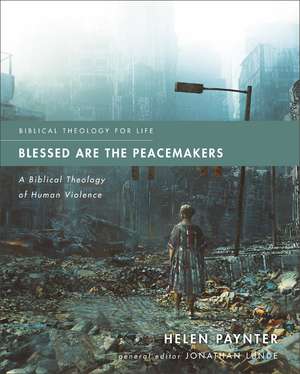
Blessed Are the Peacemakers: A Biblical Theology of Human Violence: Biblical Theology for Life
Autor Helen Paynter Jonathan Lundeen Limba Engleză Paperback – 7 noi 2023
Descoperim în Blessed Are the Peacemakers o analiză riguroasă și necesară a modului în care Scriptura interacționează cu realitatea brutală a violenței umane. Helen Paynter nu se limitează la o exegeză aridă, ci pornește de la aplicabilitatea practică a conceptelor de rezistență și pace în contextul social actual. Volumul, parte din seria Biblical Theology for Life, investighează rădăcinile violenței încă din narațiunile Genezei, oferind un cadru teoretic solid care distinge între violența naturală și cea construită social.
Notăm cu interes modul în care autoarea abordează 'hidra' violenței, identificând formele sale subtile, de la structurile de putere patriarhale până la marginalizarea rasială. Găsim aici o perspectivă distinctivă asupra modului în care profeții și ulterior Iisus Hristos demască semințele violenței din inima omului. Cititorii familiarizați cu God of Violence Yesterday, God of Love Today? vor aprecia modul în care acest nou volum extinde discuția de la textele problematice ale Vechiului Testament către o etică globală a non-violenței, aplicabilă provocărilor moderne precum imigrația sau xenofobia. Dacă în The Bible Doesn't Tell Me So autoarea s-a concentrat pe abuzul domestic, aici ea lărgește spectrul analizei către violența sistemică.
Stilul este precis, academic, dar profund ancorat în realitățile ecleziale. Helen Paynter reușește să mențină un echilibru între rigoarea studiilor biblice și urgența unui răspuns etic în fața răului. Spre deosebire de Jesusviolence de Stephen D. Moore, care explorează violența inerentă textelor evanghelice, lucrarea de față se concentrează pe puterea transformatoare a crucii ca mecanism de absorbție și înfrângere a violenței prin sacrificiu, oferind o viziune constructivă pentru comunitatea creștină.

Preț: 207.88 lei
Carte disponibilă
Livrare economică 06-20 noiembrie
Livrare express 23-29 octombrie pentru 38.96 lei
Specificații
ISBN-10: 0310125545
Pagini: 352
Dimensiuni: 189 x 231 x 21 mm
Greutate: 0.58 kg
Editura: Zondervan Academic
Colecția Zondervan Academic
Seria Biblical Theology for Life
Locul publicării:Grand Rapids, United States
De ce să citești această carte
Această carte este esențială pentru studenții la teologie și liderii ecleziali care doresc să înțeleagă complexitatea violenței în Biblie. Cititorul câștigă o perspectivă nuanțată asupra modului în care credința poate răspunde activ injustiției sociale fără a perpetua ciclul agresiunii. Este un ghid practic pentru a transforma biserica într-un spațiu al incluziunii, oferind argumente biblice solide împotriva xenofobiei și a violenței structurale.
Despre autor
Helen Paynter este o specialistă recunoscută în Vechiul Testament și director al Centrului pentru Studiul Bibliei și Violenței (CSBV). Opera sa este marcată de o preocupare constantă pentru interpretarea textelor biblice dificile și pentru modul în care acestea sunt utilizate în contextul abuzului și al violenței sociale. Prin lucrările sale anterioare, precum The Bible on Violence și Global Perspectives on Bible and Violence, Paynter s-a impus ca o voce autoritară în mediul academic, reușind să conecteze cercetarea biblică de înalt nivel cu nevoile practice ale victimelor și ale comunităților de credință.
Recenzii
'Boldly facing the pervasiveness of human violence and the charges of Christianity's complicity in it, Paynter employs rigorous research to delineate various theories, supplemented by stories and discussion questions, so that readers can begin to arrive at their own decisions on timely and timeless issues. Blessed Are the Peacemakers can serve as a resource for consultation on almost any issue dealing with violence, an exegetical guide to key biblical texts, and a practical instruction for faithful living. This will become an indispensable book to support individuals and churches who desire to live justly and peaceably amid a violent world, aiding their desire to live out the hope of God's kingdom now.'
'Helen Paynter is a seasoned biblical scholar who has devoted herself to the study of violence and Scripture. Her book Blessed Are the Peacemakers is a superb distillation of her careful engagement of this topic over the years. Whether one is a Christian just-war proponent (as I am) or a pacifist, every reader will not only find much rich, biblically rooted material to ponder, but each one will likewise be challenged to look afresh at what it means to be a peacemaker for Christ in this world.'
'In Blessed Are the Peacemakers, Helen Paynter offers a scholar's seasoned reflection on the biblical text and human violence. Attuned to many forms of violence, Paynter selects key texts and demonstrates an approach that is hermeneutically honest and theologically adept. Her work exhibits an astonishing range of thinking across the biblical corpus and the scholarly literature, and the volume's pages are filled with wise insight, compassion, and always hope. Of value to scholars and a gift to the church, it is a work I will return to again as a resource for my own teaching, writing, and thinking.'
'In Blessed Are the Peacemakers, Rev. Dr. Helen Paynter offers a broad and sweeping treatment of human violence in the Bible with an eye toward how it might inform contemporary ethics. Writing accessibly with erudition and grace, Paynter explores a wide range of Christian views, providing suggestions for how to navigate some of the most pressing issues of our time. While not everyone will agree with all her conclusions--I myself differ at points--all should celebrate her commitment to read Scripture in ways that promote peace. Blessed Are the Peacemakers is a substantial contribution to the conversation that Christians need to have about what it means to be faithful to God in a violent world.'
'In the news, on our streets, and in our own hearts and actions, violence rears its ugly and dangerous head. Why is violence so pervasive, and is there any hope? In Blessed Are the Peacemakers, Helen Paynter addresses these and other issues (war, capital punishment, gun control, structural racism) with deep biblical insight and cultural awareness. I highly recommend this profound study for all who desire to understand and implement a hopeful and redemptive Christian response to the violence of our world.'
'One way to read Paynter's work is as the story of Peace, from its creation at the beginning of the world to its consummation in the age to come. The book takes the reader across the biblical canon, stopping at insightfully chosen, familiar texts, to surprise us with sightings of Peace. At every point, the 'then' of the biblical text is made immediate and urgent with the everyday realities of 'now.' It calls both scholar and common reader, the global south as much as the north, to attend to Peace, and delight in the prosperity of its paths.'
'Paynter's Blessed Are the Peacemakers is truly an impressive volume! Her wise and thoughtful guidance through the dense foliage of Scripture's troubling texts renders the biblical panoramas of peace and peacemaking even more breathtaking. This book is theoretically informed, exegetically rich, and eminently pastoral and practical. From dealing with challenging violent texts to boots-on-the-ground issues like gun control, capital punishment, racism, and migration, this volume provides insightful and realistic guidance for Christians who want to respond well to the problems of violence in Scripture and in the world today.'
'Prompted by questions from contemporary society and informed by the best of biblical scholarship and Christian theology, Helen Paynter has written an immensely insightful book that addresses the problem of human violence and what the Bible says about it. Blessed Are the Peacemakers should be required reading for all who want to understand how Scripture speaks about and to violence in our world. Paynter makes a clear and convincing case that the Bible calls us to live without violence as we submit ourselves to the sovereignty of God.'
Descriere
Having queued up the questions, Paynter takes us to the Bible for answers. Starting with the creation narratives in Genesis considered in comparison with the ancient Near Eastern myths and moving to the conquest of Canaan--the most problematic of biblical narratives--she investigates how these deep myths speak to the origins of human violence and its consequences. The prevalence of violence through biblical history is inescapable. Scripture reveals the hydra-like nature of human violence, investigating types of violence including but not limited to: structural violence, verbal violence, sexual violence, violence as public /political act, racialised violence, including "othering." Through the voices of the prophets and then in the teaching of Jesus, the Bible reveals that the seeds of violence exist within every human heart. Even though we see evidence of resistance movements in the Bible, such as the responses to attempted genocide in Exodus and Esther, it is only on the cross that an absorption of violence by God takes place: a defeat of violence by self-sacrifice. Along the way, Paynter considers other relevant biblical themes, including the apocalypse, "crushing the serpent's head," and the concept of divine vengeance, culminating in the resurrected Christ's lack of vengeance against those who did him to death. In light of the New Testament, we will consider how the first Christians responded to the structural violence of slavery and patriarchy and how they began to apply Jesus' redemptive, non-vengeful theology to their own day.
The book concludes by discussing of what this means for Christians today. For many of us who live without routine encounters with or threats of violence, we must consider our responsibility in a world where our experience is the exception. With attention to the multi-headed hydra that is violence and the concealed structures of violence in our own Western society, Paynter challenges readers to consider their own, perhaps inherited, privilege and complicity. The question of how we regard "others," both as individuals and as societies, is a deeply relevant and urgent one for the church: The church can and should be a wholly non-othering body. So what implications does this have for the church and, for example, Black Lives Matter or the rampant xenophobia in our society or immigration and global migration issues? How do we resist evil? What does it mean to turn the other cheek when the cheek that has been slapped is not our own? How do we resist the monster without becoming the monster?