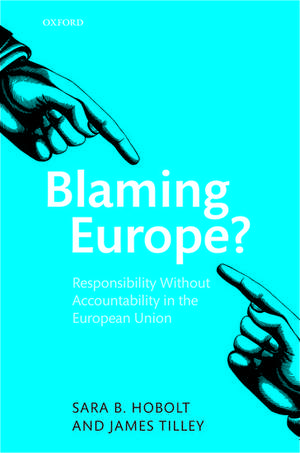
Blaming Europe?: Responsibility Without Accountability in the European Union
Autor Sara B. Hobolt, James Tilleyen Limba Engleză Hardback – 13 feb 2014
Preț: 771.45 lei
Preț vechi: 1147.37 lei
-33%
Puncte Express: 1157
Carte disponibilă
Livrare economică 30 octombrie-10 noiembrie
Livrare prin curier în România Termenul estimat este afișat lângă disponibilitate.
Transport gratuit pentru acest produs Plată online sau ramburs, în funcție de opțiunile comenzii.
Retur gratuit în 14 zile Comandă securizată și suport în română.
Specificații
ISBN-13: 9780199665686
ISBN-10: 0199665680
Pagini: 208
Dimensiuni: 162 x 240 x 21 mm
Greutate: 0.46 kg
Editura: OUP OXFORD
Colecția OUP Oxford
Locul publicării:Oxford, United Kingdom
ISBN-10: 0199665680
Pagini: 208
Dimensiuni: 162 x 240 x 21 mm
Greutate: 0.46 kg
Editura: OUP OXFORD
Colecția OUP Oxford
Locul publicării:Oxford, United Kingdom
V-ar putea interesa
-
 -30%Preț: 502.00 lei714.24 lei
 -
 The European Union and the RegionsBarry Jones-33%Preț: 773.06 lei1148.35 lei
 -
 -21%Preț: 359.21 lei455.07 lei
 -
 -31%Preț: 597.14 lei864.36 lei
 -
 -21%Preț: 354.86 lei449.68 lei
 -
 -21%Preț: 437.63 lei557.36 lei
 -
 Social Indicators: The EU and Social InclusionTony Atkinson-29%Preț: 410.50 lei574.45 lei
 -
 The European Voter: A Comparative Study of Modern DemocraciesJacques Thomassen-33%Preț: 1249.94 lei1860.60 lei
 -
 -18%Preț: 762.31 lei929.66 lei
 -
 -18%Preț: 1121.97 lei1368.25 lei
 -
 Arab Society in Revolt: The West's Mediterranean ChallengeCesare Merlini-24%Preț: 221.84 lei293.74 lei
 -
 The Uncertain Legacy of CrisisRichard YoungsPreț: 104.51 lei
 -
 European Integration: Building EuropeDavid Ramiro Troitiño-27%Preț: 1829.09 lei2492.26 lei
 -
 European Union Encyclopedia and Directory 2013Europa Publications-18%Preț: 8707.21 lei10618.54 lei
 -
 European Union Encyclopedia and Directory 2014Europa Publications-18%Preț: 5005.42 lei6104.17 lei
Recenzii
Blaming Europe is an important and timely work that is likely toset the agenda for academic analysis of EP elections. It will also beof value to those interested in attributions of responsibility more generally: the combination of the institutionalist clarity of responsibility' paradigm with work on psychological biases in responsibility attributions is an innovative and significant contribution to the broader literature.
This subtle, careful and clever book sets out to clarify a mystery - the mystery of how accountability for public policy is bestowed on public actors and institutions in the European Union... Because the problems are so carefully laid out, the solutions are quite subtle and deserve widespread consideration. This fine book should be widely read by those who are concerned about the quality of governance in the European Union and its member states.
The relationship between the EU and the citizens of Europe is troubled. Like in a crime story, a major question is who to blame, i.e. who's done it? In their book Hobolt and Tilley provide a compelling and comprehensive analysis of this intricate question. The result is a theoretically rich, empirically impressive, state of the art comparative analysis which is pushing our thinking in this field a big step forward.
This is modern political science at its very best: addressing an important and topical question (the legitimacy crisis in the EU), and answering the question with a clear theory and careful data analysis. This should be essential reading for researchers and students of democratic politics in Europe as well as of public opinion towards globalisation. Also, the finding that citizens can allocate responsibility in Europes multi-level polity correctly if they have good quality information has important implications for policymakers, politicians, journalists and opinion formers.
Does multilevel governance blur political responsibility? In Blaming Europe? Responsibility without accountability in the European Union, Sara Hobolt and James Tilley argue that citizens form judgments on the basis of information and bias. If information is poor, citizens fall back on prior EU views which color perceptions. Using a wealth of evidence they demonstrate how policy-specific information is scarce in the EU, and this deprives Europe of a transparently responsible government. The upshot is a paradox: ambiguity protects the EU from getting punished at the ballot box, but exposes it to eroding trust in EU institutions. This is a truly brilliant book that gets to the heart of EU politics in clear and compelling language and opens up new lines of inquiry concerning political responsibility in multilevel systems.
This subtle, careful and clever book sets out to clarify a mystery - the mystery of how accountability for public policy is bestowed on public actors and institutions in the European Union... Because the problems are so carefully laid out, the solutions are quite subtle and deserve widespread consideration. This fine book should be widely read by those who are concerned about the quality of governance in the European Union and its member states.
The relationship between the EU and the citizens of Europe is troubled. Like in a crime story, a major question is who to blame, i.e. who's done it? In their book Hobolt and Tilley provide a compelling and comprehensive analysis of this intricate question. The result is a theoretically rich, empirically impressive, state of the art comparative analysis which is pushing our thinking in this field a big step forward.
This is modern political science at its very best: addressing an important and topical question (the legitimacy crisis in the EU), and answering the question with a clear theory and careful data analysis. This should be essential reading for researchers and students of democratic politics in Europe as well as of public opinion towards globalisation. Also, the finding that citizens can allocate responsibility in Europes multi-level polity correctly if they have good quality information has important implications for policymakers, politicians, journalists and opinion formers.
Does multilevel governance blur political responsibility? In Blaming Europe? Responsibility without accountability in the European Union, Sara Hobolt and James Tilley argue that citizens form judgments on the basis of information and bias. If information is poor, citizens fall back on prior EU views which color perceptions. Using a wealth of evidence they demonstrate how policy-specific information is scarce in the EU, and this deprives Europe of a transparently responsible government. The upshot is a paradox: ambiguity protects the EU from getting punished at the ballot box, but exposes it to eroding trust in EU institutions. This is a truly brilliant book that gets to the heart of EU politics in clear and compelling language and opens up new lines of inquiry concerning political responsibility in multilevel systems.
Notă biografică
Sara Hobolt is Sutherland Chair in European Institutions at the European Institute of the London School of Economics and Political Science. Previously, she has held posts at the University of Oxford and the University of Michigan. She has published extensively on European Union politics, public opinion, and elections. Her book Europe in Question: Referendums on European Integration (Oxford University Press, 2009) was awarded the Best Book prize by the European Union Studies Association in 2010.James Tilley is a university lecturer at the Department of Politics and International Relations at the University of Oxford and a fellow of Jesus College, Oxford. He was previously a post-doctoral fellow at Nuffield College, Oxford and Trinity College Dublin. His research is mainly in the fields of public opinion and electoral behaviour, and he has published widely on topics including European Parliament elections, support for the EU, the attribution of responsibility, and the social bases of voting behaviour.