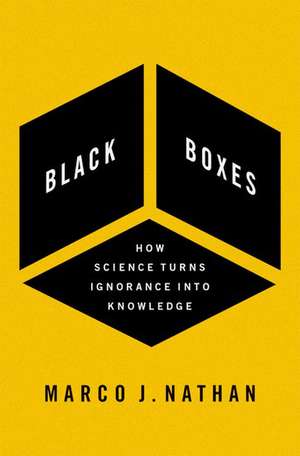
Black Boxes: How Science Turns Ignorance Into Knowledge
Autor Marco J. Nathanen Limba Engleză Hardback – 12 oct 2021
Preț: 526.98 lei
Preț vechi: 592.12 lei
-11%
Puncte Express: 790
Carte disponibilă
Livrare economică 13-24 noiembrie
Livrare prin curier în România Termenul estimat este afișat lângă disponibilitate.
Transport gratuit pentru acest produs Plată online sau ramburs, în funcție de opțiunile comenzii.
Retur gratuit în 14 zile Comandă securizată și suport în română.
Specificații
ISBN-13: 9780190095482
ISBN-10: 0190095482
Pagini: 310
Dimensiuni: 165 x 241 x 28 mm
Greutate: 0.61 kg
Editura: Oxford University Press
Colecția OUP USA
Locul publicării:New York, United States
ISBN-10: 0190095482
Pagini: 310
Dimensiuni: 165 x 241 x 28 mm
Greutate: 0.61 kg
Editura: Oxford University Press
Colecția OUP USA
Locul publicării:New York, United States
Recenzii
The innovative approach Nathan has adopted is to turn attention from preoccupation with what is known to describe the role of "black boxes" in science. Readers familiar with these debates should find that the motif of black boxes lends nuance to familiar arguments.
Notă biografică
Marco J. Nathan is Associate Professor and Chair in the Department of Philosophy at the University of Denver. His research focuses on the philosophy of science, with particular emphasis on biology, neuroscience, cognitive neuropsychology, and economics. He has published numerous articles and chapters in philosophical and scientific venues.
Cuprins
- Contents
- Preface
- Chapter 1: Bricks and Boxes
- 1.1 The Wall
- 1.2 A Theory of Everything?
- 1.3 Pandora's Gift to Science: The Black Box
- 1.4 Structure and Synopsis
- 1.5 Aim and Scope
- Chapter 2: Between Scylla and Charybdis
- 2.1 Introduction
- 2.2 The Rock Shoal and the Whirlpool
- 2.3 The Rise and Fall of Classical Reductionism
- 2.4 Antireductionism Strikes Back
- 2.5 The Reductionists Return
- 2.6 Scylla or Charybdis?
- 2.7 Why Not Have the Cake and Eat It Too?
- Chapter 3: Lessons from the History of Science
- 3.1 Introduction
- 3.2 Darwin's Quest for Inheritance and Variation
- 3.3 Mendel's Missing Mechanisms: A Tale of Two Syntheses
- 3.4 Absent Minded: Psychological Behaviors
- 3.5 The Nature and Significance of Economics
- 3.6 The Many Faces of Black Boxes
- Chapter 4: Placeholders
- 4.1 Introduction
- 4.2 Two Theses About Fitness
- 4.3 Are Dispositions Explanatory?
- 4.4 Placeholders in Scientific Theory and Practice
- 4.5 Two Types of Placeholders
- Chapter 5: Black-Boxing 101
- 5.1 Introduction
- 5.2 Step One: The Framing Stage
- 5.3 Step Two: The Difference-Making Stage
- 5.4 Step Three: The Representation Stage
- 5.5 What is a Black Box? A Three-Part Recipe
- Chapter 6: History of Science 'Black-Boxing Style'
- 6.1 Introduction
- 6.2 Darwin's Black Boxes
- 6.3 Mendel's Black Boxes
- 6.4 Skinner's Black Boxes
- 6.5 Friedman's Black Boxes
- 6.6 Black Boxes in Science: Concluding Remarks
- Chapter 7: Diet Mechanistic Philosophy
- 7.1 Introduction
- 7.2 The New Mechanistic Philosophy
- 7.3 Three Steps: A Neo-Mechanistic Perspective
- 7.4 Mechanisms, Models, and Metaphysics
- 7.5 Mechanisms and Black Boxes
- 7.6 What's in a Mechanism?
- 7.7 The Diet Recipe: Concluding Remarks
- Chapter 8: Emergence Reframed
- 8.1 Introduction
- 8.2 Emergence: Metaphysical or Epistemic?
- 8.3 Emergence in Action: Systems Neuroscience
- 8.4 Emergents and Black Boxes
- 8.5 Refinements and Implications
- 8.6 Adequacy Conditions and Advantages
- 8.7 Concluding Remarks
- Chapter 9: The Fuel of Scientific Progress
- 9.1 Introduction
- 9.2 The Roots of Incommensurability
- 9.3 Referential Models and Incommensurability
- 9.4 Black Boxes and Reference Potential, Part I
- 9.5 Black Boxes and Reference Potential, Part II
- 9.6 Incommensurability, Progress, and Black Boxes: Concluding Remarks
- Chapter 10: Sailing Through the Strait
- 10.1 Back to Bricks and Boxes
- 10.2 The Quagmire
- 10.3 Rocking the Rock, Weathering the Whirlpool
- 10.4 A History of Black Boxes
- 10.5 The Devil in the Details?
- References