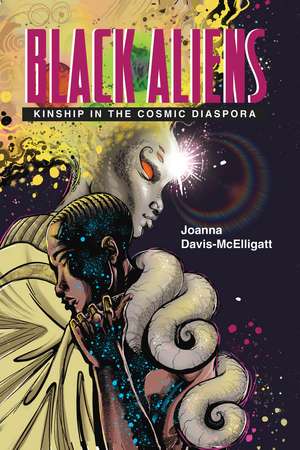
Black Aliens
Autor Joanna Davis-McElligatten Limba Engleză Paperback – 9 mar 2026
In Black Aliens, Joanna Davis-McElligatt examines extraterrestrial and interdimensional aliens in Black speculative media and culture, reading them as figural representations of a cosmic diasporic experience and charged metaphors for Black fugitivity and escape. As figures of the enslaved and their descendants, ghosts, time travelers, interstellar voyagers, immortals, and abductees, Black aliens are inherently disruptive figures. In her analysis, Davis-McElligatt foregrounds alien entanglements with terrestrial beings that generate new networks of kinship and relation—genealogical, reproductive, transspecies. As Black extraterrestrials form chosen kin-community with Black Earthlings, they extend the Black Atlantic beyond earthly boundaries.
Analyzing prose, poetry, film, record albums, comic books, illustrations, art installations, and exhibition catalogues, Davis-McElligatt traces how Octavia E. Butler, Maisy Card, Sun Ra, and Dwayne McDuffie and M. D. Bright visualize aliens whose bodies and beings are subject to interpellation as Black on Earth. She argues that these creators intentionally locate the Black alien as a subject whose galactic bonds are constructed in and as narrative form itself, made manifest in plot, characterization, and narrativization. In recasting narrative spacetime, they reimagine Black entanglements, kinship systems, and histories as a cosmic diaspora.
Analyzing prose, poetry, film, record albums, comic books, illustrations, art installations, and exhibition catalogues, Davis-McElligatt traces how Octavia E. Butler, Maisy Card, Sun Ra, and Dwayne McDuffie and M. D. Bright visualize aliens whose bodies and beings are subject to interpellation as Black on Earth. She argues that these creators intentionally locate the Black alien as a subject whose galactic bonds are constructed in and as narrative form itself, made manifest in plot, characterization, and narrativization. In recasting narrative spacetime, they reimagine Black entanglements, kinship systems, and histories as a cosmic diaspora.
Preț: 301.31 lei
Precomandă
Puncte Express: 452
Preț estimativ în valută:
53.32€ • 62.32$ • 46.30£
53.32€ • 62.32$ • 46.30£
Carte nepublicată încă
Doresc să fiu notificat când acest titlu va fi disponibil:
Se trimite...
Preluare comenzi: 021 569.72.76
Specificații
ISBN-13: 9780814259771
ISBN-10: 0814259774
Pagini: 240
Ilustrații: 10 b&w images
Dimensiuni: 152 x 229 mm
Greutate: 0.45 kg
Editura: Ohio State University Press
ISBN-10: 0814259774
Pagini: 240
Ilustrații: 10 b&w images
Dimensiuni: 152 x 229 mm
Greutate: 0.45 kg
Editura: Ohio State University Press
Recenzii
“Black Aliens is an astounding study of race, agency, and identity. Davis-McElligatt eloquently and thoroughly argues for redefining the term ‘alien’ to reflect the expansiveness and possibilities of Black experiences, Black bodies, and Black culture into outer space and beyond.”—Regina N. Bradley, author of Chronicling Stankonia: The Rise of the Hip-Hop South
“From the surprising conceptualization of history as another planet to her analysis of m/othering through connections between Octavia Butler and Connie Samaras’s art exhibition and catalogue, Davis-McElligatt not only demonstrates a robust research and archival process but makes brilliant use of those pieces through creative juxtaposition and original theorization.” —Vincent Haddad, author of The Detroit Genre: Race, Dispossession, and Resilience in American Literature and Film, 1967–2023
“Black Aliens is a profound work of scholarship that explores how authors such as Octavia Butler and Sun Ra have developed the extraterrestrial into an inspiration for a cosmic Black kinship and how the alien has also been entangled with the transatlantic slave trade, scientific racism, and astrofuturism. And yes, there are Black aliens, for as Davis-McElligatt astutely shows, you don’t have to be human to be Black. If you’re suffering from the Roswell blues and tired of the space-alien junk our society has proliferated, then come and find solace in Black Aliens.” —Matthew David Goodwin, author of The Latinx Files: Race, Migration, and Space Aliens
“The past might be another country, but according to Black Aliens, history is another planet: where alien encounters make kin, where white heteropatriarchal alienation from above is met with community from below, and where archival corrections and mothership connections historicize and transmolecularize Black lives. Joanna Davis-McElligatt traces Black alien lines of flight, charts a DIY diaspora from this ghetto called Earth, and finds an alter-destiny in the stars. Highly recommended.” —Mark Bould, coeditor of The New Routledge Companion to Science Fiction
Notă biografică
Joanna Davis-McElligatt is Assistant Professor of Black Literary Studies in the Department of English at the University of North Texas. She is the coeditor of bell hooks’s Radical Pedagogy: New Visions of Feminism, Justice, Love, and Resistance in the Classroom. Her research has appeared in south: a scholarly journal,Mississippi Quarterly, and BOOM! SPLAT! Comics and Violence.
Extras
Black Aliens: Kinship in the Cosmic Diaspora examines extraterrestrial and interdimensional aliens who appear in Black speculative media and culture as representations of a cosmic diasporic experience and as charged metaphors for Black fugitivity and escape. In other words, I take seriously Oprah’s desire for intergalactic kinship with Black extraterrestrial aliens in a galaxy we—meaning Black folk—collectively control. Through a study of prose, poetry, and film, record albums, comic books, illustrations and amateur drawings, and art installations and exhibition catalogues, Black Aliens traces how Black artists and visionaries—Octavia Butler, Maisy Card, Dwayne McDuffie and M. D. Bright, and Sun Ra—conceptualize extraterrestrial aliens who appear to be or look Black, and enter into visual, sociopolitical, experiential (phenomenological), embodied (ontological), and emotional (affective) relation with the terrestrial descendants of enslaved Africans. Stated another way, in this book I am interested in aliens whose bodies and beings are read, seen, and constituted as Black on Earth, and who make chosen kin-community with Black Earthlings. My definition of what constitutes an alien in this book is deliberately broad. Represented by the enslaved and their descendants, ghosts in the afterlife, time travelers and interstellar voyagers, extraterrestrial beings, space immortals, and alien abductees, the Black aliens I examine here are inherently disruptive figures—beings-on-the-move, out-of-joint in spacetime, typified by migration, flight, escape, with a bent toward navigation rather than stasis. Each of the Black aliens I explore comes from (and goes to) another planet or dimension—the past (Kindred), the afterlife (These Ghosts Are Family), Saturn and Jupiter (Sun Ra), and distant galaxies (Icon and Xenogenesis). And yet, as is so often the case in SF and speculative imaginaries, instead of contriving extraterrestrial and interdimensional aliens as threatening, dangerous Others, these creators construct the alien relationally as self, interspecial kin, and transgalactic community, fashioning alternative genealogies of belonging, new diasporic cartographies, and systems of interrelation for Black terrestrials and extraterrestrials alike.
As subjects entangled by spacetime in multiple locations all at once, Black aliens extend the Black Atlantic into the cosmos, and come to represent the machinations of removal, exile, and the impossibility of past return, the crisis of the present, and the inherent possibility and unknowability of the future. Black aliens can be defined by their estrangement from their homeplaces of origin, and their ongoing alienation from the dominant structures, systems, and cultures in the spaces where they find themselves—yet, just as often, Black aliens resist, innovate, and revolt by creating new strategies for survival that foreground radical forms of communalism and collectivism. Black Aliens explores how Butler, Card, McDuffie, and Ra locate the Black alien as a subject whose experience of and entanglement in the African diaspora is inherently disjunctive and transgressive, tensions made manifest at the levels of plot, characterization, narrativization, and as narrative form itself. I analyze how these creators construct Black alien being in opposition to dominant modes of Western linear narratology by disrupting narrative spacetime through the use of critical fabulation, analepsis, prolepsis, fragmentation, gapping, paratext, and achronological serialization, among other strategies. To that end, I contend that Black aliens necessarily recast narrative spacetime itself in order to represent and reimagine Black entanglements, kinship systems, and histories as a cosmic diaspora.
Black Aliens contributes to discourses in and approaches to Black study advanced by Saidiya Hartman, Octavia Butler, Christina Sharpe, Hortense Spillers, Sylvia Wynter, Orlando Patterson, and Frantz Fanon, among others, that unsettle the category of the human, and examine how Black subjects have been excluded from and/or included in civic categories of terrestrial human being. As nonterrestrial entities from another planet or dimension, Black aliens are always-already cosmogenic and nonhuman—specially, sociopolitically, and/or spatiotemporally, as the case may be—and displace the human as the universal apex of evolution and interrelation, shifting our attention to categories of being and belonging beyond those enforced on Earth.
As subjects entangled by spacetime in multiple locations all at once, Black aliens extend the Black Atlantic into the cosmos, and come to represent the machinations of removal, exile, and the impossibility of past return, the crisis of the present, and the inherent possibility and unknowability of the future. Black aliens can be defined by their estrangement from their homeplaces of origin, and their ongoing alienation from the dominant structures, systems, and cultures in the spaces where they find themselves—yet, just as often, Black aliens resist, innovate, and revolt by creating new strategies for survival that foreground radical forms of communalism and collectivism. Black Aliens explores how Butler, Card, McDuffie, and Ra locate the Black alien as a subject whose experience of and entanglement in the African diaspora is inherently disjunctive and transgressive, tensions made manifest at the levels of plot, characterization, narrativization, and as narrative form itself. I analyze how these creators construct Black alien being in opposition to dominant modes of Western linear narratology by disrupting narrative spacetime through the use of critical fabulation, analepsis, prolepsis, fragmentation, gapping, paratext, and achronological serialization, among other strategies. To that end, I contend that Black aliens necessarily recast narrative spacetime itself in order to represent and reimagine Black entanglements, kinship systems, and histories as a cosmic diaspora.
Black Aliens contributes to discourses in and approaches to Black study advanced by Saidiya Hartman, Octavia Butler, Christina Sharpe, Hortense Spillers, Sylvia Wynter, Orlando Patterson, and Frantz Fanon, among others, that unsettle the category of the human, and examine how Black subjects have been excluded from and/or included in civic categories of terrestrial human being. As nonterrestrial entities from another planet or dimension, Black aliens are always-already cosmogenic and nonhuman—specially, sociopolitically, and/or spatiotemporally, as the case may be—and displace the human as the universal apex of evolution and interrelation, shifting our attention to categories of being and belonging beyond those enforced on Earth.
Cuprins
Contents
List of Illustrations
Introduction
Chapter 1 History as Another Planet: Speculative Histofiction and Constellations of Black Alien Linealogy in Kindred and These Ghosts Are Family
Chapter 2 Black Skin, Human Masks, Alien Form: Narrative Physiognomy, Visual Phenomenology, and Image-Text Representations of (Extra)Terrestriality
Chapter 3 Black Alien M/other: Correcting the Intergalactic Archive
Chapter 4 “I Am Not of This Planet”: The Making of Le Sony’r Ra’s Cosmic Diaspora
Coda Earth Is Ghetto
Acknowledgments
Bibliography
Index
List of Illustrations
Introduction
Chapter 1 History as Another Planet: Speculative Histofiction and Constellations of Black Alien Linealogy in Kindred and These Ghosts Are Family
Chapter 2 Black Skin, Human Masks, Alien Form: Narrative Physiognomy, Visual Phenomenology, and Image-Text Representations of (Extra)Terrestriality
Chapter 3 Black Alien M/other: Correcting the Intergalactic Archive
Chapter 4 “I Am Not of This Planet”: The Making of Le Sony’r Ra’s Cosmic Diaspora
Coda Earth Is Ghetto
Acknowledgments
Bibliography
Index
Descriere
Explores the Black alien figure as constructed, imagined, and experimented on by Black writers, musicians, and artists to represent a cosmic diasporic experience.