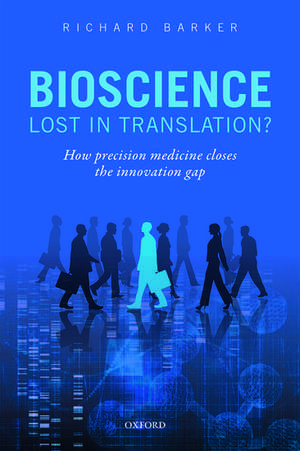
Bioscience - Lost in Translation?: How precision medicine closes the innovation gap
Autor Richard Barkeren Limba Engleză Paperback – 15 sep 2016
Preț: 391.74 lei
Preț vechi: 527.69 lei
-26%
Puncte Express: 588
Carte tipărită la comandă
Livrare economică 12-17 noiembrie
Livrare prin curier în România Termenul estimat este afișat lângă disponibilitate.
Transport gratuit de la 400.00 lei Plată online sau ramburs, în funcție de opțiunile comenzii.
Retur gratuit în 14 zile Comandă securizată și suport în română.
Specificații
ISBN-13: 9780198737780
ISBN-10: 0198737785
Pagini: 242
Dimensiuni: 157 x 233 x 13 mm
Greutate: 0.37 kg
Editura: OUP OXFORD
Colecția OUP Oxford
Locul publicării:Oxford, United Kingdom
ISBN-10: 0198737785
Pagini: 242
Dimensiuni: 157 x 233 x 13 mm
Greutate: 0.37 kg
Editura: OUP OXFORD
Colecția OUP Oxford
Locul publicării:Oxford, United Kingdom
V-ar putea interesa
-
 -5%Preț: 672.53 lei707.92 lei
 -
 Climate Change and Public HealthBarry Levy-26%Preț: 779.44 lei1053.66 lei
 -
 -26%Preț: 420.96 lei572.11 lei
 -
 Field Trials of Health Interventions: A ToolboxPeter G. Smith-26%Preț: 343.06 lei461.69 lei
 -
 -17%Preț: 511.23 lei615.03 lei
 -
 A Dictionary of EpidemiologyMiquel Porta-17%Preț: 378.09 lei457.64 lei
 -
 Environmental Tobacco SmokeCommission On Life Sciences-5%Preț: 1433.59 lei1509.03 lei
 -
 For-Profit Enterprise in Health CareCommittee on Implications of For-Profit Enterprise in Health Care-5%Preț: 1658.83 lei1746.13 lei
 -
 Collaboration Between Health Care and Public HealthTheresa Wizemann-5%Preț: 283.38 lei298.30 lei
 -
 -5%Preț: 225.93 lei237.82 lei
 -
 Quantitative Risk Assessment in RegulationLester Lave-5%Preț: 174.54 lei183.73 lei
 -
 Preț: 379.07 lei
 -
 Evolution in Dental CareRichard Elderton-22%Preț: 79.80 lei101.78 lei
 -
 How to Get from Passion to SuccessRichard BarkerPreț: 133.27 lei
Recenzii
Advance Praise: It is not easy to keep up with the rapid pace of biomedical innovation nor changes in society and markets. This book captures exactly where we are right now: an unprecedented wave of innovation that arrives in health systems that are not prepared. And neither is the business model of the pharmaceutical industry.
Advance Praise: This is a timely and provocative analysis. It is crucially important that researchers, clinicians, industry, and regulators adapt effectively to the new era of stratified medicine. This book is a welcome contribution to the debate.
Advance Praise: Richard Barker presents a provocative and thoughtful review of the health care ecosystem, demonstrating time and again that communication and collaboration across the stakeholder community are essential to realizing patient benefits from biomedical innovation.
Advance Praise: Richard Barker, drawing on a quarter of a century of deep practical involvement in the topic, has written an invaluable synthesis of the factors that account for the disappointing rate of translation of science into affordable treatments to address unmet clinical need. Crucial will be forging of transparent productive relationships between academia, industry and an enlightened regulatory system. Essential reading for all those interested in making the medical innovation process faster, more productive and sustainable.
Advance Praise: Concisely frames the rich, dynamic environment for biologic/medical science with all the opportunities and challenges and offers orderly, thoughtful, practical approaches and solutions to facilitate and optimize medical innovation science. This book is suitable for both the knowledgeable scientific and the interested lay communities.
Advance Praise: This book provides an overview and in-depth analysis of medical science, drug development, etc., along with recommendations that are impressive. Amazing to say the least.
Advance Praise: This is an important and timely book. Richard Barker comprehensively reviews current progress, but perhaps more importantly points out encouraging paths of translation as we move forward. In doing so, he provides a comprehensive scientific and socio-cultural rationale and basis for closing the collaboration gap, for bridging scientific advances, new product development and evaluation, and clinical care.
Advance Praise: This is a timely and provocative analysis. It is crucially important that researchers, clinicians, industry, and regulators adapt effectively to the new era of stratified medicine. This book is a welcome contribution to the debate.
Advance Praise: Richard Barker presents a provocative and thoughtful review of the health care ecosystem, demonstrating time and again that communication and collaboration across the stakeholder community are essential to realizing patient benefits from biomedical innovation.
Advance Praise: Richard Barker, drawing on a quarter of a century of deep practical involvement in the topic, has written an invaluable synthesis of the factors that account for the disappointing rate of translation of science into affordable treatments to address unmet clinical need. Crucial will be forging of transparent productive relationships between academia, industry and an enlightened regulatory system. Essential reading for all those interested in making the medical innovation process faster, more productive and sustainable.
Advance Praise: Concisely frames the rich, dynamic environment for biologic/medical science with all the opportunities and challenges and offers orderly, thoughtful, practical approaches and solutions to facilitate and optimize medical innovation science. This book is suitable for both the knowledgeable scientific and the interested lay communities.
Advance Praise: This book provides an overview and in-depth analysis of medical science, drug development, etc., along with recommendations that are impressive. Amazing to say the least.
Advance Praise: This is an important and timely book. Richard Barker comprehensively reviews current progress, but perhaps more importantly points out encouraging paths of translation as we move forward. In doing so, he provides a comprehensive scientific and socio-cultural rationale and basis for closing the collaboration gap, for bridging scientific advances, new product development and evaluation, and clinical care.
Notă biografică
Professor Richard Barker has been Director of CASMI since its creation and was instrumental in its inception and launch. He is a strategic advisor, speaker and author on healthcare and life sciences. Richard has spent most of his career in healthcare, as a leader of organisations, as a board member and as a consultant. His leadership roles have spanned therapeutics, diagnostics and informatics both in the United States and in Europe. He was recently voted as one of the top 50 most influential people in UK healthcare and he sits on several healthcare and life sciences advisory boards on both sides of the Atlantic. His passions include securing a sustainable future for healthcare and redesigning how new medical technology is brought into practice. He now lives in London but is a frequent visitor to the US, where he spent 11 years working in Boston, New Haven, New York and San Francisco.