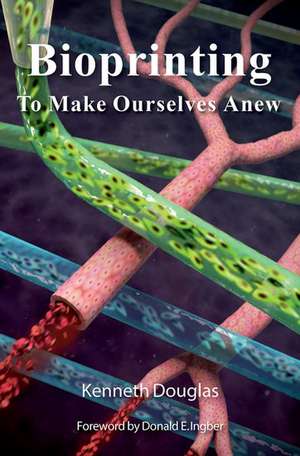
Bioprinting: To Make Ourselves Anew
Autor Kenneth Douglasen Limba Engleză Hardback – 29 iul 2021
Of the 121,000 people on donor lists in the U.S., over 100,000 need kidney transplants and thousands die each year while waiting. Bioprinting aspires to build healthy kidney tissue from a patient's own cells and transplant this to boost failing kidneys without fear of rejection...
As the 21st century dawned, a handful of inspired scientists tried to use 3D printing to create living human tissue. Their vision was to restore the health of people with intractable injuries, such as worn out cartilage, severed nerves, ailing kidneys, failing hearts―the gamut of human frailties. Their modest success energized others to join the quest. Now, after two decades of ingenious effort and hard work, they have carved out a vibrant new discipline: bioprinting.
In Bioprinting: To Make Ourselves Anew, physicist Kenneth Douglas casts an eye over the achievements and future of bioprinting. He explains the science with rigor but with a minimum of technical baggage. This is the first book on the subject written expressly for the lay audience: accessible and even entertaining. Douglas interviewed two dozen bioprinting researchers from around the world, and he enriches the narrative by sharing stories from the scientists behind the science. These contemporary vignettes are complemented by historical accounts of the women and men whose prescient contributions were foundational to the development of bioprinting.
The book describes the challenges and accomplishments in the bioprinting of blood vessels, cartilage, skin, bone, skeletal muscle, neuromuscular junctions, liver, heart, lung, kidney, and so-called organs-on-a-chip, as well as the challenges of providing a blood supply and nerves to bioprinted tissues. This is a compelling tale of a work in progress: to imitate nature and help heal people with debilitating afflictions.
Preț: 172.66 lei
Preț vechi: 202.31 lei
-15%
Carte disponibilă
Livrare economică 13-18 noiembrie
Specificații
ISBN-10: 0190943548
Pagini: 320
Dimensiuni: 236 x 157 x 23 mm
Greutate: 0.68 kg
Editura: Oxford University Press
Colecția OUP USA
Locul publicării:New York, United States
V-ar putea interesa
-
 Biomaterials Science: An Introduction to Materials in MedicineWilliam R Wagner-28%Preț: 950.47 lei1311.52 lei
 -
 -16%Preț: 80.13 lei95.94 lei
 -
 Don't Burn Anyone at the Stake TodayNaomi AldermanPreț: 121.20 lei
 -
 BiofabricationRitu RamanPreț: 89.59 lei
 -
 Transplantation - Print and E-Book: A Companion to Specialist Surgical PracticeJohn L. R. Forsythe-35%Preț: 541.44 lei832.64 lei
 -
 -27%Preț: 89.52 lei122.10 lei
 -
 Operative Techniques in Transplantation SurgeryMichael J. Englesbe M.D.-19%Preț: 2125.77 lei2628.97 lei
 -
 The Singularity is NearerRay KurzweilPreț: 94.17 lei
 -
 A Short History of Nearly Everything 2.0Bill BrysonPreț: 142.00 lei
 -
 Organ ManufacturingXiaohong Wang-27%Preț: 2072.77 lei2823.83 lei
 -
 -19%Preț: 99.15 lei122.38 lei
 -
 Bioprinting the HumanSoner Şahin-23%Preț: 928.68 lei1211.04 lei
 -
 I SwearJohn DavidsonPreț: 86.18 lei
 -
 Replaceable YouMary Roach-5%Preț: 108.32 lei114.03 lei
 -
 Dangerous MiracleLiam ShawPreț: 123.33 lei
 -
 The ImmortalistsAleks KrotoskiPreț: 123.00 lei
 -
 Life in Spite of EverythingVictoria DonovanPreț: 159.77 lei
 -
 Organ Tissue EngineeringDaniel Eberli-18%Preț: 3152.06 lei3843.97 lei
Recenzii
The amount and breadth of basic research in bioprinting is astounding. It is a huge mix of approaches with cell biology, tissue engineering, and printing methods that start from scratch with basic cells and create living tissues. Douglas takes us through this maze step by step and makes historical and clinical sense of the direction and pace of this research.
In this book, Ken Douglas tells how bioprinting first emerged at the turn of the 21st century, the enormous potential it offers for transforming the field of organ transplantation, and the real challenges that must be overcome in order for it to succeed and have an impact on the future of health care. It is a story of creativity, drive, perseverance, and passion, and it is told by recounting the personal stories of many of the key scientists who have led the chase.
Magic happens when we combine a 3D printer with tissue engineering and regenerative medicine. Add materials science, biotechnology, and medical technology, and the result is an explosion of innovation in 3D engineered tissues. Through a storytelling method, this fine book provides readers with insights into how bioprinting has changed tissue engineering and regenerative medicine and how it can change the way we approach human diseases in the future.