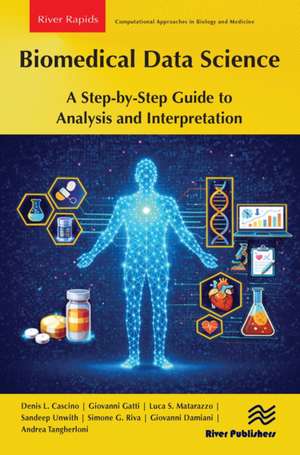
Biomedical Data Science: A Step-by-Step Guide to Analysis and Interpretation: River Publishers Rapids Series in Computational Approaches in Biology and Medicine
Autor Denis L. Cascino, Giovanni Gatti, Luca S. Matarazzo, Sandeep Unwith, Simone G. Riva, Giovanni Damiani, Andrea Tangherlonien Limba Engleză Hardback – 18 sep 2026
Instead of overwhelming the reader with derivations, it emphasises conceptual clarity, reproducibility, and interpretability, linking key ideas with Python workflows using widely adopted libraries. Core statistical tools (estimation, confidence intervals, hypothesis testing, multiple testing) are integrated with essential machine-learning practices (cross-validation, metrics, baseline vs. null models, sanity checks, and model explanation).
An end-to-end clinical case study ties everything together—demonstrating how design decisions, preprocessing, statistical analysis, and predictive modelling collectively influence conclusions and clinical significance. As the first volume of the River Series, this book establishes a practical, open, and interdisciplinary approach to data-driven biomedicine, guiding readers to “get it right” from the outset.
Preț: 804.31 lei
Preț vechi: 1005.38 lei
-20% Nou
Puncte Express: 1206
Carte tipărită la comandă
Livrare economică 28 noiembrie-12 decembrie
Livrare prin curier în România Termenul estimat este afișat lângă disponibilitate.
Transport gratuit pentru acest produs Plată online sau ramburs, în funcție de opțiunile comenzii.
Retur gratuit în 14 zile Comandă securizată și suport în română.
Specificații
ISBN-13: 9788743812463
ISBN-10: 8743812465
Pagini: 162
Ilustrații: 18
Dimensiuni: 156 x 234 mm
Greutate: 0.41 kg
Ediția:1
Editura: River Publishers
Colecția River Publishers
Seria River Publishers Rapids Series in Computational Approaches in Biology and Medicine
ISBN-10: 8743812465
Pagini: 162
Ilustrații: 18
Dimensiuni: 156 x 234 mm
Greutate: 0.41 kg
Ediția:1
Editura: River Publishers
Colecția River Publishers
Seria River Publishers Rapids Series in Computational Approaches in Biology and Medicine
Public țintă
Academic, Postgraduate, and Professional Practice & DevelopmentNotă biografică
Simone G. Riva is a senior computational and machine learning scientist in genomics at the University of Oxford. As a computational biologist working at the intersection of computer science and genomics, he specialises in developing advanced machine learning models and bioinformatics pipelines aimed at exploring and decoding non-coding regions of the genome. His research focuses on designing high-throughput computational strategies to investigate complex genomic elements, including coding sequences, splicing mechanisms, regulatory networks, and structural features. By creating efficient and reproducible workflows and curating specialised datasets, he applies cutting-edge machine learning technologies to generate novel insights into genome biology, thereby bridging the gap between artificial intelligence and biological discovery.
Denis L. Cascino is an associate consultant at Bain & Company, Milan, specialising in the Healthcare and Life Sciences Practice, jointly with the Private Equity Group. Before moving into strategy, he interned at Novartis Basel as an AI Engineer in biostatistics and advanced methodologies and has assisted Professors Tangherloni and Damiani with their research on psoriasis and male infertility. Denis earned his B.Sc. in international economics and finance and M.Sc. in data science and business analytics from Bocconi University. He is passionate about the rapid development of AI in drug discovery and aims to explore the establishment of funds specialised in advanced life science methodologies.
Giovanni Gatti is a second-year MSc student in Artificial Intelligence at Bocconi University, Milan, in the Department of Computing Sciences. He is also a Visiting Research Student at the Computational Biology Lab within the same institution, as part of the BIDSA Visiting Students Initiative. His research focuses primarily on the computational analysis of large-scale clinical data. Giovanni also has industry experience, having worked as a Software and AI Engineer in both large technology companies and startups.
Luca Silvestro Matarazzo is a researcher in the Department of Computing Sciences at Bocconi University in Milan. His current research focuses on developing statistical and machine learning techniques to model multi-omic data for precision medicine applications. He earned his B.Sc. in economics and M.Sc. in data science from Bocconi University. Luca also has research experience in economics, particularly in empirical industrial organisation.
Sandeep Unwith completed his Ph.D. in molecular oncology at the University of Oxford, where his research focused on glucose and glycogen metabolism in triple-negative breast cancer. He was a visiting scientist and EuroAge Net Awardee, conducting computational research at Bocconi University and Oxford into RNA sequencing and chromosome conformation capture techniques. He holds a Joint Honours degree in biomedical science and business management from Imperial College London. His research and professional interests include cancer metabolism, biomedical data science, and innovation in the life sciences.
Giovanni Damiani is an associate professor of dermatology at the University of Milan and a clinical professor at Case Western Reserve University (US). He holds a Ph.D. in pharmacology (2020–2024) from the University of Padua (IT), an M.Sc. in pharmacovigilance, pharmacoepidemiology, pharmacoeconomics, and real world evidence (2024–2025) from the University of Verona, Italy, and two postdoctoral positions in dermato-immunology (2018–2020) at Case Western Reserve University, and in the immunology of oral diseases (2020–2022) at the University of Milan. As a dermatologist, he strongly believes in the ""physician scientist"" model, which combines clinical evidence and research to resolve challenging cases. He has developed his expertise in cutaneous immune-mediated diseases (i.e., psoriasis, hidradenitis suppurativa, and atopic dermatitis) and eco-pharmacovigilance. His efforts materialised in 2019 with the establishment of the Italian Centre for Precision Medicine and Chronic Inflammation at the University of Milan, where various skilled professionals (i.e., biologists, bioinformaticians, doctors) collaborate to enhance daily practice through translational research.
Andrea Tangherloni is an assistant professor in the Department of Computing Sciences at Bocconi University, Milan. His research focuses on the intersection of artificial intelligence and the life sciences, aiming to develop novel computational methods to solve complex biological and medical problems. He integrates computational intelligence techniques (e.g., evolutionary computation, swarm intelligence, and fuzzy systems) with deep learning to develop efficient, interpretable tools for biomedical data analysis. His work covers multiple areas, including computational biology, systems biology, bioinformatics, biomedical image analysis, and single-cell omics. Andrea earned his B.Sc., M.Sc., and Ph.D. in computer science from the University of Milano-Bicocca, where his doctoral research investigated the use of high-performance computing and AI to solve problems in systems and genome biology. He has held research positions at the University of Cambridge, the Wellcome Sanger Institute, and Bocconi University. His current work concentrates on integrating AI and biomedical data science to advance translational research and precision medicine.
Denis L. Cascino is an associate consultant at Bain & Company, Milan, specialising in the Healthcare and Life Sciences Practice, jointly with the Private Equity Group. Before moving into strategy, he interned at Novartis Basel as an AI Engineer in biostatistics and advanced methodologies and has assisted Professors Tangherloni and Damiani with their research on psoriasis and male infertility. Denis earned his B.Sc. in international economics and finance and M.Sc. in data science and business analytics from Bocconi University. He is passionate about the rapid development of AI in drug discovery and aims to explore the establishment of funds specialised in advanced life science methodologies.
Giovanni Gatti is a second-year MSc student in Artificial Intelligence at Bocconi University, Milan, in the Department of Computing Sciences. He is also a Visiting Research Student at the Computational Biology Lab within the same institution, as part of the BIDSA Visiting Students Initiative. His research focuses primarily on the computational analysis of large-scale clinical data. Giovanni also has industry experience, having worked as a Software and AI Engineer in both large technology companies and startups.
Luca Silvestro Matarazzo is a researcher in the Department of Computing Sciences at Bocconi University in Milan. His current research focuses on developing statistical and machine learning techniques to model multi-omic data for precision medicine applications. He earned his B.Sc. in economics and M.Sc. in data science from Bocconi University. Luca also has research experience in economics, particularly in empirical industrial organisation.
Sandeep Unwith completed his Ph.D. in molecular oncology at the University of Oxford, where his research focused on glucose and glycogen metabolism in triple-negative breast cancer. He was a visiting scientist and EuroAge Net Awardee, conducting computational research at Bocconi University and Oxford into RNA sequencing and chromosome conformation capture techniques. He holds a Joint Honours degree in biomedical science and business management from Imperial College London. His research and professional interests include cancer metabolism, biomedical data science, and innovation in the life sciences.
Giovanni Damiani is an associate professor of dermatology at the University of Milan and a clinical professor at Case Western Reserve University (US). He holds a Ph.D. in pharmacology (2020–2024) from the University of Padua (IT), an M.Sc. in pharmacovigilance, pharmacoepidemiology, pharmacoeconomics, and real world evidence (2024–2025) from the University of Verona, Italy, and two postdoctoral positions in dermato-immunology (2018–2020) at Case Western Reserve University, and in the immunology of oral diseases (2020–2022) at the University of Milan. As a dermatologist, he strongly believes in the ""physician scientist"" model, which combines clinical evidence and research to resolve challenging cases. He has developed his expertise in cutaneous immune-mediated diseases (i.e., psoriasis, hidradenitis suppurativa, and atopic dermatitis) and eco-pharmacovigilance. His efforts materialised in 2019 with the establishment of the Italian Centre for Precision Medicine and Chronic Inflammation at the University of Milan, where various skilled professionals (i.e., biologists, bioinformaticians, doctors) collaborate to enhance daily practice through translational research.
Andrea Tangherloni is an assistant professor in the Department of Computing Sciences at Bocconi University, Milan. His research focuses on the intersection of artificial intelligence and the life sciences, aiming to develop novel computational methods to solve complex biological and medical problems. He integrates computational intelligence techniques (e.g., evolutionary computation, swarm intelligence, and fuzzy systems) with deep learning to develop efficient, interpretable tools for biomedical data analysis. His work covers multiple areas, including computational biology, systems biology, bioinformatics, biomedical image analysis, and single-cell omics. Andrea earned his B.Sc., M.Sc., and Ph.D. in computer science from the University of Milano-Bicocca, where his doctoral research investigated the use of high-performance computing and AI to solve problems in systems and genome biology. He has held research positions at the University of Cambridge, the Wellcome Sanger Institute, and Bocconi University. His current work concentrates on integrating AI and biomedical data science to advance translational research and precision medicine.
Cuprins
Part I — Experimental Design in Biomedical Research: Principles, Methodologies, and Technical Optimisation 1. Experimental Design 2. Study Type Part II — Statistical Methods and Machine Learning Techniques: From Hypothesis Testing to Predictive Modelling 3. Statistical Analysis in Biomedical Research 4. Machine Learning in Biomedicine research 5. An End-to-End Biomedical Case Study 6. Conclusions
Descriere
Designed for readers at the crossroads of biology, medicine, and computation, this book walks readers through the entire lifecycle of analysis, from formulating clear questions to designing robust studies, quantifying uncertainty, building and validating models, and interpreting results responsibly.