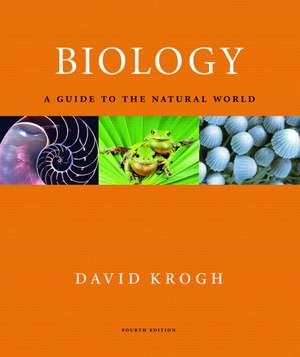
Biology: A Guide to the Natural World with mybiology": United States Edition
Autor David Kroghen Limba Engleză Mixed media product – 17 ian 2008
Intended for Introductory Biology courses, every aspect of Biology: A Guide to the Natural World was written and illustrated to guide students through biological concepts and develop their sense of scientific literacy. It is recognized as a book that students enjoy reading. The Fourth Edition builds upon the text’s popular strengths–an accessible and engaging writing style, up-to-date content, a clear illustration program, a robust media package, and a complete selection of instructor and student resources.
Preț: 823.65 lei
Preț vechi: 1069.67 lei
-23%
Puncte Express: 1235
Carte indisponibilă temporar
Doresc să fiu notificat când acest titlu va fi disponibil:
Se trimite...
Specificații
ISBN-13: 9780132254373
ISBN-10: 0132254379
Pagini: 856
Dimensiuni: 216 x 279 x 25 mm
Greutate: 1.82 kg
Ediția:Nouă
Editura: Pearson Education
Colecția Benjamin Cummings
Locul publicării:San Francisco, United States
ISBN-10: 0132254379
Pagini: 856
Dimensiuni: 216 x 279 x 25 mm
Greutate: 1.82 kg
Ediția:Nouă
Editura: Pearson Education
Colecția Benjamin Cummings
Locul publicării:San Francisco, United States
Cuprins
1. Science as a Way of Learning: A Guide to the Natural World
2. Fundamental Building Blocks: Chemistry, Water, and pH
3. Life’s Components: Biological Molecules
4. Life’s Home: The Cell
5. Life’s Border: The Plasma Membrane
6. Life’s Mainspring: An Introduction to Energy
7. Vital Harvest: Deriving Energy from Food
8. The Green World’s Gift: Photosynthesis
9. Genetics and Cell Division
10. Preparing for Sexual Reproduction: Meiosis
11. The First Geneticist: Mendel and His Discoveries
12. Units of Heredity: Chromosomes and Inheritance
13. Passing On Life’s Information: DNA Structure and Replication
14. How Proteins Are Made: Genetic Transcription, Translation, and Regulation
15. The Future Isn’t What It Used to Be: Biotechnology
16. An Introduction to Evolution Charles Darwin, Evolutionary Thought, and the Evidence for Evolution
17. The Means of Evolution: Microevolution
18. The Outcomes of Evolution: Macroevolution
19. A Slow Unfolding: The History of Life on Earth
20. Arriving Late, Traveling Far: The Evolution of Human Beings
21. Viruses, Bacteria, Archaea, and Protists: The Diversity of Life 1
22. Fungi and Plants: The Diversity of Life 2
23. Animals: The Diversity of Life 3
24. The Angiosperms: An Introduction to Flowering Plants
25. The Angiosperms: Form and Function in Flowering Plants
27. Communication and Control: The Nervous and Endocrine Systems
28. Defending the Body: The Immune System
29. Transport and Exchange 1: Blood and Breath
30. Transport and Exchange 2: Digestion, Nutrition, and Elimination
31. An Amazingly Detailed Script: Animal Development
32. How the Baby Came to Be: Human Reproduction
33. An Interactive Living World 1: Populations in Ecology
34. An Interactive Living World 2: Communities in Ecology
35. An Interactive Living World 3: Ecosystems and Biomes
36. Animals and Their Actions: Animal Behavior
2. Fundamental Building Blocks: Chemistry, Water, and pH
3. Life’s Components: Biological Molecules
4. Life’s Home: The Cell
5. Life’s Border: The Plasma Membrane
6. Life’s Mainspring: An Introduction to Energy
7. Vital Harvest: Deriving Energy from Food
8. The Green World’s Gift: Photosynthesis
9. Genetics and Cell Division
10. Preparing for Sexual Reproduction: Meiosis
11. The First Geneticist: Mendel and His Discoveries
12. Units of Heredity: Chromosomes and Inheritance
13. Passing On Life’s Information: DNA Structure and Replication
14. How Proteins Are Made: Genetic Transcription, Translation, and Regulation
15. The Future Isn’t What It Used to Be: Biotechnology
16. An Introduction to Evolution Charles Darwin, Evolutionary Thought, and the Evidence for Evolution
17. The Means of Evolution: Microevolution
18. The Outcomes of Evolution: Macroevolution
19. A Slow Unfolding: The History of Life on Earth
20. Arriving Late, Traveling Far: The Evolution of Human Beings
21. Viruses, Bacteria, Archaea, and Protists: The Diversity of Life 1
22. Fungi and Plants: The Diversity of Life 2
23. Animals: The Diversity of Life 3
24. The Angiosperms: An Introduction to Flowering Plants
25. The Angiosperms: Form and Function in Flowering Plants
27. Communication and Control: The Nervous and Endocrine Systems
28. Defending the Body: The Immune System
29. Transport and Exchange 1: Blood and Breath
30. Transport and Exchange 2: Digestion, Nutrition, and Elimination
31. An Amazingly Detailed Script: Animal Development
32. How the Baby Came to Be: Human Reproduction
33. An Interactive Living World 1: Populations in Ecology
34. An Interactive Living World 2: Communities in Ecology
35. An Interactive Living World 3: Ecosystems and Biomes
36. Animals and Their Actions: Animal Behavior
Notă biografică
David Krogh has been writing about science for 24 years in newspapers, magazines, books, and for educational institutions. He is the author of Smoking: The Artificial Passion, an account of the pharmacological and cultural motivations behind the use of tobacco, which was nominated for the Los AngelesTimes Book Prize in Science and Technology. In 1994, he began work on what would become Biology: A Guide to the Natural World, and in 1999 he completed its first edition. Since then, he has produced three more editions of A Guide to the Natural World along with a second textbook, A Brief Guide to Biology. He holds bachelor’s degrees in journalism and history from the University of Missouri.
Caracteristici
- An accessible writing style walks students step by step through complex biological processes and captures their interest with analogies from everyday life, history, art, and literature.
- Science as a way of learning essays present science as a process, highlights how our knowledge has been acquired, and demonstrates the logic of evolutionary thinking.
- This text encourages students to think like scientists and "do" science wherever possible; helps students develop sound thinking and reasoning skills that can be applied to any subject.
- A strong illustration program features guided figures and clear three-dimensional detail; key information has been expanded from the text into the illustrations.
- Coverage of current topics relates biology to relevant issues including global warming, human population growth, the dangers of suntans, etc.
- Web Animations lead students through a series of biological-related concepts with animations, interactive exercises, and quizzes for review of difficult concepts.
- Instructor Resource CD-ROM gives instructors access to all of their resources in one place; includes animations, an image bank containing every illustration and most of the photos from the text, PowerPoint® lecture and art slides, the Test Bank, Instructor's Guide, BioFlix animations, Discovery videos, and BLAST animations.
Caracteristici noi
- BioFlix animations and tutorials, available on the Instructor Resource CD-ROM and the student website, correlate to sections within chapters and illustrate important information.These student tools cover the most difficult biology topics with 3-D, movie-quality animations, labeled slide shows, carefully constructed student tutorials, study sheets, and quizzes that support all types of learners. Topics include Tour of An Animal Cell, Tour of A Plant Cell, Membrane Transport, Cellular Respiration, Photosynthesis, Mitosis, Meiosis, DNA Replication.
- "So Far . . ." questions are interspersed through the body of a chapter to give students a checkpoint and moment to reflect on what they have been reading.
- “The Process of Science” essays discuss contemporary research and topics of interest to students and replace the “How Did We Learn” essays
- Human Evolution (Chapter 20) is now an entire chapter, in addition to the History of Life chapter (Chapter 19).
- Circulation, respiration, digestion, and urination are now divided into two chapters–Circulation and respiration (29), and a second chapter on digestion, nutrition, and urination (30).
- Population and ecology are now divided into two chapters–one on populations (33) and one on communities (34).