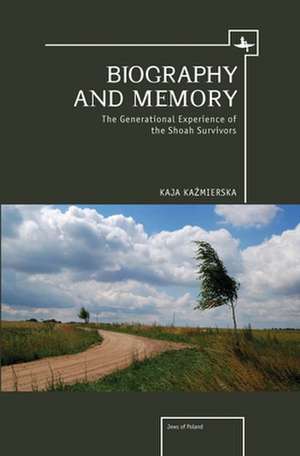
Biography and Memory: The Generational Experience of the Shoah Survivors: Jews of Poland
Autor Kaja Kaźmierska Traducere de Katarzyna Maciejczyken Limba Engleză Hardback – mai 2012





Preț: 596.98 lei
Preț vechi: 802.52 lei
-26%
Puncte Express: 895
Carte disponibilă
Livrare economică 06-20 noiembrie
Livrare express 22-28 octombrie pentru 105.46 lei
Livrare prin curier în România Termenul estimat este afișat lângă disponibilitate.
Transport gratuit pentru acest produs Plată online sau ramburs, în funcție de opțiunile comenzii.
Retur gratuit în 14 zile Comandă securizată și suport în română.
Specificații
ISBN-13: 9781936235780
ISBN-10: 1936235781
Pagini: 396
Dimensiuni: 156 x 234 x 22 mm
Greutate: 0.73 kg
Ediția:New.
Editura: Academic Studies Press
Colecția Academic Studies Press
Seria Jews of Poland
Locul publicării:Boston, MA, United States
ISBN-10: 1936235781
Pagini: 396
Dimensiuni: 156 x 234 x 22 mm
Greutate: 0.73 kg
Ediția:New.
Editura: Academic Studies Press
Colecția Academic Studies Press
Seria Jews of Poland
Locul publicării:Boston, MA, United States
V-ar putea interesa
-
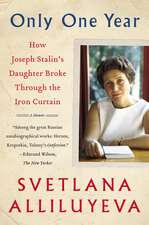 Only One YearSvetlana AlliluyevaPreț: 115.93 lei
 -
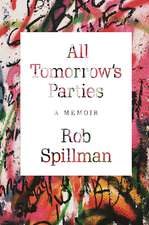 All Tomorrow's PartiesRob SpillmanPreț: 100.01 lei
 -
 Flock Together: A Love Affair with Extinct BirdsB. J. HollarsPreț: 152.68 lei
 -
 A Mother’s TalePhillip LopatePreț: 156.15 lei
 -
 Through Many WindowsHelen Woodward-18%Preț: 1264.59 lei1542.18 lei
 -
 -29%Preț: 196.45 lei275.28 lei
 -
 Canoeing with JoseJon LuriePreț: 95.22 lei
 -
 Fake Missed Connections: Divorce, Online Dating, and Other FailuresBrett Fletcher Lauer-17%Preț: 89.95 lei108.26 lei
 -
 Shadows of Survival: A Child’s Memoir of the Warsaw GhettoKristine Rosenthal Keese-18%Preț: 114.80 lei139.29 lei
 -
 -26%Preț: 588.31 lei793.26 lei
 -
 Miracle ChildAnita EpsteinPreț: 129.24 lei
 -
 Studio GraceEric SiblinPreț: 140.61 lei
 -
 Heart of a Game RangerMario CesarePreț: 156.52 lei
 -
 -11%Preț: 109.81 lei122.75 lei
Recenzii
The author has faced quite a task: of bringing together and, simultaneously, meeting the requirements of many various perspectives characteristic of sociology, psychology/social psychology, anthropology, narratology and generally discourse theories, and–on the other hand–history, in its inevitable entanglement in the perspectives of other social and cultural studies, transcending today’s traditional historiography, which tries to answer the question, “how was it?” I am convinced that this book will generate a keen interest among researchers from various fields; it has the makings of resonating with a wider, non-academic audience as well.
This amazingly well-written book, whose author makes use of the methodology of social qualitative analysis, takes up many issues vital to Polish people. To name but a few: 1. Consequences of the recent transformations in Eastern and Central Europe for many other societies and their members, 2. Our disparate perception of “Polish returns” to the Eastern Borderlands and the Jewish and German returns to Poland, 3. The separation of fates, concerning various national or religious groups living together.
Professor Kaja Kazmierska's book deals with Polish-Jewish relations before, during, and after the Holocaust. It significantly contributes to our understanding of the sociology of memory and of the continuity/disruption in human identities, focusing primarily on the consequences of Holocaust trauma. The return of survivors to the sites of their childhood and youth constitutes, according to the author, the last phase of their wartime experiences. The description and the analysis of those returns point to the enormous complexity and variety of Jewish fates. Prof. Kazmierska's book is not only a result of professional commitment to the subject of her research, it also shows intellectual courage, honesty, and insight, as well as a deep personal sensitivity of a Polish sociologist in respect to the touchy and explosive issue of Polish-Jewish relations.
This amazingly well-written book, whose author makes use of the methodology of social qualitative analysis, takes up many issues vital to Polish people. To name but a few: 1. Consequences of the recent transformations in Eastern and Central Europe for many other societies and their members, 2. Our disparate perception of “Polish returns” to the Eastern Borderlands and the Jewish and German returns to Poland, 3. The separation of fates, concerning various national or religious groups living together.
Professor Kaja Kazmierska's book deals with Polish-Jewish relations before, during, and after the Holocaust. It significantly contributes to our understanding of the sociology of memory and of the continuity/disruption in human identities, focusing primarily on the consequences of Holocaust trauma. The return of survivors to the sites of their childhood and youth constitutes, according to the author, the last phase of their wartime experiences. The description and the analysis of those returns point to the enormous complexity and variety of Jewish fates. Prof. Kazmierska's book is not only a result of professional commitment to the subject of her research, it also shows intellectual courage, honesty, and insight, as well as a deep personal sensitivity of a Polish sociologist in respect to the touchy and explosive issue of Polish-Jewish relations.