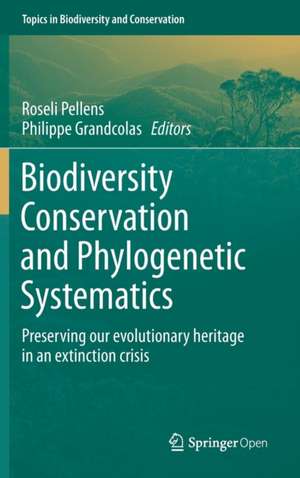
Biodiversity Conservation and Phylogenetic Systematics: Topics in Biodiversity and Conservation, cartea 14
Editat de Roseli Pellens, Philippe Grandcolasen Limba Engleză Hardback – mar 2016
Prima ediție a volumului Biodiversity Conservation and Phylogenetic Systematics marchează o etapă importantă în seria Topics in Biodiversity and Conservation, propunând o schimbare de paradigmă în gestionarea crizei actuale a extincțiilor. Spre deosebire de abordările tradiționale care se concentrează strict pe numărul de specii, această lucrare pune în centru diversitatea filogenetică (PD) ca metrică fundamentală pentru conservarea patrimoniului evolutiv. Putem afirma că volumul reușește să integreze teoria sistematicii direct în politicile de mediu, oferind un cadru riguros pentru prioritizarea ariilor protejate. Structura editorială este organizată progresiv, facilitând tranziția de la concepte teoretice la implementări tehnice. Prima secțiune analizează valoarea intrinsecă a istoriei evolutive, cu un accent deosebit pe speciile relictă și pe modul în care extincția non-aleatorie afectează „arborele vieții”. A doua parte este dedicată metodologiei, abordând probleme complexe precum efortul de eșantionare și gestionarea arborilor filogenetici conflictuali. În final, sunt prezentate aplicații concrete în planificarea sistematică, inclusiv evaluările de tip EDGE și HEDGE. Cititorii familiarizați cu Phylogeny and Conservation de Andrew Purvis vor aprecia aici actualizarea metodologică și focalizarea pe modelele matematice de descompunere a diversității bazate pe numerele Hill. Poziționarea volumului reflectă expertiza editorilor, în special a lui Philippe Grandcolas. Dacă în Natural History Collections in the Science of the 21st Century acesta sublinia importanța arhivelor biologice pentru cercetarea modernă, în lucrarea de față transformă acele date taxonomice în instrumente de conservare aplicată. Reținem că această ediție nu este doar un tratat de ecologie, ci un manual de referință pentru integrarea istoriei biologice în strategiile globale de protecție a biodiversității.
Din seria Topics in Biodiversity and Conservation
- 24%
 Preț: 1990.56 lei
 - 18%
 Preț: 1195.59 lei
 - 18%
 Preț: 921.50 lei
 - 18%
 Preț: 1191.60 lei
 - 18%
 Preț: 907.71 lei
 - 18%
 Preț: 918.33 lei
 - 15%
 Preț: 624.84 lei
 - 24%
 Preț: 896.21 lei
 - 18%
 Preț: 1083.07 lei
 - 18%
 Preț: 1096.24 lei
 - 18%
 Preț: 1774.45 lei
 - 18%
 Preț: 992.68 lei
 - 18%
 Preț: 1186.12 lei
 - 18%
 Preț: 1180.66 lei
 - 18%
 Preț: 1185.57 lei
 - 18%
 Preț: 1187.21 lei
 - 18%
 Preț: 1182.62 lei
 - 18%
 Preț: 1337.43 lei
 - 18%
 Preț: 918.33 lei
 - nou
 Preț: 1262.05 lei
Preț: 424.19 lei
Carte tipărită la comandă
Livrare economică 10-24 iulie
Specificații
ISBN-10: 3319224603
Pagini: 408
Ilustrații: XVII, 390 p. 79 illus., 51 illus. in color.
Dimensiuni: 160 x 241 x 28 mm
Greutate: 0.78 kg
Ediția:1st ed. 2016
Editura: Springer
Colecția Topics in Biodiversity and Conservation
Seria Topics in Biodiversity and Conservation
Locul publicării:Cham, Switzerland
V-ar putea interesa
-
 Immortal River: The Upper Mississippi in Ancient and Modern TimesCalvin R. FremlingPreț: 225.00 lei
 -
 Polar: A Photicular BookCarol Kaufmann-25%Preț: 120.65 lei160.71 lei
 -
 Jungle: A Photicular BookDan Kainen-32%Preț: 120.61 lei176.39 lei
 -
 Song for the Blue OceanCarl SafinaPreț: 197.15 lei
 -
 Chattahoochee River User's GuideJoe CookPreț: 145.49 lei
 -
 Protected AreasLucas N JoppaPreț: 398.91 lei
 -
 Preț: 152.33 lei
 -
 -24%Preț: 122.73 lei160.73 lei
 -
 Woodland ManagementChris StarrPreț: 132.31 lei
 -
 Alpine FlowersGillian PricePreț: 83.31 lei
Public țintă
ResearchDe ce să citești această carte
Această lucrare este esențială pentru cercetătorii și factorii de decizie care doresc să depășească modelul simplist al numărării speciilor. Cititorul câștigă o înțelegere profundă a tehnicilor de prioritizare bazate pe istoria evolutivă, învățând să utilizeze instrumente precum rețelele filogenetice și analizele de rarefiere. Este un argument științific solid pentru salvarea acelor ramuri unice ale vieții care, odată pierdute, nu mai pot fi recuperate.
Descriere scurtă
Cuprins
Textul de pe ultima copertă
This book brings an updated state of the art of phylogenetic diversity in conservation biology. Nineteen chapters written by scientists from research institutions of fourteen countries demonstrate that approaches for preserving the evolutionary heritage are now very tuned into human impacts and sustainability issues. The questions, methods and applications around which it is organized show the importance of phylogenetic diversity in avoiding biodiversity losses in the present extinction crisis. They touch important points such as the way we value phylogenetic diversity, the importance of thinking at a much wider sample of the Tree of Life, the choice of adequate measures. In methods section, new solutions, such as dealing with abundances, sampling effort, or with information coming from conflicting phylogenetic trees are provided. Application section includes study cases of different groups of organi
sms, such as mammals, amphibians, butterflies and plants, in aquatic and terrestrial ecosystems, showing that phylogenetic diversity can be applied in a very wide range of situations, including as a way for predicting conservation status of species. This highlights the interest of this book not only for students and scientists of related disciplines but also for stakeholders and policy-makers working on the implementation of global, regional, and local agendas for biodiversity conservation.