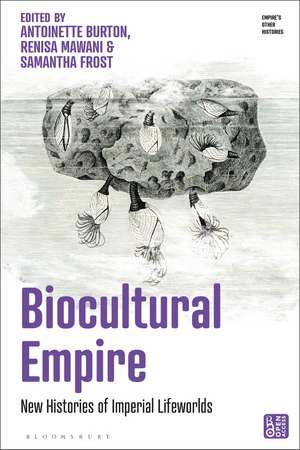
Biocultural Empire: New Histories of Imperial Lifeworlds: Empire’s Other Histories
Editat de Professor Antoinette Burton, Renisa Mawani, Samantha Frosten Limba Engleză Paperback – 25 iun 2026
In understanding the boundaries between human and nonhuman worlds as porous and open to mutual transformation, and foregrounding interspecies interactions, Biocultural Empire seeks to understand the conditions of imperial power, experience and knowledge as a remix of 'nature' and 'culture'. Bringing empire's 'biocultural histories' to the fore, it asks imperial historians to reckon with an interpretative framework which refuses the sovereignty and boundedness of the imperial subject by seeing it as inseparable from its social and ecological formations. Through this biocultural framework this collection highlights how relentlessly the human species bias of western liberal thought persists at the heart of imperial projects and their histories, and offers a new anti-colonial method that represents a significant intervention in the field of British imperial history.
The ebook editions of this book are available open access under a CC BY-NC-ND 4.0 licence on bloomsburycollections.com. Open access was funded by University of Illinois, USA and University of British Columbia, Canada.
Din seria Empire’s Other Histories
- nou
 Preț: 550.36 lei
 - 26%
 Preț: 213.94 lei
 -
 Preț: 214.93 lei
 - 28%
 Preț: 205.43 lei
 - 28%
 Preț: 209.30 lei
 - 37%
 Preț: 548.42 lei
 - 28%
 Preț: 208.66 lei
 - 28%
 Preț: 208.89 lei
 - 25%
 Preț: 208.46 lei
 - 25%
 Preț: 208.13 lei
 - 26%
 Preț: 206.77 lei
 - 25%
 Preț: 208.89 lei
 - 25%
 Preț: 208.46 lei
 - 33%
 Preț: 551.25 lei
 - 32%
 Preț: 552.81 lei
 - nou
 Preț: 543.33 lei
 - nou
 Preț: 550.36 lei
Preț: 208.89 lei
Preț vechi: 279.75 lei
-25% Nou
Puncte Express: 313
Carte disponibilă
Livrare economică 14-28 septembrie
Livrare prin curier în România Termenul estimat este afișat lângă disponibilitate.
Transport gratuit de la 400.00 lei Plată online sau ramburs, în funcție de opțiunile comenzii.
Retur gratuit în 14 zile Comandă securizată și suport în română.
Specificații
ISBN-13: 9781350451087
ISBN-10: 1350451088
Pagini: 240
Ilustrații: 10 bw illus
Dimensiuni: 152 x 232 x 16 mm
Greutate: 0.44 kg
Editura: Bloomsbury Publishing
Colecția Bloomsbury Academic
Seria Empire’s Other Histories
Locul publicării:London, United Kingdom
ISBN-10: 1350451088
Pagini: 240
Ilustrații: 10 bw illus
Dimensiuni: 152 x 232 x 16 mm
Greutate: 0.44 kg
Editura: Bloomsbury Publishing
Colecția Bloomsbury Academic
Seria Empire’s Other Histories
Locul publicării:London, United Kingdom
Cuprins
List of Figures
Acknowledgements
Introduction: Biocultural Empires as an Anti-colonial Method, Antoinette Burton (University of Illinois, USA) Renisa Mawani (University of British Columbia, Canada), Samantha Frost (University of Illinois, USA)
1. Very Like a Whale: Animal Metaphors and the Biocultural Imagination, Jamie Jones (University of Illinois, USA)
2. Biocultural Histories of the Black Anthropocene: Energy, Consumption, and Non-Human Worlds in The History of Barbados and The History of Mary Prince, Anna Feuerstein, (University of Hawai'i-Manoa, USA)
3. A Victorian Parliament of Animals; or, the Biocultural as Imperial Political Form, Antoinette Burton (University of Illinois, USA)
4. Ganja and the Godhead: Plant Matter and the Sacral Binds of the Excise Principle in British India, Utathya Chattopadhyaya (UC-Santa Barbara, USA)
5. The Royal Sacred Hairy Family of Burmah: Human Difference and Biocultural Empire in the Nineteenth Century, Jonathan Saha, (Durham University, UK)
6. History in the Water(s): Water and Empire in North America's Wet Centre", Adele Perry, (University of Manitoba, Canada)
7. Strangers, Difference and the Darkness of Empire: The HMB Endeavour in New Zealand, Tony Ballantyne (University of Otago, New Zealand)
8. Papering over Muddy Histories: Imperial Logics of Space in the Anthropocene, Debjani Bhattacharya (University of Zurich, Switzerland)
Bibliography
Index
Acknowledgements
Introduction: Biocultural Empires as an Anti-colonial Method, Antoinette Burton (University of Illinois, USA) Renisa Mawani (University of British Columbia, Canada), Samantha Frost (University of Illinois, USA)
1. Very Like a Whale: Animal Metaphors and the Biocultural Imagination, Jamie Jones (University of Illinois, USA)
2. Biocultural Histories of the Black Anthropocene: Energy, Consumption, and Non-Human Worlds in The History of Barbados and The History of Mary Prince, Anna Feuerstein, (University of Hawai'i-Manoa, USA)
3. A Victorian Parliament of Animals; or, the Biocultural as Imperial Political Form, Antoinette Burton (University of Illinois, USA)
4. Ganja and the Godhead: Plant Matter and the Sacral Binds of the Excise Principle in British India, Utathya Chattopadhyaya (UC-Santa Barbara, USA)
5. The Royal Sacred Hairy Family of Burmah: Human Difference and Biocultural Empire in the Nineteenth Century, Jonathan Saha, (Durham University, UK)
6. History in the Water(s): Water and Empire in North America's Wet Centre", Adele Perry, (University of Manitoba, Canada)
7. Strangers, Difference and the Darkness of Empire: The HMB Endeavour in New Zealand, Tony Ballantyne (University of Otago, New Zealand)
8. Papering over Muddy Histories: Imperial Logics of Space in the Anthropocene, Debjani Bhattacharya (University of Zurich, Switzerland)
Bibliography
Index
Recenzii
This provocative collection takes imperial history where it has seldom been before, re-imagining empire as a consequence of biocultural processes. Compelling essays illustrate this approach whether through keratin, chromosomes, whales, plants, water, mud and more. An essential guide for doing radical imperial history in the age of the Anthropocene.
The essays in this diverse and imaginatively assembled collection reconceptualize the history of the British empire by firmly contextualizing it within the organic and inorganic environments that always influenced the direction and impact of imperial activities and often constrained them.
Biocultural Empire is an important collection that finally brings together two of the most significant intellectual trends of the last years: the move beyond the biology/society binary, embodied by Frost's work, and anti-colonial empire histories. It is this kind of collective and multidisciplinary work that we need to document the scale and depth of harm done by unjust structures and racialized violence in the Anthropocene, from cells to empires, in human and more-than-human worlds.
The essays in this diverse and imaginatively assembled collection reconceptualize the history of the British empire by firmly contextualizing it within the organic and inorganic environments that always influenced the direction and impact of imperial activities and often constrained them.
Biocultural Empire is an important collection that finally brings together two of the most significant intellectual trends of the last years: the move beyond the biology/society binary, embodied by Frost's work, and anti-colonial empire histories. It is this kind of collective and multidisciplinary work that we need to document the scale and depth of harm done by unjust structures and racialized violence in the Anthropocene, from cells to empires, in human and more-than-human worlds.