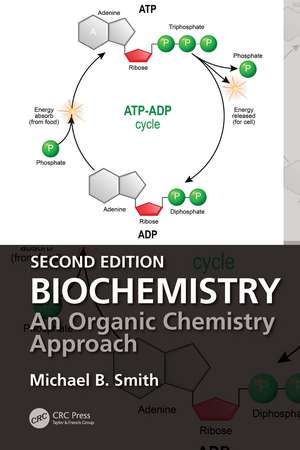
Biochemistry: An Organic Chemistry Approach
Autor Michael B. Smithen Limba Engleză Paperback – 23 ian 2026
Key Features
- Presents a review chapter of fundamental organic chemistry principles and reactions.
- Presents and explains the fundamental principles of biochemistry using principles and common reactions of organic chemistry.
- Discusses enzymes, proteins, fatty acids, lipids, vitamins, hormones, nucleic acids and other biomolecules by comparing and contrasting them with the organic chemistry reactions that constitute the foundation of these classes of biomolecules.
- Discusses the organic synthesis and reactions of amino acids, carbohydrates, nucleic acids and other biomolecules.
Preț: 987.74 lei
Preț vechi: 1085.44 lei
-9%
Puncte Express: 1482
Carte disponibilă
Livrare economică 16-30 noiembrie
Livrare express 31 octombrie-06 noiembrie pentru 44.87 lei
Livrare prin curier în România Termenul estimat este afișat lângă disponibilitate.
Transport gratuit pentru acest produs Plată online sau ramburs, în funcție de opțiunile comenzii.
Retur gratuit în 14 zile Comandă securizată și suport în română.
Specificații
ISBN-13: 9781032996196
ISBN-10: 1032996196
Pagini: 404
Ilustrații: 524
Dimensiuni: 178 x 254 mm
Greutate: 0.75 kg
Ediția:2. Auflage
Editura: CRC Press
Colecția CRC Press
ISBN-10: 1032996196
Pagini: 404
Ilustrații: 524
Dimensiuni: 178 x 254 mm
Greutate: 0.75 kg
Ediția:2. Auflage
Editura: CRC Press
Colecția CRC Press
V-ar putea interesa
-
 A Q&A Approach to Organic ChemistryMichael B. Smith-18%Preț: 1277.14 lei1557.50 lei
 -
 Microwave Heating as a Tool for Sustainable ChemistryNicholas E. Leadbeater-15%Preț: 618.90 lei728.12 lei
 -
 Phytochemical & Biological Investigations of the Carissa carandas barkMohammad Fahim Kadir-5%Preț: 213.25 lei224.48 lei
 -
 Off-Label-Use von Arzneimitteln in der PalliativmedizinKatrin Hafner-5%Preț: 420.85 lei442.99 lei
 -
 -5%Preț: 569.33 lei599.29 lei
 -
 -5%Preț: 330.78 lei348.18 lei
 -
 -5%Preț: 331.67 lei349.13 lei
 -
 Etudes Chimiques Et Biologiques Des Plantes Medicinales Camerounaises: Impact Du Stress PrenatalAristide Laurel Mokale Kognou-5%Preț: 324.04 lei341.09 lei
Public țintă
Academic, Postgraduate, and Undergraduate AdvancedCuprins
Chapter 01: Water, Acids and Bases. Chapter 02: Amino Acids. Chapter 03: Peptides and Proteins. Chapter 04: Enzymes. Chapter 05: A Review of Organic Chemistry. Chapter 6: Nucleophilic Substitution and Elimination Reactions. Chapter 7: Dienes and Conjugated Carbonyl Compounds in Biochemistry. Chapter 8: Radical Reactions. Chapter 9: Enols and Enolate Anions. Chapter 10: Lipids. Chapter 11: Aromatic Compounds and Heterocyclic Compounds. Chapter 12: Metals. Carbon-Metal Bonds, Chelating Agents and Coordination Complexes. Chapter 13: Carbohydrates. Chapter 14: Glycosides. Chapter 15: Nucleic Acids, Nucleosides and Nucleotides. Chapter 16: Answers To Homework Problems
Notă biografică
Professor Michael B. Smith was born in Detroit, Michigan in 1946 and moved to Madison Heights, Virginia in 1957, where he attended high school at Amherst County High School. He received an A.A. from Ferrum College in 1967 and a B.S. in chemistry from Virginia Polytechnic Institute in 1969. After working for three years at the Newport News Shipbuilding and Dry Dock Co. in Newport News VA as an analytical chemist, he entered graduate school at Purdue University. He received a Ph.D. in Organic chemistry in 1977, under the auspices of Professor Joe Wolinsky. Professor Smith spent one year as a faculty research associate at the Arizona State University with Professor G. Robert Pettit, working on the isolation of cytotoxic principles from plants and sponges. He spent a second year of postdoctoral work with Professor Sidney M. Hecht at the Massachusetts Institute of Technology, working on the synthesis of bleomycin A2. Professor Smith began his academic career at the University of Connecticut in 1979, where he achieved the rank of professor of chemistry. In 1986 he spent a sabbatical leave in the laboratories of Professor Leon Ghosez, at the Université Catholique de Louvain in Louvain-la-Neuve, Belgium, as a visiting professor. He retired as a full professor from the University of Connecticut on January 1, 2017, and is currently pursuing his interests as an author.
Descriere
The book provides a framework for understanding various topics of biochemistry including the chemical behavior of biomolecules, enzyme activity and more. Using several techniques and including homework, this text helps students grasp and correlate the essential organic chemistry concepts with those concepts at the root of biochemistry.
Recenzii
Describing an interesting way to teach biochemistry, especially in conjunction with organic chemistry, this textbook should find application at many schools. The first of 15 chapters is a review of the fundamentals of an organic chemistry course, but a full course may be necessary for beginners to benefit from further study. Subsequent discussion of organic reactions and mechanisms will be more meaningful for students already familiar with organic chemistry basics. Chapter 2 describes acid-base chemistry, elimination reactions, and the importance of water in chemistry. Chapter 3 discusses nucleophilic substitution; chapter 4 explains free radical reactions. Subsequent chapters discuss, respectively, dienes, conjugated systems, sigmatropic rearrangements, enols and enolate reactions, enzymes, enzyme kinetics, carboxylic acid and derivatives, lipids, aromatic chemistry, heteroaromatic chemistry, organometallic compounds, biologically relevant metals, chelating reagents, amino acids, peptides, proteins, carbohydrates and derivatives, glycosides, nucleosides, nucleotides, DNA, and RNA. Each chapter concludes with homework questions; finally, chapter 16 includes the answers to the questions. Common abbreviations are listed at the beginning of the book, and several compounds and functional groups also have line formulas or partial structures shown. The book can be used by teachers and students of chemistry, and will be useful for all chemists as a review.
--R. E. Buntrock, independent scholar
Summing Up: Recommended. Lower- and upper-division undergraduates. Graduate students, faculty, and professionals.
--R. E. Buntrock, independent scholar
Summing Up: Recommended. Lower- and upper-division undergraduates. Graduate students, faculty, and professionals.