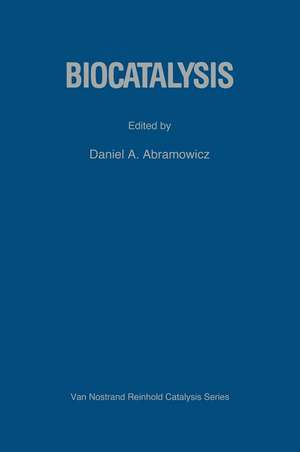
Biocatalysis: Van Nostrand Reinhold Electrical/Computer Science and Engineering Series
Editat de D. A. Abramowiczen Limba Engleză Paperback – 8 iul 2012










Preț: 381.37 lei
Puncte Express: 572
Carte tipărită la comandă
Livrare economică 27 noiembrie-11 decembrie
Livrare prin curier în România Termenul estimat este afișat lângă disponibilitate.
Transport gratuit de la 400.00 lei Plată online sau ramburs, în funcție de opțiunile comenzii.
Retur gratuit în 14 zile Comandă securizată și suport în română.
Specificații
ISBN-13: 9789401091268
ISBN-10: 9401091269
Pagini: 400
Ilustrații: XXVIII, 400 p. 24 illus.
Dimensiuni: 152 x 229 x 22 mm
Greutate: 0.58 kg
Ediția:Softcover reprint of the original 1st ed. 1990
Editura: Springer
Colecția Van Nostrand Reinhold Electrical/Computer Science and Engineering Series
Seria Van Nostrand Reinhold Electrical/Computer Science and Engineering Series
Locul publicării:Dordrecht, Netherlands
ISBN-10: 9401091269
Pagini: 400
Ilustrații: XXVIII, 400 p. 24 illus.
Dimensiuni: 152 x 229 x 22 mm
Greutate: 0.58 kg
Ediția:Softcover reprint of the original 1st ed. 1990
Editura: Springer
Colecția Van Nostrand Reinhold Electrical/Computer Science and Engineering Series
Seria Van Nostrand Reinhold Electrical/Computer Science and Engineering Series
Locul publicării:Dordrecht, Netherlands
V-ar putea interesa
-
 Electronic and Optical Properties of Conjugated PolymersWilliam Barford-23%Preț: 459.73 lei593.21 lei
 -
 Interfacial Science: An IntroductionGeoffrey Barnes-22%Preț: 394.35 lei503.73 lei
 -
 The Equilibrium Theory of Inhomogeneous PolymersGlenn Fredrickson-25%Preț: 597.69 lei797.98 lei
 -
 Handbook of Fluoropolymer Science and TechnologyDennis W Smith-9%Preț: 1175.53 lei1291.80 lei
 -
 Crystallization of PolymersLeo Mandelkern-11%Preț: 439.16 lei493.44 lei
 -
 Polymer Dynamics and RelaxationRichard BoydPreț: 388.40 lei
 -
 Chemorheology of PolymersPeter J. Halley-14%Preț: 1146.37 lei1332.99 lei
 -
 Polyurethane Casting PrimerI.R. Clemitson-18%Preț: 1467.42 lei1789.53 lei
 -
 Polymer Phase BehaviorTimothy P Ehlers-26%Preț: 1255.05 lei1706.19 lei
Public țintă
ResearchCuprins
1 The Archeology of Enzymology.- Early Highspots.- Confession of a Peroxidase Addict.- Gastric Juice: A Hearty Brew.- What Is Catalysis?.- Anticipating an Enzyme.- Some Early Enzyme Patents.- Water-Insoluble Enzymes Can Work Too.- Chemical Modification of Enzymes.- Enzymes in Organic Solvents Can Go Either Way.- Publication Velocity: A Survival Factor.- Enzyme Specificity: An Intellectual Caldron.- Developments over Time.- An Example of Serendipity in Scientific Discovery.- Time and the Cytochromes: Termination and Resuscitation.- Effect of Temperature on Fat Unsaturation.- Conclusions.- 2 Synthesis of Polyesters by Lipase-Catalyzed Polycondensation in Organic Media.- Oligomer and Polymer Synthesis with Hydrolases.- Formation of [AA-BB]x Polyesters by Lipase-Catalyzed Transesterification.- Enzymatic Synthesis of an Optically Active Polyester.- Conclusions.- 3 Regiospecific Hydroxylation of Biphenyl and Analogs by Aspergillus parasiticus.- Materials and Methods.- Results and Discussions.- Conclusions.- 4 Simple Carbohydrates as Starting Materials in Organic Synthesis: A Comparison of Strategies.- Chemical Synthesis.- Immobilized Enzyme Synthesis.- Microbial Whole Cell Synthesis.- Final Results.- 5 The Production of Amino Acids by Transamination.- Mechanism of Transamination 116 Advantages and Disadvantages of Transaminases for Biocatalytic Reactions.- Driving the Reaction to Completion 120 Production of Amino Acids Using the Aspartic Transaminase from E. Coli.- Immobilization of the Transaminase.- Production of Branched-Chain l-Amino Acids.- Enzyme Production.- Conclusion.- 6 A Biocatalytic Approach to Vitamin C Production: Metabolic Pathway Engineering of Erwinia herbicola.- Historical Perspective.- Recombinant Strategy.- Development of the Recombinant Bacterial Strain.- Carbohydrate Metabolism in the Recombinant Strains.- Conclusions.- 7 Chiral Synthons by Biocatalysis.- Background of Dehalogenase Enzymes.- Dehalogenase Technology.- 8 Enzymatic Resolution of Ibuprofen in a Multiphase Membrane Reactor.- Enzyme-Substrate Screening.- Multiphase Membrane Bioreactor-Theory of Operation.- Results and Discussion.- Conclusions.- 9 Microbial Reduction of Carbonyl Compounds: A Way to Pheromone Synthesis.- What Is a Pheromone?.- Methodology.- Chiral Alcohols or Derivatives.- Chiral Ketones.- Conclusion.- 10 Resolution of Binaphthols and Spirobiindanols Using Pancreas Extracts.- Results.- Discussion.- Experimental Section.- 11 Chiral Synthons by New Oxidoreductases and Methodologies.- What Is Meant by “New” Enzymes and Methodologies?.- Practical Aspects.- Regeneration of Viologens.- Hydrogenations with C. Tyrobutyricum Containing Hydrogenase and Enoate Reductase.- 2-Hydroxycarboxylate Viologen Oxidoreductase and Its Use for the Preparation of (2R)-Hydroxycarboxylates.- Dehydrogenation of (2R)-Hydroxycarboxylates from Racemic Mixtures for the Preparation of (2S)-Hydroxycarboxylates.- Preparation of Chiral Deuterated Compounds.- Reductions of Hydroxylamines.- Example of a Viologen-Dependent Pyridine Nucleotide Oxidoreductase.- Carboxylate Reduction with Clostridia and Carbon Monoxide.- 12 Enzymes from Extreme Environments.- Protein Stability.- Thermostable Enzymes.- Recombinant Thermostable Enzymes.- Future Applications.- 13 Biocatalysis in Anaerobic Extremophiles.- Acidoanaerobes.- Haloanaerobes.- Thermoanaerobes.- Alcohol Dehydrogenase.- Amylases.- Xylose (Glucose) Isomerase.- Summary.- 14 Large-Scale Bioconversion of Nitriles into Useful Amides and Acids.- Biotechnical Potential of Nitrile Metabolism.- Production of Acrylamide withPseudomonas Chlororaphis B23 Nitrile Hydratase.- Characterization and Cofactors of Iron-Containing Nitrile Hydratase.- Occurrence of a Cobalt-Induced and Cobalt-Containing Nitrile Hydratase in Rhodococcus Rhodochorous J1.- Production of Nicotinamide with R. Rhodochrous J1 Nitrile Hydratase.- Production of Nicotinic Acid with R. Rhodochrous J1 Nitrile.- 15 Aldolases in Organic Synthesis.- Fructose-1,6-Diphosphate Aldolase (FDP Aldolase).- Synthesis.- Thermodynamically Controlled C-C Bond Formation.- N-Acetylneuraminic Acid Aldolase (Neu5Ac Aldolase).- 16 Two-Liquid Phase Biocatalysis: Reactor Design.- Nomenclature.- Experimental Determination of Reactor Design Parameters.- Example: Benzyl Acetate Hydrolysis by Pig Liver Esterase.- Optimal Reactor Operation.- Reactor Design and Scale-Up.- Process Design.- Conclusions.- 17 Enzymes That Do Not Work in Organic Solvents: Too Polar Substrates Give Too Tight Enzyme-Product Complexes.- Discussion.
Recenzii
This useful and interesting book, with a subject index and chapter summaries. The concluding chapter by antonies Kieboom is a particularly thoughtful analysis of why carbohydrate-converting enzymes may be catalytically inactive in water-free solvents, unless the product is much less popular than the substrate. It is suggested here that a too tight enzyme-substrate or enzyme- product complex is formed in a apolar organic solvent. Chemistry and Industry; This useful and interesting book, with a subject index and chapter summaries. The concluding chapter by antonies Kieboom is a particularly thoughtful analysis of why carbohydrate-converting enzymes may be catalytically inactive in water-free solvents, unless the product is much less popular than the substrate. It is suggested here that a too tight enzyme-substrate or enzyme- product complex is formed in a apolar organic solvent. Chemistry and Industry