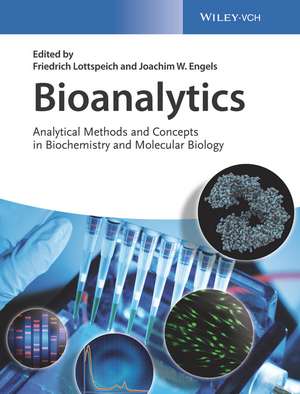
Bioanalytics
Editat de Friedrich Lottspeich, Joachim W. Engelsen Limba Engleză Hardback – 14 mar 2018
Problemele de selecție a metodologiei adecvate pentru analiza macromoleculelor constituie nucleul acestui volum masiv, care servește drept ghid de referință în peisajul complex al biotehnologiei moderne. Subliniem faptul că Bioanalytics nu se rezumă la o simplă enumerare a tehnicilor, ci propune o analiză riguroasă a fundamentelor fizico-chimice care stau la baza fiecărei metode, de la microcalorimetrie și rezonanță magnetică nucleară (NMR) până la secvențierea epigenetică. Considerăm că forța acestui tratat rezidă în capacitatea de a oferi o perspectivă de ansamblu asupra întregului domeniu, facilitând evaluarea critică a avantajelor și limitărilor specifice fiecărui protocol experimental. Descoperim aici o structură logică ce urmărește parcursul analitic complet: purificarea și determinarea proteinelor, măsurarea activității enzimatice, tehnici de hibridizare DNA și metode avansate de spectrometrie de masă. Ediția se distinge prin integrarea unor domenii emergente precum toponomica și biologia chimică, oferind cercetătorilor instrumentele necesare pentru a naviga între nivelurile de organizare moleculară. Cititorii familiarizați cu Bioanalytical Chemistry (2nd Edition) de Andreas Manz vor aprecia aici profunzimea detaliului tehnic și acoperirea mult mai vastă a interacțiunilor proteină-acid nucleic, volumul de față fiind adaptat nu doar pentru studenții la început de drum, ci și pentru experții care gestionează laboratoare de cercetare. Ritmul expunerii este unul academic, dens, susținut de numeroase referințe încrucișate care transformă cele peste 1100 de pagini într-un ecosistem informațional coerent, esențial pentru validarea datelor experimentale în biochimie și biologie moleculară.
Preț: 625.16 lei
Preț vechi: 726.94 lei
-14%
Carte disponibilă
Livrare economică 17 noiembrie-01 decembrie
Livrare express 03-07 noiembrie pentru 136.32 lei
Specificații
ISBN-10: 3527339191
Pagini: 1134
Dimensiuni: 220 x 282 x 55 mm
Greutate: 2.87 kg
Ediția:1
Editura: Wiley-VCH GmbH
Locul publicării:Weinheim, Germany
V-ar putea interesa
-
 Sustainable StormwaterThomas H Cahill-8%Preț: 593.61 lei645.22 lei
 -
 Transition Metal Drug DiscoverCrawley-5%Preț: 762.55 lei802.69 lei
 -
 Introduction to Industrial PolypropyleneDennis B Malpass-9%Preț: 899.08 lei988.00 lei
 -
 Solutions Manual for Environmental ChemistryColin Baird-40%Preț: 343.35 lei572.15 lei
 -
 Preț: 77.61 lei
 -
 -9%Preț: 1215.79 lei1336.04 lei
 -
 -14%Preț: 813.55 lei945.99 lei
 -
 -14%Preț: 839.35 lei975.99 lei
 -
 Managing Engineering, Procurement, Construction, and Commissioning ProjectsAvinashkumar V. Karre-11%Preț: 498.59 lei560.22 lei
 -
 -14%Preț: 1266.80 lei1473.03 lei
 -
 BioanalytikJens Kurreck-18%Preț: 845.70 lei1031.33 lei
 -
 Die Philosophie der WerteWilhelm OstwaldPreț: 346.86 lei
 -
 Zur Erkenntnis der KolloideRichard ZsigmondyPreț: 236.07 lei
 -
 Preț: 145.41 lei
Public țintă
Ph.D. Students in Life Sciences, Ph.D. Students in Biochemistry, Molecular Biologists, Biochemists, Biochemical Institutes, Biotechnological Institutes, Biotechnologists, Libraries at University Institutes, Libraries at Universities, Biotechnological IndustryDe ce să citești această carte
Recomandăm acest volum pentru rigoarea cu care tratează intersecția dintre biologie și chimia analitică. Cititorul câștigă o înțelegere profundă a instrumentarului modern, de la microscopia de forță atomică la tehnici PCR complexe. Este resursa definitivă pentru doctoranzii în științele vieții și cercetătorii care au nevoie de un fundament teoretic solid pentru a alege cea mai eficientă metodă de analiză în proiectele lor de laborator.
Despre autor
Friedrich Lottspeich și Joachim W. Engels sunt editori de renume în comunitatea științifică internațională, cu o expertiză vastă în biochimie și biologie moleculară. Friedrich Lottspeich este recunoscut pentru contribuțiile sale fundamentale în analiza proteinelor și proteomică, activând în cadrul Institutului Max Planck, unde a influențat dezvoltarea metodelor moderne de secvențiere. Joachim W. Engels, profesor emerit, s-a specializat în chimia acizilor nucleici și biotehnologie la Universitatea Goethe din Frankfurt. Împreună, au coordonat echipe de experți pentru a crea acest manual de referință care sintetizează decenii de progres tehnologic în bioanalitică.
Descriere scurtă
Notă biografică
Joachim W. Engels studied chemistry in Berlin and Munich and received a Ph.D. in Regensburg. He carried out post-doctoral studies at Stanford, did his habilitation in Konstanz and was a visiting scientist at the University of Colorado before joining the company Hoechst in 1981, where he developed gene synthesis. He is a full Professor of Biological Chemistry at the Goethe-University of Frankfurt since 1985. His interests range from chemical biology to bioanalytics. Joachim Engels has served as president of the International Society of Nucleotides and Nucleic Acids (2005/6), held several guest professorships at Chiba Institute, Japan (1989), Hokkaido University, Japan (1998) Shandong University, China (2004), Cady-Ayyad University, Morocco (2010), University Witwatersrand, South Africa (2012). He has authored more than 300 original publications. On retirement, he was chosen Professor Emeritus and he is now President of the Goethe-Wissenschaftliche Gesellschaft (Academy) in Frankfurt.
Descriere
Cuprins
Preface XV
Introduction XIX
Part I Protein Analytics 1
1 Protein Purification 3
2 Protein determination 23
3 Enzyme Activity Testing 35
4 Microcalorimetry 47
5 Immunological Techniques 63
6 Chemical Modification of Proteins and Protein Complexes 107
7 Spectroscopy 131
8 Light Microscopy Techniques - Imaging 181
9 Cleavage of Proteins 207
10 Chromatographic Separation Methods 219
11 Electrophoretic Techniques 243
12 Capillary Electrophoresis 275
13 Amino Acid Analysis 301
14 Protein Sequence Analysis 313
15 Mass Spectrometry 329
16 Protein-Protein Interactions 381
17 Biosensors 419
Part II 3D Structure Determination 431
18 Magnetic Resonance Spectroscopy of Biomolecules 433
19 Electron Microscopy 485
20 Atomic Force Microscopy 519
21 X-Ray Structure Analysis 529
Part III Peptides, Carbohydrates, and Lipids 553
22 Analytics of Synthetic Peptides 555
23 Carbohydrate Analysis 571
24 Lipid Analysis 613
25 Analysis of Post-translational Modifications: Phosphorylation and Acetylation of Proteins 645
Part IV Nucleic Acid Analytics 663
26 Isolation and Purification of Nucleic Acids 665
27 Analysis of Nucleic Acids 681
28 Techniques for the Hybridization and Detection of Nucleic Acids 719
29 Polymerase Chain Reaction 755
30 DNA Sequencing 785
31 Analysis of Epigenetic Modifications 817
32 Protein-Nucleic Acid Interactions 831
Part V Functional and Systems Analytics 873
33 Sequence Data Analysis 875
34 Analysis of Promoter Strength and Nascent RNA Synthesis 895
35 Fluorescent In Situ Hybridization in Molecular Cytogenetics 917
36 Physical and Genetic Mapping of Genomes 925
37 DNA-Microarray Technology 945
38 The Use of Oligonucleotides as Tools in Cell Biology 959
39 Proteome Analysis 977
40 Metabolomics and Peptidomics 1023
41 Interactomics - Systematic Protein-Protein Interactions 1033
42 Chemical Biology 1041
43 Toponome Analysis 1057
Appendix 1: Amino Acids and Posttranslational Modifications 1073
Appendix 2: Symbols and Abbreviations 1075
Appendix 3: Standard Amino Acids (three and one letter code) 1081
Appendix 4: Nucleic Acid Bases 1083
Index 1085