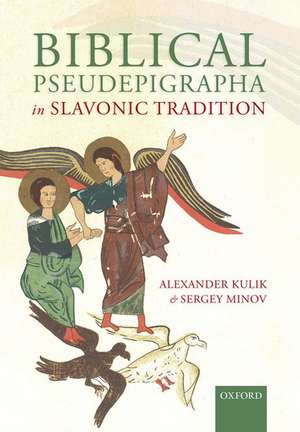
Biblical Pseudepigrapha in Slavonic Tradition
Autor Alexander Kulik, Sergey Minoven Limba Engleză Hardback – 3 noi 2016
Preț: 1306.94 lei
Preț vechi: 1923.36 lei
-32%
Puncte Express: 1960
Carte tipărită la comandă
Livrare economică 26 noiembrie-02 decembrie
Livrare prin curier în România Termenul estimat este afișat lângă disponibilitate.
Transport gratuit pentru acest produs Plată online sau ramburs, în funcție de opțiunile comenzii.
Retur gratuit în 14 zile Comandă securizată și suport în română.
Specificații
ISBN-13: 9780199590940
ISBN-10: 019959094X
Pagini: 432
Dimensiuni: 179 x 253 x 28 mm
Greutate: 2.02 kg
Editura: OUP OXFORD
Colecția OUP Oxford
Locul publicării:Oxford, United Kingdom
ISBN-10: 019959094X
Pagini: 432
Dimensiuni: 179 x 253 x 28 mm
Greutate: 2.02 kg
Editura: OUP OXFORD
Colecția OUP Oxford
Locul publicării:Oxford, United Kingdom
V-ar putea interesa
-
 -29%Preț: 500.08 lei702.96 lei
 -
 Variety and Unity in New Testament ThoughtJohn Reumann-19%Preț: 330.28 lei408.39 lei
 -
 Pauline ChristianityJ. A. Ziesler-29%Preț: 349.99 lei490.12 lei
 -
 Introducing the Old TestamentRichard Coggins-29%Preț: 389.44 lei545.82 lei
 -
 The Oxford Bible CommentaryJohn Barton-5%Preț: 318.18 lei333.91 lei
 -
 -23%Preț: 150.84 lei194.98 lei
 -
 The Jewish Study BibleAdele BerlinPreț: 351.40 lei
 -
 Walking Backwards to ChristmasStephen CottrellPreț: 76.98 lei
 -
 The Lord and His PrayerN T WrightPreț: 69.46 lei
 -
 Blood on the AltarCris PutnamPreț: 115.64 lei
 -
 David, King of Israel, and Caleb in Biblical MemoryJacob L. WrightPreț: 182.00 lei
 -
 The Wonder-Working GodJared C. WilsonPreț: 118.90 lei
 -
 The Three HeavensJohn HageePreț: 113.01 lei
 -
 Longing, Waiting, BelievingRodney Dennis HolderPreț: 108.72 lei
Recenzii
Any scholarly work of high quality that makes primary sources available to a wider readership is welcome and praiseworthy. This fine publication brings attention to the once dynamic and widespread tradition of Slavonic pseudepigrapha and provides all the necessary tools for their further study.
[The authors] find parallels in the motives of the Slavic pseudepigrapha in unexpected places -- Old Irish, Scandanavian, medieval Latin, Arabic and Armenian mythology and texts as well as Zoroastrian sources -- indicating the extremely deep familiarity the authors have with their subject. At points, the authors also suggest an East Slavic origin for some of the pseudepigraphic texts. There is an impressive bibliography with books in more than ten languages and three indexes.
The material in these works can contribute significantly to a better understanding of the roots of postbiblical mysticism, rabbinic Judaism and early Christianity, ancient and medieval dualistic movements, as well as the beginnings of the Slavonic literary tradition. The volume provides a collection of the minor biblical pseudepigrapha preserved solely in Slavonic; at the same time, it is also the first collection of Slavonic pseudepigrapha translated into a western European language. It includes the original texts, their translations, and commentaries focusing on the history of motifs and based on the study of parallel material in ancient and medieval Jewish and Christian literature.
[The authors] find parallels in the motives of the Slavic pseudepigrapha in unexpected places -- Old Irish, Scandanavian, medieval Latin, Arabic and Armenian mythology and texts as well as Zoroastrian sources -- indicating the extremely deep familiarity the authors have with their subject. At points, the authors also suggest an East Slavic origin for some of the pseudepigraphic texts. There is an impressive bibliography with books in more than ten languages and three indexes.
The material in these works can contribute significantly to a better understanding of the roots of postbiblical mysticism, rabbinic Judaism and early Christianity, ancient and medieval dualistic movements, as well as the beginnings of the Slavonic literary tradition. The volume provides a collection of the minor biblical pseudepigrapha preserved solely in Slavonic; at the same time, it is also the first collection of Slavonic pseudepigrapha translated into a western European language. It includes the original texts, their translations, and commentaries focusing on the history of motifs and based on the study of parallel material in ancient and medieval Jewish and Christian literature.
Notă biografică
Alexander Kulik is Associate Professor and Chairman of the Department of German, Russian and East European Studies at the Hebrew University of Jerusalem. He held visiting positions at Harvard, Moscow State University, University College London, Stanford, Freie Universitaet Berlin. Kulik authored two books: Retroverting Slavonic Pseudepigrapha (Society of Biblical Literature: Atlanta GA, 2004 and Leiden-Boston: Brill, 2005), 3 Baruch: Greek-Slavonic Apocalypse of Baruch (Berlin-New York: Walter de Gruyter, 2009), and edited the collected volume History of the Jews in Russia: From Antiquity to Early Modern Period with Zalman Shazar Center (Jerusalem) and Gesharim (Moscow). Kulik has founded and headed the Brill book series Studia Judaeoslavica Sergey Minov has completed his doctoral studies at the Hebrew University of Jerusalem, specializing in the history of ancient Judaism and Christianity, apocryphal literature and biblical exegesis.
Cuprins
- Introduction
- 1: About All Creation
- 2: The Creation of Adam
- 3: Adam's Contract with Satan
- 4: The Tale about the Tree of the Cross
- 5: The Appeal of Adam to Lazarus
- 6: The Sea of Tiberias
- 7: About the Ark
- 8: The Ladder of Jacob
- Bibliography