
Bi-directionality in Human-AI Collaborative Systems
Editat de William Lawless, Ranjeev Mittu, Donald Sofge, Marco Brambillaen Limba Engleză Paperback – 10 iul 2025
It will also be useful for government scientists, business leaders, social scientists, philosophers, regulators and legal experts interested in the impact of autonomous human-machine teams and systems.
- Investigates the challenges in creating synergistic human and AI-based autonomous system-of-systems
- Integrates concepts from a wide range of disciplines, including applied and theoretical AI, quantum mechanics, social sciences, and systems engineering
- Presents debates, models, and concepts of mutual dependency for autonomous human-machine teams, challenging assumptions across AI, systems engineering, data science, and quantum mechanics
Preț: 885.40 lei
Preț vechi: 1348.74 lei
-34%
Puncte Express: 1328
Carte tipărită la comandă
Livrare economică 23 noiembrie-07 decembrie
Livrare prin curier în România Termenul estimat este afișat lângă disponibilitate.
Transport gratuit pentru acest produs Plată online sau ramburs, în funcție de opțiunile comenzii.
Retur gratuit în 14 zile Comandă securizată și suport în română.
Specificații
ISBN-13: 9780443405532
ISBN-10: 0443405530
Pagini: 506
Dimensiuni: 191 x 235 mm
Greutate: 0.98 kg
Editura: ELSEVIER SCIENCE
ISBN-10: 0443405530
Pagini: 506
Dimensiuni: 191 x 235 mm
Greutate: 0.98 kg
Editura: ELSEVIER SCIENCE
V-ar putea interesa
-
 In Robots We TrustSamuele Vinanzi-16%Preț: 147.25 lei175.17 lei
 -
 The Means of Prediction: How AI Really Works (and Who Benefits)Maximilian Kasy-20%Preț: 121.37 lei151.71 lei
 -
 Collaborative IntelligenceArathi Sethumadhavan-14%Preț: 454.49 lei528.48 lei
 -
 If Anyone Builds It, Everyone DiesEliezer Yudkowsky-20%Preț: 117.02 lei146.26 lei
 -
 Responsible Use of AI in Military SystemsJan Maarten Schraagen-20%Preț: 412.71 lei515.88 lei
 -
 Driving Intelligence: The Green Book: Routes to AutonomyJ. Mark Bishop-20%Preț: 297.95 lei372.44 lei
 -
 -20%Preț: 419.94 lei524.92 lei
 -
 -20%Preț: 201.82 lei252.28 lei
 -
 AI + the New Human FrontierErica OrangePreț: 162.50 lei
 -
 Agentic AI For DummiesPam Baker-20%Preț: 145.95 lei182.44 lei
 -
 -35%Preț: 134.23 lei206.56 lei
 -
 -41%Preț: 57.96 lei99.07 lei
 -
 Preț: 140.14 lei
 -
 -20%Preț: 191.04 lei239.83 lei
 -
 Shaping Collaborative Ecosystems for TomorrowAlfonso Reyes-23%Preț: 602.21 lei782.08 lei
 -
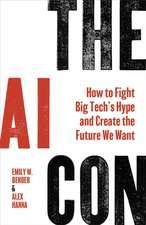 The AI ConEmily M. BenderPreț: 151.96 lei
 -
 Hybrid Human-AI Collaborative NetworksLuis M. Camarinha-Matos-20%Preț: 782.74 lei978.42 lei
 -
 At the Edge of AI: Human Computation Systems and Their Intraverting RelationsLibuše Hannah Veprek-24%Preț: 341.15 lei451.38 lei
 -
 Empire of AIKaren HaoPreț: 163.45 lei
Cuprins
Chapter 1 Introduction to bidirectionality in human–AI collaborative systems
Chapter 2 Foundational approaches to post-hoc explainability for image classification
Chapter 3 Explaining poisoned AI models
Chapter 4 Desirability vs. feasibility: a research through design inquiry of explainable AI
Chapter 5 Credition, uncertainty, consciousness, and communication
Chapter 6 On the principles and effectiveness of gamification in bidirectional artificial intelligence and explainable AI
Chapter 7 Employing Kolmogorov–Arnold network for man–machine collaboration
Chapter 8 Collaborative communication for unnamable risks: a creative writing approach to aligning human–machine situation models in an open world
Chapter 9 Not all explanations are created equal: investigating the pitfalls of current XAI evaluation
Chapter 10 A mixture-of-experts flock: examining expert influence
Chapter 11 On replacing humans with human simulators in human-in-the-loop systems built to interact with humans
Chapter 12 Addressing procrastination and improving task completion efficiency through agent-based interventions
Chapter 13 Navigating the sociotechnical labyrinth: dynamic certification for responsible embodied AI
Chapter 14 Searching XAI collaborating with manager: bidirectional learning for human-tech applications
Chapter 15 Natural perception-based control types for human/machine systems
Chapter 16 Hybrid forums as a means to perceive bidirectional risks
Chapter 17 Credit assignment: challenges and opportunities in developing human-like learning agents
Chapter 18 Human–machine teams: advantages afforded by the quantum-likeness of interdependence
Chapter 2 Foundational approaches to post-hoc explainability for image classification
Chapter 3 Explaining poisoned AI models
Chapter 4 Desirability vs. feasibility: a research through design inquiry of explainable AI
Chapter 5 Credition, uncertainty, consciousness, and communication
Chapter 6 On the principles and effectiveness of gamification in bidirectional artificial intelligence and explainable AI
Chapter 7 Employing Kolmogorov–Arnold network for man–machine collaboration
Chapter 8 Collaborative communication for unnamable risks: a creative writing approach to aligning human–machine situation models in an open world
Chapter 9 Not all explanations are created equal: investigating the pitfalls of current XAI evaluation
Chapter 10 A mixture-of-experts flock: examining expert influence
Chapter 11 On replacing humans with human simulators in human-in-the-loop systems built to interact with humans
Chapter 12 Addressing procrastination and improving task completion efficiency through agent-based interventions
Chapter 13 Navigating the sociotechnical labyrinth: dynamic certification for responsible embodied AI
Chapter 14 Searching XAI collaborating with manager: bidirectional learning for human-tech applications
Chapter 15 Natural perception-based control types for human/machine systems
Chapter 16 Hybrid forums as a means to perceive bidirectional risks
Chapter 17 Credit assignment: challenges and opportunities in developing human-like learning agents
Chapter 18 Human–machine teams: advantages afforded by the quantum-likeness of interdependence