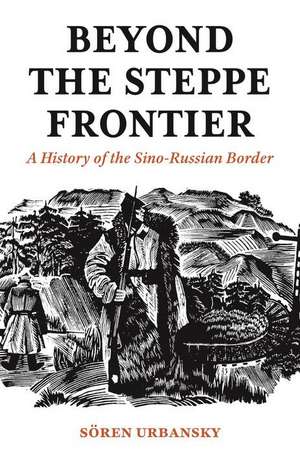
Beyond the Steppe Frontier
Autor Soeren Urbanskyen Limba Engleză Paperback – 14 dec 2021
Descoperim în Beyond the Steppe Frontier o lucrare care redefinește istoriografia marginilor imperiale, concentrându-se pe transformarea radicală a frontierei dintre Rusia și China. Notăm cu interes modul în care Soeren Urbansky reușește să demonteze interpretările politice „de sus în jos”, oferind în schimb o istorie socială a unei linii de demarcație care, timp de secole, a fost aproape invizibilă pentru comunitățile locale. Volumul aduce un aport documentar semnificativ prin utilizarea unor arhive eurasiatice rar explorate, oferind o perspectivă rară asupra modului în care două dintre cele mai mari puteri ale lumii au trecut de la coexistență fluidă la o separare rigidă, marcată de sârmă ghimpată și turnuri de control. Suntem de părere că forța acestei analize rezidă în atenția acordată „actorilor mici” — păstori, contrabandiști și lucrători la căile ferate — ale căror vieți au fost fragmentate de procesele de consolidare statală. Autorul explică metodic cum mecanismele de asimilare forțată și propaganda au fost utilizate pentru a tăia legăturile economice și religioase tradiționale. Această abordare acoperă aceeași arie tematică precum On the Edge de Franck Billé, dar se distinge printr-o rigoare istorică mai accentuată asupra tranziției de la secolul al XVII-lea la modernitate, în timp ce On the Edge se apleacă mai mult asupra realităților contemporane și a tensiunilor politice actuale. De asemenea, spre deosebire de abordarea din Eurasian Borderlands, care se concentrează pe spațiul post-sovietic general, lucrarea de față oferă o examinare specifică și profundă a micro-dinamicilor de la granița chineză, evidențiind succesul statelor în suprimarea identităților transfrontaliere.
Preț: 228.17 lei
Carte tipărită la comandă
Livrare economică 27 noiembrie-11 decembrie
Livrare express 23-29 octombrie pentru 50.94 lei
Specificații
ISBN-10: 0691208948
Pagini: 386
Dimensiuni: 156 x 234 x 23 mm
Greutate: 0.57 kg
Editura: Princeton University Press
V-ar putea interesa
-
 -9%Preț: 633.10 lei695.71 lei
 -
 Preț: 255.58 lei
 -
 Preț: 424.32 lei
 -
 Geopolitics: An Introductory ReaderJason Dittmer-18%Preț: 1306.77 lei1593.62 lei
 -
 Geopolitics: An Introductory ReaderJason Dittmer-8%Preț: 473.90 lei515.12 lei
 -
 -37%Preț: 846.12 lei1339.95 lei
 -
 -18%Preț: 1248.54 lei1522.61 lei
 -
 Ambiguous Foreign Policy of the United States toward the Muslim WorldDavid S Oualaalou-15%Preț: 632.24 lei743.82 lei
 -
 -33%Preț: 549.41 lei815.30 lei
 -
 -32%Preț: 584.18 lei864.60 lei
 -
 Political Discourse in Emergent, Fragile, and Failed DemocraciesDaniel Ochieng Orwenjo-18%Preț: 1059.87 lei1292.53 lei
 -
 The Politics of Bodies at Risk: The Human in the BodyMaria Boikova Struble-26%Preț: 727.24 lei985.96 lei
 -
 The Politics of Bodies at Risk: The Human in the BodyMaria Boikova Struble-24%Preț: 255.41 lei334.15 lei
 -
 Energy, Economics, and Ethics: The Promise and Peril of a Global Energy TransitionKenneth Martens Friesen-19%Preț: 313.89 lei388.62 lei
 -
 Cities and the European UnionSamuele DossiPreț: 286.76 lei
 -
 China's Strategic Interests in the South China Sea: Power and ResourcesSigfrido Burgos CáceresPreț: 457.74 lei
 -
 The American Offensive: Dispatches from the FrontJack KerwickPreț: 83.52 lei
 -
 Steppengras und StacheldrahtSören UrbanskyPreț: 283.87 lei
De ce să citești această carte
Această carte este esențială pentru cercetătorii în geopolitică și istorie eurasiatică, oferind o înțelegere profundă a modului în care granițele sunt construite nu doar pe hartă, ci și în viața oamenilor. Cititorul va câștiga o perspectivă documentată asupra mecanismelor prin care statele transformă zone de contact cultural în bariere politice insurmontabile, un subiect extrem de relevant în contextul actual al relațiilor sino-ruse.
Despre autor
Soeren Urbansky este un istoric specializat în istoria modernă a Asiei de Est și a Rusiei, cu un interes deosebit pentru studiul frontierelor și al migrației. Cercetările sale se concentrează pe dinamicile transfrontaliere și pe modul în care comunitățile locale interacționează cu politicile imperiale și naționale. Prin lucrarea de față, publicată la prestigioasa editură Princeton University Press, Urbansky demonstrează o expertiză remarcabilă în navigarea arhivelor multilingve din Eurasia, reușind să sintetizeze surse complexe în narațiuni istorice coerente despre spațiul sino-rus.
Descriere
A comprehensive history of the Sino-Russian border, one of the longest and most important land borders in the world
The Sino-Russian border, once the world’s longest land border, has received scant attention in histories about the margins of empires. Beyond the Steppe Frontier rectifies this by exploring the demarcation’s remarkable transformation―from a vaguely marked frontier in the seventeenth century to its twentieth-century incarnation as a tightly patrolled barrier girded by watchtowers, barbed wire, and border guards. Through the perspectives of locals, including railroad employees, herdsmen, and smugglers from both sides, Sören Urbansky explores the daily life of communities and their entanglements with transnational and global flows of people, commodities, and ideas. Urbansky challenges top-down interpretations by stressing the significance of the local population in supporting, and undermining, border making.
Because Russian, Chinese, and native worlds are intricately interwoven, national separations largely remained invisible at the border between the two largest Eurasian empires. This overlapping and mingling came to an end only when the border gained geopolitical significance during the twentieth century. Relying on a wealth of sources culled from little-known archives from across Eurasia, Urbansky demonstrates how states succeeded in suppressing traditional borderland cultures by cutting kin, cultural, economic, and religious connections across the state perimeter, through laws, physical force, deportation, reeducation, forced assimilation, and propaganda.
Beyond the Steppe Frontier sheds critical new light on a pivotal geographical periphery and expands our understanding of how borders are determined.