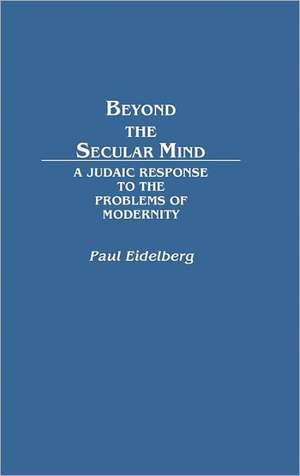
Beyond the Secular Mind
Autor Paul Eidelberg, Joseph Trippen Limba Engleză Hardback – 19 mai 1989
Eidelberg enumerates and elucidates the characteristics that make Jewish law particularly suited to reopening the secular mind and elevating democracy's formative principles. The author compares and contrasts Jewish law with political philosophy. His goal is to derive freedom and equality from a conception of man and society that goes beyond the usual political and social categories, avoiding both relativism and absolutism. In conclusion, Eidelberg attempts to overcome the perennial problem of democracy: how to reconcile wisdom and consent. This he does by sketching the basic institutions of a new community. This unique analysis should be read by political and religious theoreticians alike.
Preț: 488.10 lei
Preț vechi: 802.99 lei
-39%
Puncte Express: 732
Carte tipărită la comandă
Livrare economică 02-16 ianuarie 27
Livrare prin curier în România Termenul estimat este afișat lângă disponibilitate.
Transport gratuit pentru acest produs Plată online sau ramburs, în funcție de opțiunile comenzii.
Retur gratuit în 14 zile Comandă securizată și suport în română.
Specificații
ISBN-13: 9780313266638
ISBN-10: 0313266638
Pagini: 198
Dimensiuni: 161 x 240 x 15 mm
Greutate: 0.42 kg
Editura: Praeger
ISBN-10: 0313266638
Pagini: 198
Dimensiuni: 161 x 240 x 15 mm
Greutate: 0.42 kg
Editura: Praeger
V-ar putea interesa
-
 Encyclopaedia JudaicaMichael Berenbaum-18%Preț: 35391.40 lei43160.24 lei
-
 -30%Preț: 951.01 lei1355.79 lei
-
 -9%Preț: 343.66 lei379.32 lei
-
 -32%Preț: 799.58 lei1167.35 lei
-
 Introducing JudaismEliezer SegalPreț: 424.34 lei
-
 Jewish Cultural Nationalism: Origins and InfluencesDavid AberbachPreț: 474.64 lei
-
 A History of the Jewish PeopleLawrence JoffePreț: 141.54 lei
-
 llustrated Guide to JudaismDan Cohn-SherbokPreț: 144.24 lei
-
 Preț: 539.44 lei
-
 Practicing Piety in Medieval AshkenazElisheva BaumgartenPreț: 297.70 lei
-
 Preț: 439.57 lei
-
 Ben: Sonship and Jewish MysticismProfessor Moshe Idel-18%Preț: 434.15 lei532.50 lei
-
 -18%Preț: 1986.44 lei2422.50 lei
-
 Preț: 430.99 lei
-
 Torah from Heaven – The Reconstruction of FaithNorman SolomonPreț: 423.33 lei
Descriere
Going beyond Allan BlooM&Apos;s The Closing of the American Mind, Paul Eidelberg shows how the cardinal principles of democracy--freedom and equality--can be saved from the degradation of moral relativism by applying Jewish law to these principles. The author attempts to overcome the dichotomy of religion and secularism as well as other contradictions of Western civilization by means of a philosophy of history that uses thoroughly rational concepts and is supported by empirical evidence.
Eidelberg enumerates and elucidates the characteristics that make Jewish law particularly suited to reopening the secular mind and elevating democracy's formative principles. The author compares and contrasts Jewish law with political philosophy. His goal is to derive freedom and equality from a conception of man and society that goes beyond the usual political and social categories, avoiding both relativism and absolutism. In conclusion, Eidelberg attempts to overcome the perennial problem of democracy: how to reconcile wisdom and consent. This he does by sketching the basic institutions of a new community. This unique analysis should be read by political and religious theoreticians alike.
Eidelberg enumerates and elucidates the characteristics that make Jewish law particularly suited to reopening the secular mind and elevating democracy's formative principles. The author compares and contrasts Jewish law with political philosophy. His goal is to derive freedom and equality from a conception of man and society that goes beyond the usual political and social categories, avoiding both relativism and absolutism. In conclusion, Eidelberg attempts to overcome the perennial problem of democracy: how to reconcile wisdom and consent. This he does by sketching the basic institutions of a new community. This unique analysis should be read by political and religious theoreticians alike.
Notă biografică
PAUL EIDELBERG is a Professor of Political Science at Bar Ilan University in Israel. He is the author of Jerusalem vs. Athens, A Discourse on Statesmanship, The Philosophy of the American Constitution, and other books and articles.