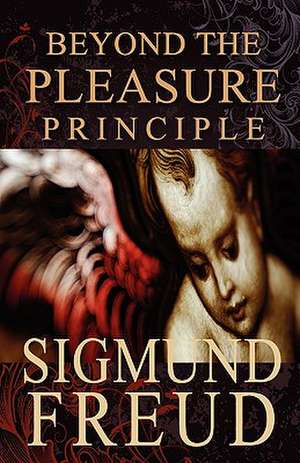
Beyond the Pleasure Principle: Ebooksuccess4free
Autor Sigmund Freud Traducere de James Stracheyen Limba Engleză Paperback – 28 feb 2010
Această ediție în format paperback a lucrării Beyond the Pleasure Principle reprezintă un volum esențial pentru înțelegerea turnurii radicale în gândirea lui Sigmund Freud. Notăm cu interes faptul că textul din 1920 nu este prezentat izolat, ci ca un nod central într-o rețea de influențe și dezvoltări ulterioare. Apreciem structura riguroasă a volumului care, pe lângă eseul fundamental tradus de James Strachey, oferă un Appendix generos cu fragmente din lucrări precum The Ego and the Id sau Civilization and Its Discontents. Această organizare permite cititorului să urmărească modul în care conceptul de „instinct al morții” (Thanatos) a fost rafinat și integrat în modelul structural al psihicului uman (id, ego, super-ego). Descoperim aici o perspectivă speculativă, aproape filosofică, în care Freud depășește faza centrată exclusiv pe Eros pentru a explora natura compulsivă a comportamentului uman și tendința organismelor vii de a reveni la o stare anorganică. Alternativă la Reading Freud’s Beyond the Pleasure Principle de Herman Westerink pentru cursurile de psihanaliză, acest volum are avantajul de a plasa textul sursă într-un context istoric și intelectual vast, incluzând răspunsuri continentale de la Jacques Lacan sau Melanie Klein. Spre deosebire de lucrările sale timpurii, precum The Interpretation of Dreams, unde visul era strict o îndeplinire a dorinței, aici Freud recalibrează teoria pentru a explica retrăirea viselor traumatice, oferind o bază teoretică pentru studiul psihopatologiei moderne.
Preț: 40.22 lei
Carte disponibilă
Livrare economică 10-24 noiembrie
Specificații
ISBN-10: 1451537182
Pagini: 118
Dimensiuni: 140 x 216 x 6 mm
Greutate: 0.15 kg
Editura: CreateSpace Independent Publishing Platform
V-ar putea interesa
-
 The Art of RhetoricAristotlePreț: 28.01 lei
 -
 The User IllusionTor NorretrandersPreț: 116.59 lei
 -
 Going SaneAdam PhillipsPreț: 114.82 lei
 -
 Sexual DeviationIsmond Rosen-24%Preț: 660.12 lei868.42 lei
 -
 A Case of Hysteria: (Dora)Sigmund Freud-20%Preț: 57.15 lei71.12 lei
 -
 Anecdotes of the CynicsRobert Dobbin-39%Preț: 17.44 lei28.47 lei
 -
 Why I Am so CleverFriedrich Nietzsche-39%Preț: 17.06 lei28.11 lei
 -
 Sigmund Freud and Lou Andreas-Salomae, LettersSigmund FreudPreț: 127.58 lei
 -
 Home Is Where We Start fromDonald Woods WinnicottPreț: 144.86 lei
 -
 On the Nature of the PsycheC. G. JungPreț: 140.64 lei
 -
 Preț: 175.17 lei
 -
 Preț: 431.71 lei
 -
 Preț: 384.83 lei
 -
 Preț: 435.34 lei
 -
 Toward an Emancipatory Psychoanalysis: Brandchaft's Intersubjective VisionBernard BrandchaftPreț: 413.65 lei
 -
 Preț: 379.60 lei
 -
 PoeticsAristotle-19%Preț: 20.09 lei24.92 lei
 -
 On DreamsSigmund FreudPreț: 21.11 lei
 -
 The Ego and the IdSigmund FreudPreț: 34.87 lei
 -
 Preț: 439.14 lei
 -
 Preț: 426.42 lei
 -
 Psyche and MatterMarie-Louise von Franz-23%Preț: 203.57 lei265.43 lei
 -
 Beyond the Pleasure Principle-First Edition text.Sigmund FreudPreț: 43.27 lei
De ce să citești această carte
Recomandăm această ediție studenților și cercetătorilor care doresc o înțelegere profundă a celui mai controversat concept freudian: pulsiunea de moarte. Cititorul câștigă acces nu doar la textul original, ci și la o genealogie a ideilor, de la Schopenhauer la psihanaliza contemporană. Este un instrument critic superior pentru oricine studiază fundamentele psihologiei clinice sau ale filosofiei continentale.
Despre autor
Sigmund Freud (1856–1939) a fost un neurolog austriac și fondatorul psihanalizei, metodă care a revoluționat tratamentul psihopatologiei prin dialog. După studii de medicină la Viena și o carieră în neuropatologie, Freud a dezvoltat tehnici fundamentale precum asociația liberă și a teoretizat complexul lui Oedip. În lucrarea de față, el își extinde sistemul teoretic dincolo de libido, introducând „pusiunea de moarte” ca sursă a agresiunii și a vinovăției nevrotice. Forțat să părăsească Austria în 1938 din cauza persecuției naziste, Freud a murit în exil în Regatul Unit, lăsând în urmă o operă care a modelat decisiv cultura secolului XX.
Descriere scurtă
Textul de pe ultima copertă
"Beyond the Pleasure Principle" is among Freud's most intensely debated works, and the important questions that it raises continue to be widely debated a century later. Rejected by some as a pseudo-biological speculation, the concept of Thanatos was embraced by others and formed a path to subsequent theories concerning the mind's attacks on itself, negative narcissism, and addiction to near-death experiences. The concept also helped link Western psychoanalysis with Eastern perspectives on life and death, making this book essential reading for students of psychology, history, and literature.
Dover (2015) republication of the English translation by James Strachey.
See every Dover book in print at
www.doverpublications.com
Notă biografică
Descriere
Beyond the Pleasure Principle is Freud’s most philosophical and speculative work, exploring profound questions of life and death, pleasure and pain. In it Freud introduces the fundamental concepts of the “repetition compulsion” and the “death drive,” according to which a perverse, repetitive, self-destructive impulse opposes and even trumps the creative drive, or Eros. The work is one of Freud’s most intensely debated, and raises important questions that have been discussed by philosophers and psychoanalysts since its first publication in 1920.
The text is presented here in a contemporary new translation by Gregory C. Richter. Appendices trace the work’s antecedents and the many responses to it, including texts by Plato, Friedrich Nietzsche, Melanie Klein, Herbert Marcuse, Jacques Derrida, and Judith Butler, among many others.
Recenzii
The text is presented here in a contemporary new translation by Gregory C. Richter. Appendices trace the work’s antecedents and the many responses to it, including texts by Plato, Friedrich Nietzsche, Melanie Klein, Herbert Marcuse, Jacques Derrida, and Judith Butler, among many others.
“The collection of writings gathered here cover a great breadth and demonstrate quite clearly the importance of the ideas proposed in Freud’s Beyond.” — Metapsychology
“Todd Dufresne’s book sets a new standard for critical editions of Freud. In addition to the lucid new English translation by Gregory C. Richter, there is a splendidly informative introduction, related excerpts from Freud’s other works, and a provocative appendix of critical essays, including contributions from Schopenhauer, Nietzsche, Marcuse, Derrida, and Zizek, that challenge and destabilize this ‘metaphysical’ essay of Freud’s middle period. The pleasures of the text are rich and complex; in it we see Freud, as Dufresne aptly notes, moving ‘beyond psychoanalysis, in philosophy’—a journey of joyful intellectual homecoming.” — Mark Kingwell, Professor of Philosophy, University of Toronto
“Freud’s strange and conceptually adventurous Beyond the Pleasure Principle carves out a wholly original space between philosophy, psychology, and biology—a space we still find difficult to occupy, but one that opens up a range of challenging theoretical ideas from which we can continue to learn. In this new edition, Todd Dufresne expertly re-introduces us to a book that has spawned many important philosophical responses and interventions over the past half-century and reminds us why it is such a key book in Freud’s oeuvre. Gregory C. Richter’s superb new translation and Dufresne’s fantastic choice of both older theories on which Freud draws and newer thinkers who draw on Freud make this a book that anyone interested in contemporary philosophy and critical theory should add to their libraries and their classrooms.” — Imre Szeman, Canada Research Chair in Cultural Studies, University of Alberta
Cuprins
Introduction
Sigmund Freud: A Brief Chronology
Translator’s Note
Beyond the Pleasure Principle
Appendix A: Other Works by Sigmund Freud
- From “The Uncanny” (1919)
- From The Ego and the Id (1923)
- From “The Economic Problem of Masochism” (1924)
- From “A Note about the ‘Mystic Writing Pad’” (1926)
- From Civilization and Its Discontents (1930)
- From “Analysis Terminable and Interminable” (1937)
- From Empedocles, Love and Strife (ca. 420 BCE )
- From Plato, Aristophanes’ Discourse on Love (ca. 385 BCE )
- From Arthur Schopenhauer, Death is the Résumé of Life (1892)
- From Friedrich Nietzsche, Repetition, Pleasure, and Pain (1882, 1886, posthumous)
- From Walter Benjamin, Shock and the Creative Process (1939)
- From Jacques Lacan, Death, Desire, and Freud’s Radical Turn (1954-55)
- From Melanie Klein, On the Development of Mental Functioning (1958)
- From Norman O. Brown, Instinctual Dialectics against Instinctual Dualism (1959)
- From Norman O. Brown, On Death, Time, and Eternity from Hegel to Freud (1959)
- From Paul Ricoeur, Superego and Culture: A Hermeneutic Interpretation (1965)
- From Paul Ricoeur, Open Questions: On Negation, Pleasure, Reality (1965)
- From Gilles Deleuze, Sadism, Masochism, and the Death Instinct (1967)
- From Jacques Derrida, Freud’s Mystic Writing Pad (1967)
- From Herbert Marcuse, “A Decisive Correction”: Non-Repressive Progress and Freud’s Instinct Theory (1970)
- From Jean Laplanche, Economic Paradox of the Death Drive (1970)
- From Gilles Deleuze and Félix Guattari, First Positive Task of Schizoanalysis (1972)
- From Erich Fromm, A Humanist Response to the Death Instinct Theory (1973)
- From Rodolphe Gasché, Scientific Discourse in the Light of Metapsychological Speculation (1974)
- From Jean Baudrillard, The Metaphor of the Death Drive and Its Counter-Finality (1976)
- From J.-B. Pontalis, The Work of Death (1976)
- From Samuel Weber, Freud, Aristophanes, and the Phantastic Hypothesis (1979)
- From Jacques Derrida, “A Kind of Discourse on Method”: Freud’s Performative Writing (1980)
- From Judith Butler, The Pleasures of Repetition: A Phenomenological Perspective (1987)
- From Todd Dufresne, “The Possibility of Happiness”: Absolute Narcissism and the Problem of Sociality (2000)
- From Slavoj Žižek, Paradox of the Freudian Death Drive (2006)
Index