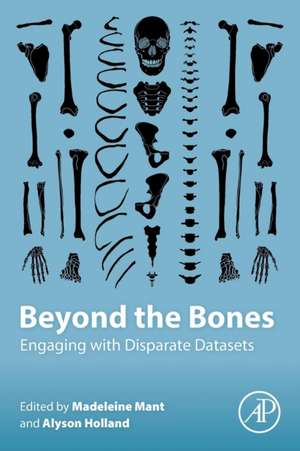
Beyond the Bones: Engaging with Disparate Datasets
Autor Alyson Holland, Madeleine Manten Limba Engleză Paperback – 11 mai 2016
Remarcăm în volumul Beyond the Bones o abordare riguroasă a provocărilor inerente cercetării antropologice contemporane, pornind de la capitolul dedicat deconstrucției mortalității infantile prin seturi de date noi din populațiile cimitirelor istorice. Această lucrare, coordonată de Alyson Holland și Madeleine Mant, nu este doar o prezentare de metodologii, ci un forum activ în care studenții și cercetătorii explorează limitele unirii dovezilor calitative cu cele cantitative. Structura cărții este construită în jurul unor studii de caz concrete, facilitând trecerea de la teoria pură la aplicabilitate practică în medicină legală și investigație criminalistică.
Suntem de părere că progresia conținutului, de la utilizarea radiografiei digitale în analiza ansamblurilor scheletice arheologice până la integrarea datelor lingvistice în cercetarea bioarheologică din sud-vestul american, oferă o imagine de ansamblu holistă asupra disciplinei. Beyond the Bones acoperă aceeași arie tematică precum Evaluating Evidence in Biological Anthropology, dar cu o abordare mai aplicată pe integrarea surselor divergente, precum înregistrările spitalicești și ADN-ul vechi, față de perspectiva critic-teoretică a volumului menționat. De asemenea, spre deosebire de Bioarchaeological Analyses and Bodies, care pune accent pe contextul social și politic prin prisma culturii materiale, lucrarea de față se concentrează pe intersecția tehnică dintre noile tehnologii și metodele tradiționale.
Fiecare capitol servește ca un ghid pentru viitorii cercetători, evidențiind beneficiile și limitările utilizării seturilor de date clinice moderne pentru a informa analizele paleopatologice ale bolilor osoase metabolice. Putem afirma că volumul reușește să transforme complexitatea cercetării interdisciplinare într-un discurs constructiv, esențial pentru înțelegerea stărilor de sănătate umană în contexte istorice și contemporane.
Preț: 188.91 lei
Preț vechi: 302.86 lei
-38%
Carte tipărită la comandă
Livrare economică 28 noiembrie-12 decembrie
Specificații
ISBN-10: 0128046015
Pagini: 168
Dimensiuni: 229 x 152 x 13 mm
Greutate: 0.26 kg
Editura: Academic Press
V-ar putea interesa
-
 Microbial ForensicsBruce Budowle-29%Preț: 496.46 lei702.08 lei
 -
 The Science of Crime ScenesMax M. Houck-32%Preț: 439.24 lei648.42 lei
 -
 Forensic Testimony: Science, Law and Expert EvidenceC. Michael Bowers-19%Preț: 493.18 lei606.55 lei
 -
 Forensic Psychology: A Very Short IntroductionDavid Canter-20%Preț: 57.03 lei71.06 lei
 -
 Forensic Facial ReconstructionCaroline Wilkinson-10%Preț: 324.60 lei361.56 lei
 -
 -20%Preț: 1135.27 lei1419.09 lei
 -
 The Use of Forensic AnthropologyRobert B. Pickering-18%Preț: 1152.21 lei1405.14 lei
 -
 Fundamentals of Fourier Transform Infrared SpectroscopyBrian C. Smith-18%Preț: 1415.84 lei1726.63 lei
 -
 -18%Preț: 1011.57 lei1233.61 lei
 -
 Human and Nonhuman Bone Identification: A Concise Field GuideDiane L. France-15%Preț: 705.04 lei829.46 lei
 -
 Bone Histology: An Anthropological PerspectiveSam D. Stout-18%Preț: 1300.05 lei1585.44 lei
De ce să citești această carte
Această resursă este esențială pentru studenții și profesioniștii din antropologie și medicină legală care doresc să stăpânească integrarea datelor complexe. Cititorul câștigă o metodologie clară pentru combinarea dovezilor biologice cu arhivele istorice și tehnologia digitală, oferind instrumente practice pentru a răspunde la întrebări complexe despre sănătatea populațiilor trecute prin studii de caz documentate riguros.
Cuprins
Chapter 1. Introduction: Beyond the bones in physical anthropology
Chapter 2. Missing, presumed dead: Deconstructing ‘high’ infant mortality with new data sets in historic cemetery populations
Chapter 3. Direct digital radiographic imaging of archaeological skeletal assemblages: An advantageous technique and the use of the images as a research resource
Chapter 4. ‘Readmitted under urgent circumstance’: Uniting archives and bioarchaeology at the Royal London Hospital
Chapter 5. Between the lines: Interpreting disparate data in castration studies
Chapter 6. Hunting for pathogens: Ancient DNA and the historical record
Chapter 7. The use of linguistic data in bioarchaeological research: An example from the American Southwest
Chapter 8. The present informs the past: Incorporating modern clinical data into paleopathological analyses of metabolic bone disease
Chapter 9. Uniting perception and reality in human nutrition: Integration of qualitative and quantitative data to understand consumption
Chapter 10. Conclusions and Future Directions
Descriere
Interdisciplinary research is a rewarding enterprise, but there are inherent challenges, especially in current anthropological study. Anthropologists investigate questions concerning health, disease, and the life course in past and contemporary societies, necessitating interdisciplinary collaboration. Tackling these 'big picture' questions related to human health-states requires understanding and integrating social, historical, environmental, and biological contexts and uniting qualitative and quantitative data from divergent sources and technologies.
The crucial interplay between new technologies and traditional approaches to anthropology necessitates innovative approaches that promote the emergence of new and alternate views. Beyond the Bones: Engaging with Disparate Datasets fills an emerging niche, providing a forum in which anthropology students and scholars wrestle with the fundamental possibilities and limitations in uniting multiple lines of evidence. This text demonstrates the importance of a multi-faceted approach to research design and data collection and provides concrete examples of research questions, designs, and results that are produced through the integration of different methods, providing guidance for future researchers and fostering the creation of constructive discourse.
Contributions from various experts in the field highlight lines of evidence as varied as skeletal remains, cemetery reports, hospital records, digital radiographs, ancient DNA, clinical datasets, linguistic models, and nutritional interviews, including discussions of the problems, limitations, and benefits of drawing upon and comparing datasets, while illuminating the many ways in which anthropologists are using multiple data sources to unravel larger conceptual questions in anthropology. * Examines how disparate datasets are combined using case studies from current research.* Draws on multiple sub-disciplines of anthropological research to produce a holistic overview that speaks to anthropology as a discipline.* Explores examples drawn from qualitative, quantitative, and mixed methods research to illustrate the breadth of anthropological work.