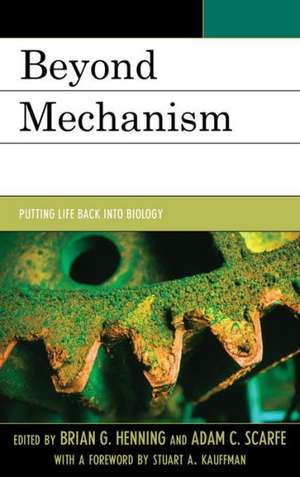
Beyond Mechanism: Putting Life Back Into Biology
Autor Brian G. Henning, Adam Scarfeen Limba Engleză Paperback – 25 feb 2015
Preț: 383.05 lei
Preț vechi: 583.46 lei
-34%
Puncte Express: 575
Carte tipărită la comandă
Livrare economică 03-17 decembrie
Livrare prin curier în România Termenul estimat este afișat lângă disponibilitate.
Transport gratuit de la 400.00 lei Plată online sau ramburs, în funcție de opțiunile comenzii.
Retur gratuit în 14 zile Comandă securizată și suport în română.
Specificații
ISBN-13: 9781498511223
ISBN-10: 1498511228
Pagini: 484
Dimensiuni: 152 x 232 x 32 mm
Greutate: 0.74 kg
Editura: Bloomsbury Publishing
Colecția Lexington Books
Locul publicării:New York, United States
ISBN-10: 1498511228
Pagini: 484
Dimensiuni: 152 x 232 x 32 mm
Greutate: 0.74 kg
Editura: Bloomsbury Publishing
Colecția Lexington Books
Locul publicării:New York, United States
Cuprins
Foreword: Evolution Beyond Newton, Darwin, and Entailing Law
Introduction: On a "Life-Blind Spot" in Neo-Darwainism's Mechanistic Metaphysical Lens
Section 1: Complexity, Systems Theory, and Emergence
Chapter 1: Complex Systems Dynamics in Evolution and Emergence Processes
Chapter 2: Why Emergence Matters
Chapter 3: On the Incompatibility of the Neo-Darwinian Hypothesis With Systems-Theoretical Explanations of Biological Development
Chapter 4: Process-First Ontology
Chapter 5: Ordinal Pluralism as Metaphysics for Biology
Section 2: Biosemiotics
Chapter 6: Why Do We Need a Semiotic Understanding of Life?
Chapter 7: The Irreducibility of Life to Mentality: Biosemiotics or Emergence?
Section 3: Homeostasis, Thermodynamics, and Symbiogenesis
Chapter 8: Biology's Second Law: Homeostasis, Purpose and Desire
Chapter 9: "Wind at Life's Back" -Toward a Naturalistic, Whiteheadian Teleology: Symbiogenesis and the Second Law
Chapter 10: Of Termites and Men: On the Ontology of Collective Individuals
Section 4: The Baldwin Effect, Behavior, and Evolution
Chapter 11: The Baldwin Effect in an Extended Evolutionary Synthesis
Chapter 12: On the Ramifications of the Theory of Organic Selection for Environmental and Evolutionary Ethics
Section 5: Autogen, Teleology, and Teleodynamics
Chapter 13: Teleology Versus Mechanism in Biology: Beyond Self-Organization
Chapter 14: Teleodynamics: A Neo-Naturalistic Conception of Organismic Teleology
Section 6: Epigenetics
Chapter 15: Epigenetics: Toward An Inclusive Concept of Evolution
Chapter 16: Epigenetics, Soft Inheritance, Mechanistic Metaphysics, and Bioethics
Section 7: Organism and Mechanism
Chapter 17: From Organicism to Mechanism-and Half-Way Back?
Chapter 18: Machines and Organisms: The Rise and Fall of a Conflict
About the Contributors
Introduction: On a "Life-Blind Spot" in Neo-Darwainism's Mechanistic Metaphysical Lens
Section 1: Complexity, Systems Theory, and Emergence
Chapter 1: Complex Systems Dynamics in Evolution and Emergence Processes
Chapter 2: Why Emergence Matters
Chapter 3: On the Incompatibility of the Neo-Darwinian Hypothesis With Systems-Theoretical Explanations of Biological Development
Chapter 4: Process-First Ontology
Chapter 5: Ordinal Pluralism as Metaphysics for Biology
Section 2: Biosemiotics
Chapter 6: Why Do We Need a Semiotic Understanding of Life?
Chapter 7: The Irreducibility of Life to Mentality: Biosemiotics or Emergence?
Section 3: Homeostasis, Thermodynamics, and Symbiogenesis
Chapter 8: Biology's Second Law: Homeostasis, Purpose and Desire
Chapter 9: "Wind at Life's Back" -Toward a Naturalistic, Whiteheadian Teleology: Symbiogenesis and the Second Law
Chapter 10: Of Termites and Men: On the Ontology of Collective Individuals
Section 4: The Baldwin Effect, Behavior, and Evolution
Chapter 11: The Baldwin Effect in an Extended Evolutionary Synthesis
Chapter 12: On the Ramifications of the Theory of Organic Selection for Environmental and Evolutionary Ethics
Section 5: Autogen, Teleology, and Teleodynamics
Chapter 13: Teleology Versus Mechanism in Biology: Beyond Self-Organization
Chapter 14: Teleodynamics: A Neo-Naturalistic Conception of Organismic Teleology
Section 6: Epigenetics
Chapter 15: Epigenetics: Toward An Inclusive Concept of Evolution
Chapter 16: Epigenetics, Soft Inheritance, Mechanistic Metaphysics, and Bioethics
Section 7: Organism and Mechanism
Chapter 17: From Organicism to Mechanism-and Half-Way Back?
Chapter 18: Machines and Organisms: The Rise and Fall of a Conflict
About the Contributors
Recenzii
A wonderful volume edited by Brian Henning and Adam Scarfe. . . .the book provides many helpful intuitions, and also arguments and explanations, towards the understanding of. . . .life itself. . . .The work by Brian Henning and Adam Scarfe deserves much appreciation.
This is a remarkable book that comes at a timely moment, both for theoretical biology and for the philosophy of biology. . . .Beyond Mechanism not only presents a wide repertoire of arguments in defense of a more pluralistic view of evolution, but more importantly, it constitutes a piece of research into a new conceptual framework for biology. . . .Globally speaking, the set of chapters in this book constitute an excellent, profound and very comprehensive criticism of the reductionist traditions in biology, and a fascinating exploration of new alternatives.
Suspicion about the adequacy of mechanistic views of nature has lately become increasingly audible. Contributors to this uniformly excellent body of essays not only amplify this suspicion but they also offer scientifically and intellectually sophisticated alternatives. I consider this book essential reading for anyone seriously interested in understanding biology in its relationship to other fields of scientific and philosophical inquiry.
This collection of papers explores some ways forward for biological science, out of its neo-Darwinian stasis and its mechanistic bonds. Perspectives brought to bear on this project herein range from ontogeny to ecology, entrained by a renewed bio-philosophy, and influenced as well by semiotics and moral considerability. The contributors include biologists and philosophers as well as a theologian. Major influences from the past are Aristotle, Kant, Lloyd Morgan and Whitehead, among more recent ones like Justus Buchler and Waddington. Anti-mechanicism is the overall organizing theme, as suggested by the phenomena of emergence and complexity, and mediated by concepts like self-organization and finality. Bacon's prohibition against final cause serving as a motivation within scientific models is finally being jettisoned. Special topics include: adaptive state space, agency, anticipation, autonomy, epigenetics, hierarchical structures, interpretation, niche construction, organic selection, performativity, process philosophy, and symbiogenesis. Structural attractors are hinted at in regard to extension outward of relevant environments. There is a bit of internal criticism, as well as a muted demurrer by an observer from the current establishment. I recommend this volume to those willing to consider some of the possibilities emerging now within biological science.
This is a remarkable book that comes at a timely moment, both for theoretical biology and for the philosophy of biology. . . .Beyond Mechanism not only presents a wide repertoire of arguments in defense of a more pluralistic view of evolution, but more importantly, it constitutes a piece of research into a new conceptual framework for biology. . . .Globally speaking, the set of chapters in this book constitute an excellent, profound and very comprehensive criticism of the reductionist traditions in biology, and a fascinating exploration of new alternatives.
Suspicion about the adequacy of mechanistic views of nature has lately become increasingly audible. Contributors to this uniformly excellent body of essays not only amplify this suspicion but they also offer scientifically and intellectually sophisticated alternatives. I consider this book essential reading for anyone seriously interested in understanding biology in its relationship to other fields of scientific and philosophical inquiry.
This collection of papers explores some ways forward for biological science, out of its neo-Darwinian stasis and its mechanistic bonds. Perspectives brought to bear on this project herein range from ontogeny to ecology, entrained by a renewed bio-philosophy, and influenced as well by semiotics and moral considerability. The contributors include biologists and philosophers as well as a theologian. Major influences from the past are Aristotle, Kant, Lloyd Morgan and Whitehead, among more recent ones like Justus Buchler and Waddington. Anti-mechanicism is the overall organizing theme, as suggested by the phenomena of emergence and complexity, and mediated by concepts like self-organization and finality. Bacon's prohibition against final cause serving as a motivation within scientific models is finally being jettisoned. Special topics include: adaptive state space, agency, anticipation, autonomy, epigenetics, hierarchical structures, interpretation, niche construction, organic selection, performativity, process philosophy, and symbiogenesis. Structural attractors are hinted at in regard to extension outward of relevant environments. There is a bit of internal criticism, as well as a muted demurrer by an observer from the current establishment. I recommend this volume to those willing to consider some of the possibilities emerging now within biological science.