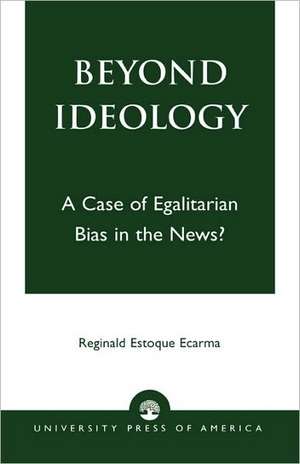
Beyond Ideology: A Case of Egalitarian Bias in the News?
Autor Reginald Estoque Ecarmaen Limba Engleză Paperback – 15 ian 2003
Specifically, the purpose of this qualitative study is to reinterpret previous research about the ideology of the leading national news media through Aaron Wildavsky's (1987, 1991) cultural theory. In applying Wildavsky's cultural theory, this study will reconceptualize and reinterpret previous media studies to ascertain the specific type of culture the media primarily reflects. Through this analysis, a better understanding of media culture may be developed in order to explain the proper constitutional role of the press. A fundamental goal of this study is not necessarily to expose biases, but, more profoundly, to identify the perspectives or more distinctly, the culture that informs journalists' understanding.
Preț: 348.77 lei
Preț vechi: 528.69 lei
-34%
Puncte Express: 523
Carte tipărită la comandă
Livrare economică 05-19 decembrie
Livrare prin curier în România Termenul estimat este afișat lângă disponibilitate.
Transport gratuit de la 400.00 lei Plată online sau ramburs, în funcție de opțiunile comenzii.
Retur gratuit în 14 zile Comandă securizată și suport în română.
Specificații
ISBN-13: 9780761824824
ISBN-10: 0761824820
Pagini: 150
Dimensiuni: 136 x 214 x 12 mm
Greutate: 0.2 kg
Editura: Bloomsbury Publishing
Colecția University Press of America
Locul publicării:New York, United States
ISBN-10: 0761824820
Pagini: 150
Dimensiuni: 136 x 214 x 12 mm
Greutate: 0.2 kg
Editura: Bloomsbury Publishing
Colecția University Press of America
Locul publicării:New York, United States
V-ar putea interesa
-
 -27%Preț: 379.13 lei519.85 lei
 -
 No ContestAlfie Etc KohnPreț: 132.49 lei
 -
 The Richest Man In BabylonGeorge S. ClasonPreț: 60.47 lei
 -
 Management EthicsNorman E BowiePreț: 334.80 lei
 -
 Preț: 251.51 lei
 -
 The New Leaders: Transforming the Art of LeadershipDaniel Goleman-27%Preț: 72.75 lei99.25 lei
 -
 The Ethics of Cultural StudiesDr Joanna Zylinska-21%Preț: 513.51 lei651.81 lei
 -
 Ethics for the Real WorldRonald A. HowardPreț: 201.91 lei
 -
 A Good Disruption: Redefining Growth in the Twenty-First CenturyMartin Stuchtey-34%Preț: 135.48 lei205.81 lei
 -
 Cannibals with ForksJohn ElkingtonPreț: 98.48 lei
 -
 The Civil CorporationSimon ZadekPreț: 443.66 lei
 -
 Responsibility and FreedomRobert Gianni-9%Preț: 1016.57 lei1117.12 lei
Cuprins
Chapter 1 Preface
Chapter 2 Acknowledgements
Chapter 3 Introduction: Statement of the Problem; Purpose of the Study; Statement of the Method; Significance of the Study
Chapter 4 Literature Review: Aaron Wildavsky; Cultural Theory; Political Culture and the Four Ways; Cultural Competition, Politics and Egalitarianism; Case Studies Supporting Wildavsky's Claim: Newsroom Culture and Egalitarianism; Reviews of Wildavsky's Work
Chapter 5 Methodology: Middle-Range Analysis; Meta-Analysis of Cultural Theory; Cultural Theory and the Reason for the Method; Hypothesis: Criteria and Procedure; Coding the Media Studies; Criteria for Choosing Data Sources; Unit of Analysis
Chapter 6 Results: Research Question; Findings; Hypothesis
Chapter 7 Discussion: Summary of Findings; Reasons for Findings; Limitations; Future Studies; Cultural Theory and Egalitarian Consequences in Theory and Practice; Possible Alternatives and Changes; Conclusion
Chapter 8 References
Chapter 9 Index
Chapter 2 Acknowledgements
Chapter 3 Introduction: Statement of the Problem; Purpose of the Study; Statement of the Method; Significance of the Study
Chapter 4 Literature Review: Aaron Wildavsky; Cultural Theory; Political Culture and the Four Ways; Cultural Competition, Politics and Egalitarianism; Case Studies Supporting Wildavsky's Claim: Newsroom Culture and Egalitarianism; Reviews of Wildavsky's Work
Chapter 5 Methodology: Middle-Range Analysis; Meta-Analysis of Cultural Theory; Cultural Theory and the Reason for the Method; Hypothesis: Criteria and Procedure; Coding the Media Studies; Criteria for Choosing Data Sources; Unit of Analysis
Chapter 6 Results: Research Question; Findings; Hypothesis
Chapter 7 Discussion: Summary of Findings; Reasons for Findings; Limitations; Future Studies; Cultural Theory and Egalitarian Consequences in Theory and Practice; Possible Alternatives and Changes; Conclusion
Chapter 8 References
Chapter 9 Index
Recenzii
Combining technical detail with advanced philosophical concepts, 'Beyond Ideology' grapples with soul-searchingly difficult issues in the seemingly endless quest to provide the world with accurate interpretation of major events. 'Beyond Ideology' is most especially recommended for students of journalism, political science, and controversial social/cultural issues.