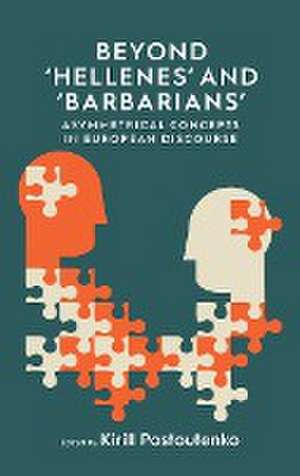
Beyond 'Hellenes' and 'Barbarians': European Conceptual History
Editat de Kirill Postoutenkoen Limba Engleză Hardback – 14 oct 2022

Preț: 725.44 lei
Preț vechi: 942.12 lei
-23%
Puncte Express: 1088
Preț estimativ în valută:
128.41€ • 149.16$ • 111.25£
128.41€ • 149.16$ • 111.25£
Carte tipărită la comandă
Livrare economică 02-16 martie
Livrare express 23-29 ianuarie pentru 121.63 lei
Preluare comenzi: 021 569.72.76
Specificații
ISBN-13: 9781800736795
ISBN-10: 1800736797
Pagini: 360
Dimensiuni: 157 x 235 x 24 mm
Greutate: 0.67 kg
Editura: BERGHAHN BOOKS
Seria European Conceptual History
ISBN-10: 1800736797
Pagini: 360
Dimensiuni: 157 x 235 x 24 mm
Greutate: 0.67 kg
Editura: BERGHAHN BOOKS
Seria European Conceptual History
Notă biografică
Kirill Postoutenko is Senior Researcher in the Special Research Area 1288 (Practices of Comparison) at Bielefeld University, Germany, and Adjunct Associate Professor (Docent) of Russian literature and culture at the University of Helsinki, Finland. He is the author and editor of eight books and eighty articles devoted to the history of Russian poetry and literary criticism, history of media and communication in the Soviet Union and Nazi Germany, systems theory, conversation analysis, and social history of identity.