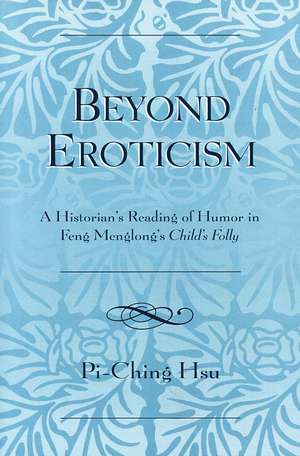
Beyond Eroticism: A Historian's Reading of Humor in Feng Menglong's Child's Folly
Autor Pi-Ching Hsuen Limba Engleză Paperback – dec 2005
Eroticism was Feng Menglong's trademark, but Hsu looks beyond that trademark, arguing that Feng used eroticism both to sell his books and to satirize the puritan state's orthodoxy and the "loose" love ethics of the masses. He did the former as a canny author of the commercial press, and the latter as a marginal member of the "gentry society"-social elite who formed "public opinions" through employment of their cultural capital. An intellectual of high self-esteem, Feng Menglong took advantage of the transgressive nature of humor to project his social, cultural, and political criticism into his erotic, as well as non-erotic satire.
Preț: 343.76 lei
Preț vechi: 532.32 lei
-35%
Puncte Express: 516
Carte tipărită la comandă
Livrare economică 24 noiembrie-08 decembrie
Livrare prin curier în România Termenul estimat este afișat lângă disponibilitate.
Transport gratuit de la 400.00 lei Plată online sau ramburs, în funcție de opțiunile comenzii.
Retur gratuit în 14 zile Comandă securizată și suport în română.
Specificații
ISBN-13: 9780761833536
ISBN-10: 0761833536
Pagini: 268
Dimensiuni: 164 x 228 x 23 mm
Greutate: 0.43 kg
Editura: Bloomsbury Publishing
Colecția University Press of America
Locul publicării:New York, United States
ISBN-10: 0761833536
Pagini: 268
Dimensiuni: 164 x 228 x 23 mm
Greutate: 0.43 kg
Editura: Bloomsbury Publishing
Colecția University Press of America
Locul publicării:New York, United States
V-ar putea interesa
-
 Arab and JewDavid K. ShiplerPreț: 129.24 lei
 -
 Zen at WarBrian Daizen Victoria-20%Preț: 317.22 lei397.48 lei
 -
 Headlines from the Holy LandJames RodgersPreț: 255.26 lei
 -
 From the First World War to the Arab SpringM. E. McMillan-18%Preț: 781.58 lei953.16 lei
 -
 -37%Preț: 66.07 lei105.44 lei
 -
 Being PalestinianYasir Suleiman-Malley-6%Preț: 156.68 lei165.91 lei
 -
 -23%Preț: 545.22 lei708.08 lei
 -
 The Book of SamuraiAntony CumminsPreț: 192.55 lei
 -
 -24%Preț: 396.78 lei519.47 lei
 -
 The Young Atatürk: From Ottoman Soldier to Statesman of TurkeyGeorge W. Gawrych-20%Preț: 138.35 lei172.53 lei
 -
 Invasion Syria, 1941: Churchill and de Gaulle's Forgotten WarHenri de Wailly-26%Preț: 383.69 lei518.16 lei
 -
 The Life of Mahatma GandhiLouis Fischer-18%Preț: 89.40 lei109.11 lei
 -
 Pappe, I: Idea of IsraelIlan PappéPreț: 243.48 lei
 -
 Annihilation of CasteB R AmbedkarPreț: 172.16 lei
Cuprins
Chapter 1 Preface
Chapter 2 Notes on Conventions
Chapter 3 Prologue
Chapter 4 Historicizing the Humor of Child's Folly
Chapter 5 Feng Menglong and His World
Chapter 6 Hanging Twigs andHill Songs: The Triumph and Trial of Emotions and Desires
Chapter 7 Treasury of Laughs: Humorous Satire with a Philosophical Undertone
Chapter 8 Epilogue
Chapter 9 Bibliography
Chapter 10 Glossary of Chinese Characters
Chapter 11 Index
Chapter 12 About the Author
Chapter 2 Notes on Conventions
Chapter 3 Prologue
Chapter 4 Historicizing the Humor of Child's Folly
Chapter 5 Feng Menglong and His World
Chapter 6 Hanging Twigs andHill Songs: The Triumph and Trial of Emotions and Desires
Chapter 7 Treasury of Laughs: Humorous Satire with a Philosophical Undertone
Chapter 8 Epilogue
Chapter 9 Bibliography
Chapter 10 Glossary of Chinese Characters
Chapter 11 Index
Chapter 12 About the Author