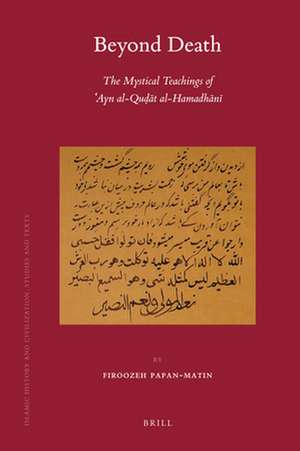
Beyond Death
Autor Firoozeh Papan-Matinen Limba Engleză Hardback – 27 apr 2010
Preț: 955.50 lei
Preț vechi: 1240.90 lei
-23%
Puncte Express: 1433
Preț estimativ în valută:
169.16€ • 196.97$ • 146.95£
169.16€ • 196.97$ • 146.95£
Carte tipărită la comandă
Livrare economică 24 februarie-10 martie
Preluare comenzi: 021 569.72.76
Specificații
ISBN-13: 9789004174139
ISBN-10: 9004174133
Pagini: 256
Dimensiuni: 165 x 244 x 20 mm
Greutate: 0.57 kg
Editura: de Gruyter Brill
ISBN-10: 9004174133
Pagini: 256
Dimensiuni: 165 x 244 x 20 mm
Greutate: 0.57 kg
Editura: de Gruyter Brill
V-ar putea interesa
-
 -40%Preț: 16.22 lei27.11 lei
 -
 The Sufi Book of LifeNeil Douglas-KlotzPreț: 96.50 lei
 -
 The Masnavi, Book OneJalal al-Din Rumi-20%Preț: 50.22 lei62.43 lei
 -
 Preț: 73.25 lei
 -
 Living PresencePhD Helminski, KabirPreț: 124.79 lei
 -
 SufismLlewellyn Vaughan-LeePreț: 82.20 lei
 -
 RumiJonathan StarPreț: 54.88 lei
 -
 The Rumi DaybookKabir Edmund Helminski-20%Preț: 109.48 lei137.47 lei
 -
 SufismWilliam C ChittickPreț: 57.79 lei
 -
 Al-Ghazali on Vigilance and Self-examinationAbu Hamid al-GhazaliPreț: 108.51 lei
 -
 The Fragrant Scent'Abd Al-Rahman Al-'AydarusPreț: 102.75 lei
 -
 Root Speaks to Bud: Fulfilling the Purpose of LifeWilliam Hassan Suhrawardi Gebel PhD-13%Preț: 145.58 lei167.32 lei
 -
 The Sufi Message of Hazrat Inayat Khan Vol. 1 Centennial EditionHazrat Inayat KhanPreț: 219.28 lei
Notă biografică
Firoozeh Papan-Matin, Ph.D. (2003) in Near Eastern Languages and Cultures, University of California, Los Angeles, has published extensively on topics in Persian literature and Islamic mysticism including The Unveiling of Secrets (Kashf al-Asrār): The Visionary Autobiography of Rūzbihān al-Baqlī (A.D. 1128-1209) (Brill, 2006).
Recenzii
"... this monograph provides a valuable and thought-provoking study of ʿAyn al-Qudat al-Hamadhani's works."
Stephen Burge in Journal of Shiʿa Islamic Studies 5.1 (2012), 98-101.
“Beyond Death […] offers readers a glimpse into the sublime nature of ʿAyn al-Quḍāt’s vision. And this is surely because Papan-Matin’s translations from the Tamhīdāt are often able to capture, with considerable beauty, the soaring and tantalizingly elliptical nature of ʿAyn al-Quḍāt’s Persian prose.”
Mohammed Rustom in Journal of Sufi Studies 2.2 (2013), 203-206.
DOI: 10.1163/22105956-12341258
Stephen Burge in Journal of Shiʿa Islamic Studies 5.1 (2012), 98-101.
“Beyond Death […] offers readers a glimpse into the sublime nature of ʿAyn al-Quḍāt’s vision. And this is surely because Papan-Matin’s translations from the Tamhīdāt are often able to capture, with considerable beauty, the soaring and tantalizingly elliptical nature of ʿAyn al-Quḍāt’s Persian prose.”
Mohammed Rustom in Journal of Sufi Studies 2.2 (2013), 203-206.
DOI: 10.1163/22105956-12341258