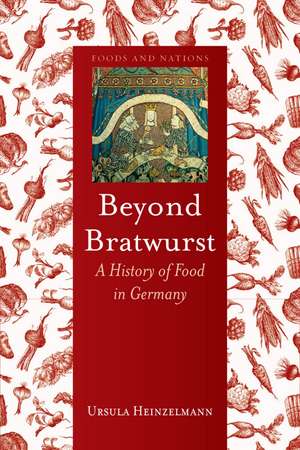
Beyond Bratwurst: Foods and Nations
Autor Ursula Heinzelmannen Limba Engleză Hardback – apr 2014
Prin lucrarea Beyond Bratwurst, Ursula Heinzelmann propune o schimbare de paradigmă în istoriografia culinară europeană, depășind clișeele reductive despre dieta germană bazată exclusiv pe bere și cârnați. Ceea ce aduce nou acest volum este o perspectivă istorică profundă, care demonstrează că inovația și adaptabilitatea au fost constantele gastronomiei germane, nu doar tradiționalismul rigid. Remarcăm modul în care autoarea reușește să sintetizeze perioade complexe, de la primele culturi de cereale din Neolitic până la 'Toast Hawaii' din perioada postbelică, oferind o analiză riguroasă a modului în care geografia și politica au modelat farfuria germană. Structura cărții este organizată cronologic în douăsprezece capitole dense, facilitând o înțelegere clară a progresiei de la hrana de subzistență la industrializarea masivă. Suntem de părere că secțiunile dedicate secolului XX sunt deosebit de valoroase, documentând foametea din timpul celor două războaie mondiale și divergențele culinare dintre RDG și RFG. Comparabil cu The Kitchen, Food, and Cooking in Reformation Germany de Volker Bach în rigurozitatea cercetării, volumul de față este actualizat pentru a include contextul globalizării contemporane și reintegrarea regionalismului în Germania modernă. Față de lucrarea anterioară a autoarei, Food Culture in Germany, acest titlu plonjează mult mai adânc în arheologia culinară și în mecanismele socio-economice care au permis adoptarea unor ingrediente precum cartoful sau zahărul, oferind o imagine de ansamblu mult mai vastă decât un simplu ghid de cultură gastronomică.





Preț: 204.32 lei
Preț vechi: 233.17 lei
-12%
Carte disponibilă
Livrare economică 17-24 noiembrie
Livrare express 03-07 noiembrie pentru 92.31 lei
Specificații
ISBN-10: 1780232721
Pagini: 384
Ilustrații: 20 color plates, 80 halftones
Dimensiuni: 167 x 243 x 33 mm
Greutate: 1.07 kg
Editura: REAKTION BOOKS
Colecția Foods and Nations
Seria Foods and Nations
V-ar putea interesa
-
 Preț: 283.54 lei
 -
 Why Calories CountMarion NestlePreț: 172.66 lei
 -
 -23%Preț: 823.26 lei1069.17 lei
 -
 Imagining Sustainable Food Systems: Theory and PracticeAlison Blay-Palmer-15%Preț: 462.55 lei544.18 lei
 -
 Preț: 357.72 lei
 -
 The Psychology of Overeating: Food and the Culture of ConsumerismProfessor Kima Cargill-24%Preț: 790.74 lei1040.24 lei
 -
 The Handbook of Food ResearchAnne Murcott-15%Preț: 290.27 lei340.71 lei
 -
 The Still HunterTheodore S. Van DykePreț: 102.92 lei
 -
 A Shangri-La EconomyMahmood AnsariPreț: 164.34 lei
 -
 -27%Preț: 1252.47 lei1704.50 lei
 -
 U S Farms: Income Trends & Typology UpdatesDawson P Haynes-25%Preț: 455.47 lei607.44 lei
 -
 Meat Production: Emerging Trends & Market DemandsKimberly B Murch-27%Preț: 999.20 lei1362.23 lei
 -
 Physiologie Du Goût, Ou Méditations de Gastronomie Transcendante (N Éd) (Éd.1839)Jean Anthelme Brillat-SavarinPreț: 231.87 lei
 -
 Preț: 196.46 lei
 -
 Vom KäsemachenUrsula HeinzelmannPreț: 150.37 lei
 -
 ScheunenwirtinUrsula HeinzelmannPreț: 244.21 lei
 -
 Monsieur VuongUrsula HeinzelmannPreț: 140.24 lei
 -
 Monsieur VuongUrsula HeinzelmannPreț: 156.41 lei
 -
 Water Scarcity and Food Security Along the NileTerje OestigaardPreț: 90.19 lei
De ce să citești această carte
Recomandăm această carte istoricilor culinari și profesioniștilor din gastronomie care doresc să înțeleagă rădăcinile europene ale alimentației moderne. Cititorul câștigă o perspectivă nuanțată asupra modului în care o națiune își redefinește identitatea prin mâncare în perioade de criză și prosperitate. Este o resursă esențială pentru oricine vrea să descopere complexitatea din spatele stereotipurilor despre 'bratwurst', fiind completată de ilustrații valoroase și rețete istorice autentice.
Despre autor
Ursula Heinzelmann este o scriitoare independentă specializată în gastronomie și vinuri, stabilită la Berlin, fiind recunoscută ca un cercetător de marcă în domeniul istoriei alimentare. Expertiza sa este vastă, fiind autoarea unor lucrări de referință precum Food Culture in Germany și colaboratoare la volume prestigioase ca The Oxford Companion to Sugar and Sweets. Prin scrierile sale, precum Vom Käsemachen, Heinzelmann explorează legătura dintre tradiție și sustenabilitate, fiind distinsă pentru promovarea filosofiei culinare de calitate. Activitatea sa pendulează între rigoarea academică și pasiunea practică pentru rețete care păstrează patrimoniul cultural.
Descriere scurtă
Surveying the many traditions that make up German food today, Heinzelmann shows that regional variations of the country’s food have not only been marked by geographic and climatic differences between north and south, but also by Germany’s political, cultural, and socioeconomic history. She explores the nineteenth century’s back-to-the-land movement, which called for people to grow food on their own land for themselves and others, as well as the development of modern mass-market products, rationing and shortages under the Nazis, postwar hunger, and divisions between the East and West. Throughout, she illustrates how Germans have been receptive to influences from the countries around them and frequently reinvented their cuisine, developing a food culture with remarkable flexibility.
Telling the story of beer, stollen, rye bread, lebkuchen, and other German favorites, the recipe-packed Beyond Bratwurst will find a place on the shelves of food historians, chefs, and spätzle lovers alike.
Notă biografică
Cuprins
1. From Gruel to Sourdough Bread: The Neolithic, Bronze and Iron Ages
2. Fresh Meat and Lac Concretum: The Roman Age, 1st Century BC to 5th Century AD
3. Christianity, Social Stratification and Medicine: The Early Middle Ages, 5th to 11th Century
4. Luxurious Feasts and Terrible Famine: The High Middle Ages, 11th to 14th Century
5. Butterbrot and Saffron: The Late Middle Ages: 14th to 15th Centuries
6. German Food Writing: The Early Modern Period, 1500 to 1648
7. Coffee, Sugar and Potatoes, 1648 to 1815
8. Potatoes without Salt and Soup Kitchens: Pauperism, 1815 to 1871
9. Stock Cubes and Baking Powder: The Industrialization of Food, 1871 to 1914
10. Hope and Hunger, Volkornbrot and Swedes, 1914 to 1949
11. Kasslerrollen and Toast Hawaii: Post-Wart Indulgence, East and West, 1949 to 1990
12. Spaghetti and Rouladen: Regionality in a Globalized World, Reunited Germany since 1990
References
Select Bibliography
Acknowledgements
Photo Acknowledgements
Index