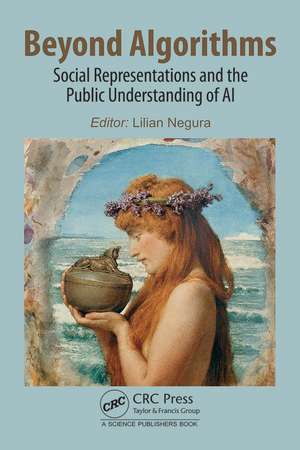
Beyond Algorithms: Social Representations and the Public Understanding of AI
Editat de Lilian Neguraen Limba Engleză Hardback – 29 sep 2026
Preț: 934.95 lei
Preț vechi: 1140.18 lei
-18% Nou
Puncte Express: 1402
Carte tipărită la comandă
Livrare economică 01-15 decembrie
Livrare prin curier în România Termenul estimat este afișat lângă disponibilitate.
Transport gratuit pentru acest produs Plată online sau ramburs, în funcție de opțiunile comenzii.
Retur gratuit în 14 zile Comandă securizată și suport în română.
Specificații
ISBN-13: 9781032804118
ISBN-10: 1032804114
Pagini: 312
Ilustrații: 66
Dimensiuni: 156 x 234 mm
Greutate: 0.74 kg
Ediția:1
Editura: CRC Press
Colecția CRC Press
ISBN-10: 1032804114
Pagini: 312
Ilustrații: 66
Dimensiuni: 156 x 234 mm
Greutate: 0.74 kg
Ediția:1
Editura: CRC Press
Colecția CRC Press
Public țintă
AcademicCuprins
Foreword—Social Representation Theory, Artificial Intelligence and Common Sense. Preface. Introduction: Representing and Represented by AI. REPRESENTING AI—NARRATIVES, MEDIA, AND SOCIETY. Cultural and Historical Dimensions of AI. AI in Utopian and Science Fiction Literature: From Fictional Accounts to Common Sense. AI in Society and Media. Artificial Intelligence in the Public Eye: The Social Construction of AI as a Problem in the National English‑Language Canadian Newspapers. From AlphaGo to ChatGPT—Mobilising Public Salience and Awareness of AI in the UK and South Korea, 2000–2023. The Political Impact of AI Social Representations. Work and Education Transformation. Artificial Intelligence and World of Work: Social Representations of AI in the Context of Job Displacement and Transformations. Navigating the Future With AI: Sociotechnical Imaginaries and Social Representations in the Work of AI Developers. Social Representation of GenAI (Generative Artificial Intelligence) and ChatGPT in Educational Policy Discourse and Among Teachers. Health, Law and Ethics of AI. Between Copy and Distortion: Social Representations of Synthetic Data and Digital Twins in the Shifting Epistemic Landscape of Primary Care Research. Ethics and Governance in AI Integration for Law Enforcement: Societal Aspects and Public Perceptions. REPRESENTED BY AI—CONTENT GENERATION AND SOCIAL EFFECTS. Epistemics & Simulation: AI as a Quasi-Agent. Social Representations and Communication in the Era of Artificial Intelligence: Machine Learning as Subject, Other or Object of the Semiotic Triangle or Crossing All? Real World Knowledge in Social Representations and Artificial Intelligence. Cultural Production, Bias & Justice. “Tell Me a Story About Yourself” Social Representations of Artificial Intelligence Through AI-Generated Comics. Reproducing Hierarchies: AI and the Social Representation of Intelligence. Conclusion—AI at the Crossroads of Representation: Object, Agent, and Social Imaginary. Index.
Notă biografică
Lilian Negura is a Professor at the Faculty of Social Sciences at the University of Ottawa, Canada. His research focuses on Social Representations Theory, the social construction of public problems, and the role of knowledge and power in shaping social realities. He has published extensively on topics such as artificial intelligence, addiction, health, and social inequalities. His work combines theoretical development with empirical research aimed at understanding contemporary social transformations.
Descriere
This book explores how artificial intelligence is understood, debated, and socially constructed across different social, cultural, and institutional contexts. This volume examines the meanings, hopes, fears, and controversies associated with AI in domains such as education, health, work, ethics, communication, and public policy.