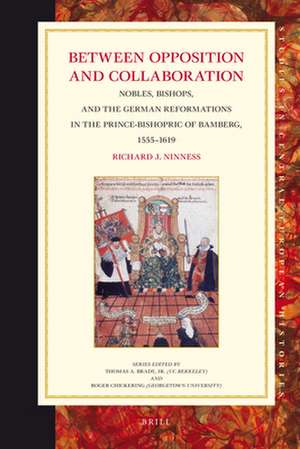
Between Opposition and Collaboration
Autor Richard Ninnessen Limba Engleză Hardback – 9 sep 2011
Preț: 913.29 lei
Preț vechi: 1186.09 lei
-23%
Puncte Express: 1370
Preț estimativ în valută:
161.66€ • 188.87$ • 140.30£
161.66€ • 188.87$ • 140.30£
Carte tipărită la comandă
Livrare economică 25 februarie-11 martie
Preluare comenzi: 021 569.72.76
Specificații
ISBN-13: 9789004201545
ISBN-10: 9004201548
Pagini: 240
Dimensiuni: 165 x 244 x 18 mm
Greutate: 0.54 kg
Editura: de Gruyter Brill
ISBN-10: 9004201548
Pagini: 240
Dimensiuni: 165 x 244 x 18 mm
Greutate: 0.54 kg
Editura: de Gruyter Brill
V-ar putea interesa
-
 -19%Preț: 440.55 lei547.23 lei
 -
 -14%Preț: 778.17 lei904.85 lei
 -
 David Hume: A Treatise of Human Nature: Volume 2: Editorial MaterialDavid Fate Norton-11%Preț: 336.54 lei377.04 lei
 -
 Cultures of Plague: Medical thinking at the end of the RenaissanceJr. Samuel K. Cohn-12%Preț: 369.19 lei419.34 lei
 -
 The German Myth of the East: 1800 to the PresentVejas Gabriel Liulevicius-13%Preț: 330.72 lei381.90 lei
 -
 -15%Preț: 674.30 lei793.29 lei
 -
 The Resurrection of the RomanovsGreg KingPreț: 235.30 lei
 -
 Guilds, Innovation and the European Economy, 1400–1800S. R. EpsteinPreț: 388.74 lei
 -
 Preț: 364.31 lei
 -
 Preț: 298.76 lei
 -
 Down Down Deeper and Down: Ireland in the 70s and 80sEAMONN SWEENEYPreț: 101.13 lei
 -
 Preț: 128.74 lei
 -
 -9%Preț: 1348.74 lei1482.13 lei
 -
 -34%Preț: 62.83 lei94.64 lei
Notă biografică
Richard J. Ninness, Ph.D. (2006) in History, University of Pennsylvania, is Assistant Professor at Touro College in New York City.
Recenzii
"To Ninness’s credit, he has discovered that noble, familial alliances were the true authorities of this prince-bishopric. [...] Ninness reminds us that this is a fascinating and complex moment in early modern German history, one that is well served by this fine study." – Erica Bastress-Dukeheart, in: H-HRE, H-Net Reviews, May 2013
"This study, which looks at the role of the imperial knights in the governance and politics of the prince-bishopric of Bamberg in the late sixteenth century, advances our understanding of how the imperial church in particular, and the Empire more generally, responded to the challenges posed by the Reformation." – Marc R. Forster, in: German Studies Review'(GSR) 36/1 (February 2013), 167-170
"This interesting story is told in an able analysis based on solid archival research." – R. Po-chia Hsia, Pennsylvania State University, in: The Journal of Ecclesiastical History 63/4 (October 2012), pp. 820-821
"[H]istorical realities revealed by Ninness’s careful study of the prince-bishopric of Bamberg. Hopefully it will inspire historians to take up a similar approach for other areas of the Empire." – C. Scott Dixon, in: The Catholic Historical Review 98/3 (July 2012)
"This study, which looks at the role of the imperial knights in the governance and politics of the prince-bishopric of Bamberg in the late sixteenth century, advances our understanding of how the imperial church in particular, and the Empire more generally, responded to the challenges posed by the Reformation." – Marc R. Forster, in: German Studies Review'(GSR) 36/1 (February 2013), 167-170
"This interesting story is told in an able analysis based on solid archival research." – R. Po-chia Hsia, Pennsylvania State University, in: The Journal of Ecclesiastical History 63/4 (October 2012), pp. 820-821
"[H]istorical realities revealed by Ninness’s careful study of the prince-bishopric of Bamberg. Hopefully it will inspire historians to take up a similar approach for other areas of the Empire." – C. Scott Dixon, in: The Catholic Historical Review 98/3 (July 2012)
Cuprins
Abbreviations
Introduction
1 Lay of the Land
2 The Protestant Reformation and Aristocratic Control of Bamberg
3 The Aristocratic Church and Resistance to Reform
4 Protestant Officials as Agents of the Counter-Reformation
5 The Counter-Reformation and the Alienation of the Imperial Knights, 1594–1599
6 Confession and the Limits of Cooperation
Conclusion The Prince-Bishopric of Bamberg and the Imperial Knights
Bibliography
Index
Introduction
1 Lay of the Land
2 The Protestant Reformation and Aristocratic Control of Bamberg
3 The Aristocratic Church and Resistance to Reform
4 Protestant Officials as Agents of the Counter-Reformation
5 The Counter-Reformation and the Alienation of the Imperial Knights, 1594–1599
6 Confession and the Limits of Cooperation
Conclusion The Prince-Bishopric of Bamberg and the Imperial Knights
Bibliography
Index