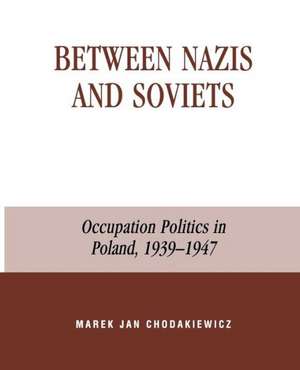
Between Nazis and Soviets: Occupation Politics in Poland, 1939-1947: Lexington Books
Autor Marek Jan Chodakiewiczen Limba Engleză Hardback – 9 iun 2004
Din seria Lexington Books
- 32%
 Preț: 729.63 lei
 - 59%
 Preț: 427.24 lei
 - 35%
 Preț: 574.44 lei
 - 22%
 Preț: 341.76 lei
 - 31%
 Preț: 437.25 lei
 - 28%
 Preț: 352.50 lei
 - 23%
 Preț: 321.53 lei
 - 23%
 Preț: 333.36 lei
 - 23%
 Preț: 327.54 lei
 - 35%
 Preț: 593.04 lei
 - 33%
 Preț: 358.06 lei
 - 26%
 Preț: 363.28 lei
 - 25%
 Preț: 362.03 lei
 - 22%
 Preț: 330.56 lei
 - 28%
 Preț: 346.74 lei
 - 24%
 Preț: 308.07 lei
 - 23%
 Preț: 321.63 lei
 - 27%
 Preț: 263.04 lei
 - 24%
 Preț: 369.89 lei
 - 25%
 Preț: 884.44 lei
 - 36%
 Preț: 730.77 lei
 - 29%
 Preț: 345.71 lei
 - 34%
 Preț: 537.45 lei
 - 33%
 Preț: 428.79 lei
 - 34%
 Preț: 616.07 lei
 - 29%
 Preț: 342.12 lei
 - 26%
 Preț: 362.85 lei
 - 22%
 Preț: 338.89 lei
 - 28%
 Preț: 356.18 lei
 - 23%
 Preț: 321.63 lei
 - 28%
 Preț: 346.74 lei
 - 22%
 Preț: 340.40 lei
 - 29%
 Preț: 345.71 lei
 - 23%
 Preț: 318.96 lei
 - 37%
 Preț: 660.07 lei
 - 27%
 Preț: 355.41 lei
 - 32%
 Preț: 727.58 lei
 - 24%
 Preț: 313.51 lei
 - 28%
 Preț: 614.62 lei
 - 24%
 Preț: 309.62 lei
 - 34%
 Preț: 630.22 lei
 - 34%
 Preț: 575.26 lei
 - 34%
 Preț: 607.70 lei
 - 33%
 Preț: 639.19 lei
 - 33%
 Preț: 642.37 lei
 - 33%
 Preț: 640.95 lei
 - 25%
 Preț: 369.74 lei
Preț: 843.89 lei
Preț vechi: 1269.06 lei
-34%
Puncte Express: 1266
Carte tipărită la comandă
Livrare economică 30 noiembrie-14 decembrie
Livrare prin curier în România Termenul estimat este afișat lângă disponibilitate.
Transport gratuit pentru acest produs Plată online sau ramburs, în funcție de opțiunile comenzii.
Retur gratuit în 14 zile Comandă securizată și suport în română.
Specificații
ISBN-13: 9780739104842
ISBN-10: 0739104845
Pagini: 512
Dimensiuni: 163 x 239 x 42 mm
Greutate: 0.88 kg
Ediția:New.
Editura: Bloomsbury Publishing
Colecția Lexington Books
Seria Lexington Books
Locul publicării:New York, United States
ISBN-10: 0739104845
Pagini: 512
Dimensiuni: 163 x 239 x 42 mm
Greutate: 0.88 kg
Ediția:New.
Editura: Bloomsbury Publishing
Colecția Lexington Books
Seria Lexington Books
Locul publicării:New York, United States
Cuprins
Chapter 1 Introduction
Chapter 2 On the Eve, 1914-39
Chapter 3 The Local Elite and the German Authorities, 1939-44
Chapter 4 The Polish Majority under Nazi Rule, 1939-44
Chapter 5 Ethnic Minorities under Nazi Rule, 1939-44
Chapter 6 The Independentists and their Enemies, 1939-47
Chapter 7 The Local Elite under Soviet Occupation, 1944-47
Chapter 8 The Polish Majority under Soviet Occupation, 1944-47
Chapter 9 Ethnic Minorities under Soviet Occupation, 1944-47
Chapter 10 Accomodation and Resistance
Chapter 11 Maps
Chapter 12 Tables
Chapter 2 On the Eve, 1914-39
Chapter 3 The Local Elite and the German Authorities, 1939-44
Chapter 4 The Polish Majority under Nazi Rule, 1939-44
Chapter 5 Ethnic Minorities under Nazi Rule, 1939-44
Chapter 6 The Independentists and their Enemies, 1939-47
Chapter 7 The Local Elite under Soviet Occupation, 1944-47
Chapter 8 The Polish Majority under Soviet Occupation, 1944-47
Chapter 9 Ethnic Minorities under Soviet Occupation, 1944-47
Chapter 10 Accomodation and Resistance
Chapter 11 Maps
Chapter 12 Tables
Recenzii
Recommended.
Research on occupation policies during the Second World War era falls into three main subcategories. The most fully examined era concentrates on German wartime aggression and attempts to explain the impact of Nazi ethnic, racial, and resettlement policieson the indigenous (captured) populations of Eastern Europe. Another thoroughly mined genre tackles occupation from the viewpoint of the occupied, by focusing on the heroism of the resistance and the misdeeds of the collaborators. The postwar era comprises yet another subgroup, and helps explain how victorious Allies rebuilt the institutions of the vanquished nations. Marek Jan Chodakiewicz's volume, Between Nazi's and Soviets, transcends these categories by attempting to treat the Nazi and Soviet administrations of Poland as different manifestations of a single occupation experience. This novel approach not only sheds new light on an important period in Polish history, it also leads scholars to consider more generalized conclusions about the natureof occupation as a distinct historical phenomenon. The result is an intriguing look at the entirety of Poland's seven years as an occupied nation, one that informs us as much about the tactics and motivations of the occupied as about the goals and strate
Holocaust education in western societies has favored the minimizing of the Polish agony during WWII, and has spawned a large body of misconceptions regarding Polish-Jewish relationships during this tragic time. This profusely-documented work goes a long way towards clarifying these issues.
Research on occupation policies during the Second World War era falls into three main subcategories. The most fully examined era concentrates on German wartime aggression and attempts to explain the impact of Nazi ethnic, racial, and resettlement policies on the indigenous (captured) populations of Eastern Europe. Another thoroughly mined genre tackles occupation from the viewpoint of the occupied, by focusing on the heroism of the resistance and the misdeeds of the collaborators. The postwar era comprises yet another subgroup, and helps explain how victorious Allies rebuilt the institutions of the vanquished nations. Marek Jan Chodakiewicz's volume, Between Nazi's and Soviets, transcends these categories by attempting to treat the Nazi and Soviet administrations of Poland as different manifestations of a single occupation experience. This novel approach not only sheds new light on an important period in Polish history, it also leads scholars to consider more generalized conclusions about the nature of occupation as a distinct historical phenomenon. The result is an intriguing look at the entirety of Poland's seven years as an occupied nation, one that informs us as much about the tactics and motivations of the occupied as about the goals and strategies of the occupiers.. Chodakiewicz's exhaustive research in the primary and secondary source is admirable. If for no other reason, this book would be a valuable contribution to scholarship simply by bringing the vast amount of information available in Polish to an English-reading audience. Over 100 pages of notes join 160 pages of maps and statistical appendices. This book is an undeniably valuable glimpse into the local manifestations of occupation in Poland.
Research on occupation policies during the Second World War era falls into three main subcategories. The most fully examined era concentrates on German wartime aggression and attempts to explain the impact of Nazi ethnic, racial, and resettlement policieson the indigenous (captured) populations of Eastern Europe. Another thoroughly mined genre tackles occupation from the viewpoint of the occupied, by focusing on the heroism of the resistance and the misdeeds of the collaborators. The postwar era comprises yet another subgroup, and helps explain how victorious Allies rebuilt the institutions of the vanquished nations. Marek Jan Chodakiewicz's volume, Between Nazi's and Soviets, transcends these categories by attempting to treat the Nazi and Soviet administrations of Poland as different manifestations of a single occupation experience. This novel approach not only sheds new light on an important period in Polish history, it also leads scholars to consider more generalized conclusions about the natureof occupation as a distinct historical phenomenon. The result is an intriguing look at the entirety of Poland's seven years as an occupied nation, one that informs us as much about the tactics and motivations of the occupied as about the goals and strate
Holocaust education in western societies has favored the minimizing of the Polish agony during WWII, and has spawned a large body of misconceptions regarding Polish-Jewish relationships during this tragic time. This profusely-documented work goes a long way towards clarifying these issues.
Research on occupation policies during the Second World War era falls into three main subcategories. The most fully examined era concentrates on German wartime aggression and attempts to explain the impact of Nazi ethnic, racial, and resettlement policies on the indigenous (captured) populations of Eastern Europe. Another thoroughly mined genre tackles occupation from the viewpoint of the occupied, by focusing on the heroism of the resistance and the misdeeds of the collaborators. The postwar era comprises yet another subgroup, and helps explain how victorious Allies rebuilt the institutions of the vanquished nations. Marek Jan Chodakiewicz's volume, Between Nazi's and Soviets, transcends these categories by attempting to treat the Nazi and Soviet administrations of Poland as different manifestations of a single occupation experience. This novel approach not only sheds new light on an important period in Polish history, it also leads scholars to consider more generalized conclusions about the nature of occupation as a distinct historical phenomenon. The result is an intriguing look at the entirety of Poland's seven years as an occupied nation, one that informs us as much about the tactics and motivations of the occupied as about the goals and strategies of the occupiers.. Chodakiewicz's exhaustive research in the primary and secondary source is admirable. If for no other reason, this book would be a valuable contribution to scholarship simply by bringing the vast amount of information available in Polish to an English-reading audience. Over 100 pages of notes join 160 pages of maps and statistical appendices. This book is an undeniably valuable glimpse into the local manifestations of occupation in Poland.