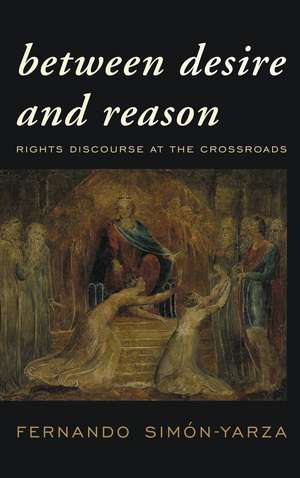
Between Desire and Reason: Rights Discourse at the Crossroads
Autor Fernando Simón-Yarzaen Limba Engleză Hardback – 6 noi 2019
| Toate formatele și edițiile | Preț | Express |
|---|---|---|
| Paperback (1) | 209.46 lei 6-8 săpt. | |
| Bloomsbury Publishing – 18 aug 2022 | 209.46 lei 6-8 săpt. | |
| Hardback (1) | 690.92 lei 6-8 săpt. | |
| Bloomsbury Publishing – 6 noi 2019 | 690.92 lei 6-8 săpt. |
Preț: 690.92 lei
Preț vechi: 998.46 lei
-31%
Puncte Express: 1036
Preț estimativ în valută:
122.36€ • 142.90$ • 106.29£
122.36€ • 142.90$ • 106.29£
Carte tipărită la comandă
Livrare economică 21 februarie-07 martie
Preluare comenzi: 021 569.72.76
Specificații
ISBN-13: 9781786614407
ISBN-10: 1786614405
Pagini: 240
Ilustrații: 1 graphs;
Dimensiuni: 160 x 232 x 20 mm
Greutate: 0.46 kg
Editura: Bloomsbury Publishing
Colecția Rowman & Littlefield Publishers
Locul publicării:New York, United States
ISBN-10: 1786614405
Pagini: 240
Ilustrații: 1 graphs;
Dimensiuni: 160 x 232 x 20 mm
Greutate: 0.46 kg
Editura: Bloomsbury Publishing
Colecția Rowman & Littlefield Publishers
Locul publicării:New York, United States
Cuprins
Preface: A possible framework for understanding / Part I: Good and reason in two classical political traditions / 1. The Aristotelian-Thomistic tradition / 2. Immanuel Kant / Part II: Antiperfectionist liberalism and the desire principle / 3. "Free and equals": John Rawls's political philosophy / 4. "Equal concern and respect": Ronald Dworkin's philosophy of rights / 5. Goods and processes: Jürgen Habermas's ethical-political project / Part III: The dehumanization of human rights / 6. Mutual disinterest and civil liberties / 7. Desireless life and undesirable life / 8. Playing God? Promethean desires / Part IV. Constructive proposals / 9. Teleology of civil liberties / 10. Perfectionist liberalism and restriction of the rights discourse / Bibliography
Recenzii
Between Desire and Reason is a very important and original contribution to what might be best called the 'natural-law civil liberties' project, inaugurated in effect by John Finnis' Natural Law and Natural Rights in 1980, and probably best exemplified by Robert P. George's 1993 Making Men Moral. Simón's book is, in my judgment, the best book-length full-orbed treatment of contemporary problems in constitutional theory from this basic perspective since George's magisterial text of 1993. The incorporation of key European court decision distinguishes it (in a welcome way) from even the best of the Anglo works of its kind.
This is an unfailingly clear and fair-minded, as well as deep and novel, critique of modern liberalism. The quality of Simón's scholarship is high: I have learned a great deal from the book about both the classical tradition, and about the theories of Rawls, Dworkin, Singer, and Habermas. Simón's objections to the modern liberal theories, grounded in a frankly teleological conception of human nature and in the work of Robert Spaemann, pose a challenge that is not easily set aside, demonstrating that they all rely on a paradoxically 'ateleological teleology.'
This book challenges the doctrine of contemporary liberalism as grounded in the contingent desires of human beings. Simón Yarza strongly defends a conception of human intentions and actions explained under the guise of the good. His account is provocative and controversial, but it compels us to reconsider the scope of the idea of the priority of the right over the good.
Taking up the torch from some of the most influential political thinkers of our time, this book insightfully shows that reducing rights to bare desires is neither accidental nor for free. It stems from deeper disbelieve in the objective distinction between right and wrong, and it logically leads to deny the universality of human rights. It is thus an unavoidable source of inquiry for students and researchers concerned with understanding the roots of the increasing loss of legitimacy of the discourse of rights, and with finding a way back from skepticism.
This is an unfailingly clear and fair-minded, as well as deep and novel, critique of modern liberalism. The quality of Simón's scholarship is high: I have learned a great deal from the book about both the classical tradition, and about the theories of Rawls, Dworkin, Singer, and Habermas. Simón's objections to the modern liberal theories, grounded in a frankly teleological conception of human nature and in the work of Robert Spaemann, pose a challenge that is not easily set aside, demonstrating that they all rely on a paradoxically 'ateleological teleology.'
This book challenges the doctrine of contemporary liberalism as grounded in the contingent desires of human beings. Simón Yarza strongly defends a conception of human intentions and actions explained under the guise of the good. His account is provocative and controversial, but it compels us to reconsider the scope of the idea of the priority of the right over the good.
Taking up the torch from some of the most influential political thinkers of our time, this book insightfully shows that reducing rights to bare desires is neither accidental nor for free. It stems from deeper disbelieve in the objective distinction between right and wrong, and it logically leads to deny the universality of human rights. It is thus an unavoidable source of inquiry for students and researchers concerned with understanding the roots of the increasing loss of legitimacy of the discourse of rights, and with finding a way back from skepticism.