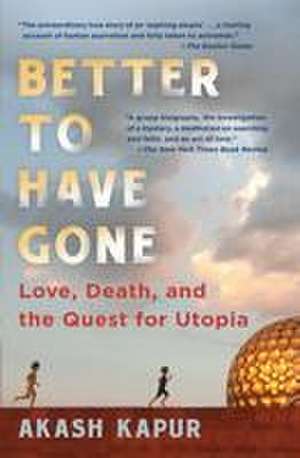
Better to Have Gone
Autor Akash Kapuren Limba Engleză Paperback – 12 iul 2022
Relația dintre Akash Kapur și subiectul volumului Better To Have Gone nu este una de simplă observație jurnalistică, ci una profund viscerală. Kapur nu scrie doar despre o comunitate utopică îndepărtată, ci despre propria sa istorie și despre tragedia care a marcat familia soției sale, Auralice. Considerăm că forța acestui text rezidă tocmai în această dublă perspectivă: cea a cercetătorului format la Oxford și cea a copilului care a crescut în „orașul zorilor”, Auroville, fără a înțelege pe deplin umbrele care îi înconjurau pe adulți. Găsim în această carte o reconstrucție meticuloasă a anilor '60, când John Walker, un american dintr-o familie influentă, și Diane Maes, o tânără din Belgia, au abandonat convențiile occidentale pentru un petic de pământ arid în sudul Indiei. Premisa este una tulburătoare: cum au ajuns acești idealiști să moară în aceeași zi, două decenii mai târziu, pe podeaua unei colibe de trestie? Merită menționat că autorul evită senzaționalismul, alegând în schimb o proză dăltuită, care analizează cum aspirațiile colective pot strivi destine individuale. În aceeași familie cu The Utopians de A. Neima, volumul adaugă o dimensiune personală și intimă, transformând analiza istorică a „visării sociale” într-o elegie despre pierdere și memorie. Dacă în lucrarea sa anterioară, India Becoming, Kapur examina transformările macroeconomice și sociale ale Indiei moderne, aici el se apleacă asupra micro-universului din Auroville, păstrând aceeași rigoare antropologică, dar infuzând-o cu o vulnerabilitate nouă. Este o explorare a modului în care credința totală într-o idee poate deveni, paradoxal, o formă de izolare.
Preț: 100.12 lei
Carte tipărită la comandă
Livrare economică 12-26 septembrie
Specificații
ISBN-10: 1501132520
Pagini: 384
Dimensiuni: 137 x 211 x 25 mm
Greutate: 0.32 kg
Editura: Scribner
V-ar putea interesa
-
 No Country for Love: Heartbreaking and compelling World War 2 fictionYaroslav Trofimov-25%Preț: 53.97 lei72.07 lei
 -
 Rustad, H: Lost in the Valley of DeathHarley RustadPreț: 169.43 lei
 -
 A Person is a PrayerAmmar Kalia-22%Preț: 59.34 lei76.27 lei
 -
 Preț: 159.61 lei
 -
 Gold Diggers: 'Magical and entirely original' —ShondalandSanjena SathianPreț: 64.56 lei
 -
 The AnthropologistsAysegül Savas-5%Preț: 66.52 lei70.13 lei
 -
 -20%Preț: 85.71 lei106.89 lei
 -
 -20%Preț: 85.33 lei106.09 leiRecomandat
 -
 The Days I Loved You MostAmy Neff-26%Preț: 47.70 lei64.48 lei
 -
 The UtopiansAnna Neima-43%Preț: 52.01 lei92.04 lei
 -
 Everyday UtopiaKristen Ghodsee-19%Preț: 63.98 lei78.68 lei
 -
 Happiness and LoveZoe DubnoPreț: 121.05 lei
 -
 Your UtopiaBora ChungPreț: 99.77 lei
 -
 The Life ExperimentJess Kitching-19%Preț: 75.30 lei92.67 leiRecomandat
 -
 Half LightMahesh RaoPreț: 134.70 lei
 -
 What Will People Think?Vedashree Khambete-SharmaPreț: 71.63 lei
 -
 A Better WorldSarah Langan-18%Preț: 59.52 lei72.41 lei
 -
 Behind the Beautiful ForeversKatherine BooPreț: 77.74 lei
 -
 Utopia Realized: In Search of A Just SocietyKurt WarnerPreț: 99.94 lei
 -
 Lost in the Valley of DeathHarley RustadPreț: 35.51 lei
De ce să citești această carte
Recomandăm această carte celor care vor să înțeleagă ce se întâmplă atunci când idealismul întâlnește realitatea brutală. Cititorul va câștiga o perspectivă unică asupra experimentului Auroville, văzut nu din exterior, ci prin ochii cuiva care a trăit acolo. Este o lectură esențială pentru pasionații de memorii și sociologie, oferind o meditație profundă despre prețul pe care îl plătim pentru dorința de a clădi un paradis terestru.
Despre autor
Akash Kapur este un scriitor și cercetător distins, cunoscut pentru analizele sale pătrunzătoare asupra Indiei contemporane. A fost titularul rubricii „Letter from India” pentru International Herald Tribune și a contribuit constant la publicații de prestigiu precum The New Yorker, The Atlantic și The New York Times Book Review. Cu o licență în antropologie socială la Harvard și un doctorat în drept la Oxford, unde a fost bursier Rhodes, Kapur îmbină rigoarea academică cu sensibilitatea literară. Experiența sa personală în Auroville și cariera de consultant pentru organizații internaționale îi oferă o autoritate rară în explorarea temelor legate de dezvoltare, cultură și utopie.
Descriere scurtă
A "haunting and elegant" (The Wall Street Journal) story about love, faith, the search for utopia?and the often devastating cost of idealism.
It's the late 1960s, and two lovers converge on an arid patch of earth in South India. John Walker is the handsome scion of a powerful East Coast American family. Diane Maes is a beautiful hippie from Belgium. They have come to build a new world?Auroville, an international utopian community for thousands of people. Their faith is strong, the future bright.
So how do John and Diane end up dying two decades later, on the same day, on a cracked concrete floor in a thatch hut by a remote canyon? This is the mystery Akash Kapur sets out to solve in Better to Have Gone, and it carries deep personal resonance: Diane and John were the parents of Akash's wife, Auralice. Akash and Auralice grew up in Auroville; like the rest of their community, they never really understood those deaths.
In 2004, Akash and Auralice return to Auroville from New York, where they have been living with John's family. As they reestablish themselves in the community, along with their two sons, they must confront the ghosts of those distant deaths. Slowly, they come to understand how the tragic individual fates of John and Diane intersected with the collective history of their town.
"A riveting account of human aspiration and folly taken to extremes" (The Boston Globe), Better to Have Gone probes the underexplored yet universal idea of utopia and portrays in vivid detail the daily life of one such community. Richly atmospheric and filled with remarkable characters, spread across time and continents, this is narrative writing of the highest order?a "gripping…compelling…[and] heartbreaking story, deeply researched and lucidly told" (The New York Times Book Review).
Recenzii
'Akash Kapur’s Better to Have Gone is a troubling and moving account of lives gone wrong in the search for an eastern Utopia.'
'This beautifully written account ... is fascinating in describing the efforts of people...to carve out a sustainable community in such a forbidding environment. But it becomes more fascinating still when it begins to explore the contradictions between idealism and real life.'
'A haunting, heartbreaking story, deeply researched and lucidly told, with an almost painful emotional honesty... I kept wanting to read Better to Have Gone because I found it so gripping; I kept wanting not to read it because I found it so upsetting. Better to Have Gone ends with an unexpected lightness, even transcendence, as Kapur helps us see what Auroville has given him, gives him still, despite the pain.'
'Using the framework of a personal historical quest, Akash Kapur gives us a gripping morality tale, phosphorescent and unsettling, of the cruelty that accompanies utopia.'
'Haunting and elegant... The beauty of Mr Kapur’s story lies in our conviction, by the end, that he and his wife have found most of the answers they were looking for.'
'Akash Kapur has written a trenchant, nuanced account of the longing for a perfect world. Working from personal experience and a writer’s profound curiosity, he takes us deep into the heart of an intentional community’s ambitions and failures. This is an important work about the eternal human desire for utopia, and about the dystopia that always lurks within these dreams.'
'Haunting...a harrowing quest to understand the blinkered idealism that led to [his parents-in-law's] deaths, on the same day, in 1986'
'In this compulsively readable account, Akash Kapur ... unravels a mystery whose players are yogis and hippies, Tamil villagers and a disaffected son of the American elite. Kapur’s great achievement is to narrate a personal tragedy with such generosity and insight that it becomes a love story - one that doesn’t shy from the passionate idealism or devastating failures of sixties utopianism.'
'Kapur weaves together memoir, history and ethnography to tell a story of the desire for utopia and the cruelties committed in its name… told with a native son’s fondness, fury, stubborn loyalty, exasperated amusement… the story is suspensefully structured, and I consumed it with a febrile intensity… It is a complicated offering, this book, and the artefact of a great love.'
'Kapur's account of the trajectories of his main characters is gripping... [he] has a fine understanding of the fundamentally flawed, even cankered, nature of any utopia. The author's cool, clean style, and his admirable refusal to judge any of his characters' words and actions...give the book a quiet cumulative power.'
'Better to Have Gone tells the extraordinary true story of an "aspiring utopia" named Auroville, "The City of Dawn", established near Pondicherry in southeast India in 1968. A riveting account of human aspiration and folly taken to extremes.'
'A riveting memoir of a search for utopia… Kapur is a terrific storyteller…his writing compels you to follow him as he digs deeper.'
'An enthralling and sometimes shocking account of the birth and uneasy growth of Auroville, a utopian village in south India. The author and his wife both grew up in Auroville and were surrounded by idealism and tragedy but, perhaps surprisingly, were drawn back there after spending some years in the orthodox world. It should win an award: a gripping tale.'
'This gripping, magical, deeply moving book is a story of stubborn, self-sacrificing idealism - both its beauty and its cost. Akash Kapur set out to understand the visionary lives and terrible deaths of his wife’s parents in Auroville, the South Indian utopian community where he and she grew up... It is exhilarating to read about a place and time where utopia seemed not just possible but close.'
'An enlightening look at how a well-meaning utopian community in India became complicated by reality. In a propulsive narrative, [Kapur] chronicles the story of John Walker and Diane Maes, the parents of his wife, Auralice, who left their homes in the waning days of the hippie movement for South India’s idealistic “planned city” Auroville... Expect the unexpected in this riveting story.'
'A forensic reconstruction of two deaths set against the background of the flawed tropical utopia of Auroville. It is beautifully written and structured, deeply moving, and realised in wise, thoughtful, chiselled prose.'
'This haunting memoir, by a man who grew up in an intentional community in India and returned to live there with his wife and children, is a sensitive excavation of fraught family history as well as a philosophical meditation on the utopian impulse.'
'The moving history of a quest for enlightenment and how idealistic dreams came crashing down to earth.'
'Spellbinding and otherworldly, Better to Have Gone is an exquisite literary achievement. With graceful, luminous prose, Akash Kapur's intimate account of utopian Auroville is entrancing, devastating and unforgettable. Above all, this book is a hauntingly beautiful love story, composed by a writer in full command of his craft.'
'Written with insight and compassion, Better to Have Gone takes us on the journey of the author and his wife as they seek to reconstruct the events that brought them together as children and then shaped their lives as adults. At the same time, the book also explores the rivalries and tensions that defined Auroville's early years and what it means to try to create a utopian environment.'
Descriere
A transfixing masterwork that probes an unsolved family mystery and portrays a utopian community striving to create a better world.