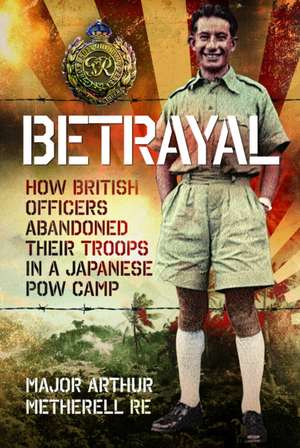
Betrayal
Autor Maj Arthur Metherell RE Rtden Limba Engleză Hardback – 30 noi 2026
Arthur Metherell was born in London in 1914. He left school at 14, and two scholarships taught him cabinet making. On graduation, he secured a position designing furniture for the fledgling British film industry. But he fell out with his boss - who had been taking credit for Arthur's work. At a loose end at the height of the depression era, Arthur was recruited into the Devonshire Regiment - a move that pleased his dad as both he and his own father had been regular soldiers in the Royal Artillery. Arthur transferred to the Royal Engineers and in 1938 - shortly after he met a young nurse - he was posted to Singapore. There he enjoyed all the advantages of a young NCO in a tropical posting in the British Empire: a relaxed work environment; opportunities for recreation; and the prospect of soon returning to the UK. The outbreak of war put an end to that third advantage, although until the invasion of Malaya, military life in Singapore was minimally affected by the war. That ended in February 1942 with the garrison surrender to the Japanese.
At first the PoWs were incarcerated in the military complex at Changi, where Arthur had been stationed. Conditions were rough, so when the Japanese started to move prisoners out of Singapore, some felt that conditions couldn't be any worse. How wrong they were. Starting with the overcrowded "hell ship" that transported them to Korea and ending up in the forsaken wilds of Manchuria. Arthur's memoir vividly captures the deprivations of PoW life and the despair of constantly being told they would never see home again. The NCOs and other ranks were marched to a factory daily to do manual work, but the officers invoked the Geneva Conventions that relieved them of such indignities. Furthermore, the officers adopted an attitude that permitted them to take for themselves what few privileges there were - the men under their command be damned. What was there to live for? Red parachutes drifting from a low-flying American aircraft when liberation was at hand after the dropping of the atomic bombs. On repatriation, his nurse was waiting for Arthur despite 71/2 years of separation. They were married 10 days after the troopship docked in Southampton.
Arthur re-enlisted and he and his new bride were posted to West Africa - where they and other survivors of the war determined to make the most of life. Postings to Germany and a return to Singapore - much changed from its pre-war opulence - along with an officer's commission saw out Arthur's military career. It was followed by a stint as a civil engineer at Southampton docks until a retirement hastened by ill health that he attributed to medical issues suffered as a PoW.
Preț: 225.11 lei
Precomandă
Puncte Express: 338
Carte nepublicată încă
Livrare prin curier în România Precomanda se expediază când titlul devine disponibil.
Transport gratuit de la 400.00 lei Plată online sau ramburs, în funcție de opțiunile comenzii.
Retur gratuit în 14 zile Comandă securizată și suport în română.
Doresc să fiu notificat când acest titlu va fi disponibil:
Se trimite...
Specificații
ISBN-13: 9781036142421
ISBN-10: 1036142426
Pagini: 224
Dimensiuni: 156 x 234 mm
Editura: Pen & Sword Books Ltd
ISBN-10: 1036142426
Pagini: 224
Dimensiuni: 156 x 234 mm
Editura: Pen & Sword Books Ltd
Notă biografică
Through most of his life, Arthur didn't talk much about his PoW experience. He attended a number of FEPOW reunions, but it was obvious that he had no real affection for those he met there - particularly the officers. [He had no real antagonism against Japanese people - his favourite car was a Honda at a time when some who had fought in WWII wouldn't touch German or Japanese products.] Toward the end of his life, however, he did start to unburden himself of some of his memories. His son John - then a producer of television documentaries living in the United States - persuaded him to record his recollections. He said that he wanted it to be known that his experience as a PoW was not the stiff upper lip of The Bridge on the River Kwai or The Great Escape. He wanted to go on record to tell the story of how the allied officers in the camp had abandoned their 'duty of care' for their troops as detailed in this book. Arthur also displayed amazing recall of his childhood, and this volume is the memoir of a life lived in the service of his country, told in a relatable first-person narrative.