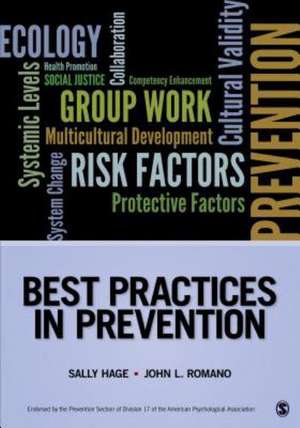
Best Practices in Prevention: Prevention Practice Kit
Editat de Sally M. Hage, John L. Romanoen Limba Engleză Electronic book text – 19 mar 2013


Preț: 166.94 lei
Preț vechi: 175.73 lei
-5%
Puncte Express: 250
Indisponibil temporar
Doresc să fiu notificat când acest titlu va fi disponibil:
Se trimite...
Specificații
ISBN-13: 9781483307626
ISBN-10: 148330762X
Pagini: 72
Dimensiuni: 178 x 254 mm
Ediția:1
Editura: SAGE Publications
Colecția Sage Publications, Inc
Seria Prevention Practice Kit
Locul publicării:Thousand Oaks, United States
ISBN-10: 148330762X
Pagini: 72
Dimensiuni: 178 x 254 mm
Ediția:1
Editura: SAGE Publications
Colecția Sage Publications, Inc
Seria Prevention Practice Kit
Locul publicării:Thousand Oaks, United States
Cuprins
Chapter
1.
Why
Practice
Prevention?
Why
now?
-
Sally
Hage,
John
Romano
Chapter 2. Four Theories and Perspectives to Support Prevention Interventions
Chapter 3. Guidelines for Prevention Practice, Research, Education, and Public Policy
Chapter 4. Research Informed Prevention Practice: Learning from the Wisdom of Science
Chapter 5. Empirically Supported Prevention Applications
Chapter 6. Ethical and Professional Issues in Prevention
Chapter 7. Applying Prevention Learning: Five Learning Exercises
Chapter 2. Four Theories and Perspectives to Support Prevention Interventions
Chapter 3. Guidelines for Prevention Practice, Research, Education, and Public Policy
Chapter 4. Research Informed Prevention Practice: Learning from the Wisdom of Science
Chapter 5. Empirically Supported Prevention Applications
Chapter 6. Ethical and Professional Issues in Prevention
Chapter 7. Applying Prevention Learning: Five Learning Exercises
Descriere
This
second
book
in
thePrevention
Practice
Kitprovides
counselors,
psychologists,
and
other
mental
health
workers
with
practical
steps
that
need
to
be
considered
by
prevention
practitioners
as
they
engage
with
others
in
developing
and
delivering
prevention
projects.
A
context
for
engaging
in
prevention
practice
is
provided,
including
discussion
of
how
prevention
fits
with
traditional
models
of
psychology,
descriptions
of
theoretical
models
for
doing
prevention
practice,
and
examples
of
empirically-supported
prevention
interventions.