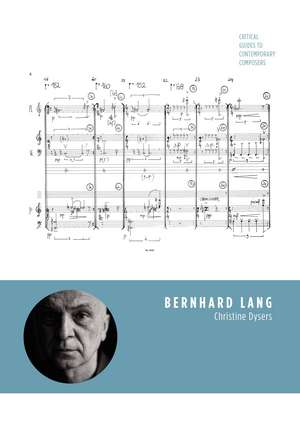
Bernhard Lang: Critical Guides to Contemporary Composers: Critical Guides to Contemporary Composers
Autor Christine Dysersen Limba Engleză Hardback – 25 apr 2023
The work of Austrian composer Bernhard Lang eludes easy categorization. While rooted simultaneously in DJ culture, free jazz, pop culture, and the Austro-European new music scene, his oeuvre explicitly foregrounds repetition. He is, in his own words, a “repeat offender.”
Bernhard Lang serves as a critical guide to the composer’s music and traces the phenomenon of repetition throughout his oeuvre. To examine Lang’s repetitive aesthetics, Christine Dysers employs various philosophical methods, such as Gilles Deleuze’s differential ontology. Fusing critical musicology, aesthetic theory, poststructuralist thought, and music analysis, Bernhard Lang brings fresh insight to the work of an award-winning contemporary composer.
Preț: 614.80 lei
Preț vechi: 798.43 lei
-23%
Puncte Express: 922
Carte disponibilă
Livrare economică 07-21 noiembrie
Livrare express 24-30 octombrie pentru 31.87 lei
Livrare prin curier în România Termenul estimat este afișat lângă disponibilitate.
Transport gratuit pentru acest produs Plată online sau ramburs, în funcție de opțiunile comenzii.
Retur gratuit în 14 zile Comandă securizată și suport în română.
Specificații
ISBN-13: 9781789387636
ISBN-10: 1789387639
Pagini: 208
Ilustrații: 42 halftones
Dimensiuni: 170 x 244 x 15 mm
Greutate: 0.48 kg
Editura: Intellect Ltd
Colecția Intellect Ltd
Seria Critical Guides to Contemporary Composers
ISBN-10: 1789387639
Pagini: 208
Ilustrații: 42 halftones
Dimensiuni: 170 x 244 x 15 mm
Greutate: 0.48 kg
Editura: Intellect Ltd
Colecția Intellect Ltd
Seria Critical Guides to Contemporary Composers
Notă biografică
Christine Dysers is a postdoctoral researcher in the Uppsala University Department of Musicology.
Cuprins
Figures
Acknowledgements
Introduction
Chapter 1: Philosophies of repetition
Discovering Deleuze
2. Circular thinking
3. Seriality and the rhizomatic oeuvre
Chapter 2: Different repetitions
The same, again
2. The paradox of repetition
3. The same, but different
4. Calculating the unforeseen
Chapter 3: Acts of repetition
Stories about repetition
2. Repetitive stories
3. Repetitive gestures
4. Repetitive scenographies
Chapter 4: Politics of repetition
It’s all about history
2. Take the power back
3. The analytic faculty
4. The limits of the intertext
Epilogue
Notes
Bibliography
Index
Acknowledgements
Introduction
Chapter 1: Philosophies of repetition
Discovering Deleuze
2. Circular thinking
3. Seriality and the rhizomatic oeuvre
Chapter 2: Different repetitions
The same, again
2. The paradox of repetition
3. The same, but different
4. Calculating the unforeseen
Chapter 3: Acts of repetition
Stories about repetition
2. Repetitive stories
3. Repetitive gestures
4. Repetitive scenographies
Chapter 4: Politics of repetition
It’s all about history
2. Take the power back
3. The analytic faculty
4. The limits of the intertext
Epilogue
Notes
Bibliography
Index
Recenzii
"Dysers explores the concept of repetition, insightfully examining Lang's use of textual quotation, and his practice of musical borrowing. She argues that while repetition is commonly treated as reiteration of a previously explored idea, this is too reductive. She treats it more as radical instability. [...] The book is indebted to music theory, psychology and post-structuralist philosophy, and Dysers has engaged in extended interviews with the composer."
"This perceptive volume offers the first sustained, book-length treatment of Bernhard Lang that manages to be at once accessible and intellectually ambitious... Dysers’s prose is an exemplar of scholarly clarity: she avoids needless obscurantism while still conducting a theoretically informed inquiry. Her interdisciplinary horizon, which crosses philosophy, theatre studies, and political aesthetics, is not artificial but functional; it helps make Lang’s music intelligible on its own terms. Equally important, the work fills a genuine gap in contemporary musicology: Lang has been comparatively overlooked in English-language scholarship, and Dysers’s volume should act as a corrective and as an invitation to further research. This book will be of value to a diverse readership: composers and performers interested in process-based composition, and musicologists who wish to expand the analytic toolbox for contemporary repertories. Dysers gives us an interpretative vocabulary that will make listening to Lang’s music richer and more exacting. The book is a model of how to write about a living composer without resorting to hagiography, and it should be required reading for anyone seeking to understand the aesthetics, philosophy, and method behind one of Europe’s most inventive contemporary composers."