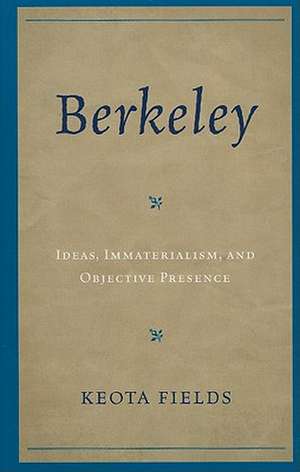
Berkeley: Ideas, Immateralism, and Objective Presence
Autor Keota Fieldsen Limba Engleză Hardback – 15 mar 2011
Early moderns routinely used the doctrine of objective presence to justify transcendental arguments for the existence of material substance. The claim was that physical qualities are necessary for any causal explanation of the content of sensory ideas; since those qualities are represented to perceivers as ontologically dependent, material substance is the necessary condition for the existence of physical qualities and a fortiori any causal explanation of the content of sensory ideas. On the reading defended here, Berkeley rejects Locke's transcendental argument for the existence of material substratum on the grounds that it turns decisively on the aforementioned category-transcendent abstract ideas, which Berkeley rejects as logically inconsistent. In its place, Berkeley offers his own transcendental argument designed to show that only minds and ideas exist. He uses that argument as a
Preț: 634.11 lei
Preț vechi: 958.94 lei
-34%
Puncte Express: 951
Carte tipărită la comandă
Livrare economică 07-21 decembrie
Livrare prin curier în România Termenul estimat este afișat lângă disponibilitate.
Transport gratuit pentru acest produs Plată online sau ramburs, în funcție de opțiunile comenzii.
Retur gratuit în 14 zile Comandă securizată și suport în română.
Specificații
ISBN-13: 9780739142950
ISBN-10: 073914295X
Pagini: 239
Dimensiuni: 163 x 240 x 22 mm
Greutate: 0.54 kg
Editura: Bloomsbury Publishing
Colecția Lexington Books
Locul publicării:New York, United States
ISBN-10: 073914295X
Pagini: 239
Dimensiuni: 163 x 240 x 22 mm
Greutate: 0.54 kg
Editura: Bloomsbury Publishing
Colecția Lexington Books
Locul publicării:New York, United States
Cuprins
Chapter 1. Introduction
Chapter 2. Ideas as Perceptual Acts
Chapter 3. Seeing Distance, Size, and Orientation
Chapter 4. The Molyneux Man
Chapter 5. Immediate Perception and Heterogeneity
Chapter 6. Abstraction and General Notions
Chapter 7. Immaterialism
Chapter 8. The World as a Divine Text
Chapter 2. Ideas as Perceptual Acts
Chapter 3. Seeing Distance, Size, and Orientation
Chapter 4. The Molyneux Man
Chapter 5. Immediate Perception and Heterogeneity
Chapter 6. Abstraction and General Notions
Chapter 7. Immaterialism
Chapter 8. The World as a Divine Text
Recenzii
Fields offers a persuasive argument for appealing more to Arnauld than to Descartes, Malebranche, or Locke to understand Berkeley's doctrines of vision, perception, abstraction, and God. By showing how Berkeley treats ideas as acts, Fields provocatively reinterprets Berkeley's contribution to modern philosophy.