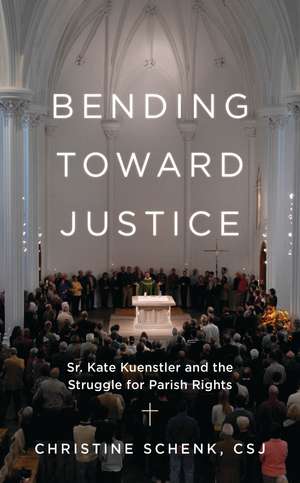
Bending Toward Justice: Sr. Kate Kuenstler and the Struggle for Parish Rights
Autor Christine Schenken Limba Engleză Hardback – 17 dec 2024
Preț: 174.47 lei
Preț vechi: 225.29 lei
-23%
Puncte Express: 262
Preț estimativ în valută:
30.88€ • 36.09$ • 26.81£
30.88€ • 36.09$ • 26.81£
Carte tipărită la comandă
Livrare economică 19 februarie-05 martie
Preluare comenzi: 021 569.72.76
Specificații
ISBN-13: 9798881800475
Pagini: 268
Ilustrații: 14 BW Photos, 2 Tables
Dimensiuni: 160 x 230 x 20 mm
Greutate: 0.52 kg
Editura: Bloomsbury Publishing
Colecția Sheed & Ward
Locul publicării:New York, United States
Pagini: 268
Ilustrații: 14 BW Photos, 2 Tables
Dimensiuni: 160 x 230 x 20 mm
Greutate: 0.52 kg
Editura: Bloomsbury Publishing
Colecția Sheed & Ward
Locul publicării:New York, United States
Cuprins
Acknowledgements
Chapter One: Context - A Church in Crisis
Chapter Two: Seeds of a Prophetic Life
Chapter Three: Canon Law Studies in Rome
Chapter Four: Catholics Discover They Have Rights
Chapter Five: Advocate for the Laity- St. Mary Jamesville, NY
Chapter Six: Making a Way Where There Was No Way
Chapter Seven: In the Diocese of Cleveland, Catholics Rise Up
Chapter Eight: Parishioners Persevere
Chapter Nine: A Landmark Ruling - Rome Upholds Cleveland Appeals
Chapter Ten: Bringing Forth a Harvest
Chapter Eleven: "Making All Things Revenue" - Archdiocese of New York
Chapter Twelve: Perseverance, Pain, and the Will of God
Epilogue
Bibliography
Index
About the Author
Chapter One: Context - A Church in Crisis
Chapter Two: Seeds of a Prophetic Life
Chapter Three: Canon Law Studies in Rome
Chapter Four: Catholics Discover They Have Rights
Chapter Five: Advocate for the Laity- St. Mary Jamesville, NY
Chapter Six: Making a Way Where There Was No Way
Chapter Seven: In the Diocese of Cleveland, Catholics Rise Up
Chapter Eight: Parishioners Persevere
Chapter Nine: A Landmark Ruling - Rome Upholds Cleveland Appeals
Chapter Ten: Bringing Forth a Harvest
Chapter Eleven: "Making All Things Revenue" - Archdiocese of New York
Chapter Twelve: Perseverance, Pain, and the Will of God
Epilogue
Bibliography
Index
About the Author
Recenzii
Schenk's narrative offers the opportunity to feel the surprise, the disappointment, the anger, the determination, the love, and the hope of the parishioner groups who spearheaded each of these cases. Careful attention to detail is one of the great strengths of the book.
This book adds depth and color to the struggles for equality and justice.
Bending Toward Justice offers the compelling story Sister Kate Kuenstler, a midwestern U.S. nun who used her training in the Church's legal system (Canon Law) to awaken Catholics-from average churchgoers all the way through the popes-to the rights of lay Catholics. Once again, and with punch, the book raises the question-where would the church be without its sisters? A warm and fitting tribute to Kuenstler as a true leader of the church, the book also promises to inspire Catholics to take ownership of their faith and their parishes as scenes of communal meaning, power, and justice.
Through the text Bending Toward Justice, Sr Christine Schenk captures well Sr Kate Kuenstler's love for the Church alongside her fight for just treatment of the laity when bishops overstepped. It presents this canon lawyer's walk of the thin line between directness and discretion, criticism of the Church with loving respect, and the unrelenting quest for justice for its faithful when their parishes were threatened by unlawful closure.
The shift in the demographics of Catholics as well as the changing number of priests to serve as pastors in the decades since the 1960s led to a serious situation of what to do with the many parishes erected in dioceses. Out of necessity, dioceses had to make decisions to close and/or combine parishes. But these decisions often caused loss of identity for the parishioners who held the impacted parishes as a central piece of their lives. A parish is more than property and a pastor. It is where the parishioners are formed and sustained in their faith lives. Decisions to close parishes have to involve the parishioners from the very beginning of the consideration and need to be based on more than what are practical business choices. This text presents well the painful journey of this decision-making and information on how the Church's canon law provides means of recourse for parishioners who experience being left out of the conversation to close their parish. It is well-worth reading.
This compelling narrative invites readers to reflect deeply on the authentic meaning of ecclesial community: a church not constrained by bureaucratic structures and rigid norms but one that truly incarnates God's presence in the lived experiences of its people.
This book adds depth and color to the struggles for equality and justice.
Bending Toward Justice offers the compelling story Sister Kate Kuenstler, a midwestern U.S. nun who used her training in the Church's legal system (Canon Law) to awaken Catholics-from average churchgoers all the way through the popes-to the rights of lay Catholics. Once again, and with punch, the book raises the question-where would the church be without its sisters? A warm and fitting tribute to Kuenstler as a true leader of the church, the book also promises to inspire Catholics to take ownership of their faith and their parishes as scenes of communal meaning, power, and justice.
Through the text Bending Toward Justice, Sr Christine Schenk captures well Sr Kate Kuenstler's love for the Church alongside her fight for just treatment of the laity when bishops overstepped. It presents this canon lawyer's walk of the thin line between directness and discretion, criticism of the Church with loving respect, and the unrelenting quest for justice for its faithful when their parishes were threatened by unlawful closure.
The shift in the demographics of Catholics as well as the changing number of priests to serve as pastors in the decades since the 1960s led to a serious situation of what to do with the many parishes erected in dioceses. Out of necessity, dioceses had to make decisions to close and/or combine parishes. But these decisions often caused loss of identity for the parishioners who held the impacted parishes as a central piece of their lives. A parish is more than property and a pastor. It is where the parishioners are formed and sustained in their faith lives. Decisions to close parishes have to involve the parishioners from the very beginning of the consideration and need to be based on more than what are practical business choices. This text presents well the painful journey of this decision-making and information on how the Church's canon law provides means of recourse for parishioners who experience being left out of the conversation to close their parish. It is well-worth reading.
This compelling narrative invites readers to reflect deeply on the authentic meaning of ecclesial community: a church not constrained by bureaucratic structures and rigid norms but one that truly incarnates God's presence in the lived experiences of its people.