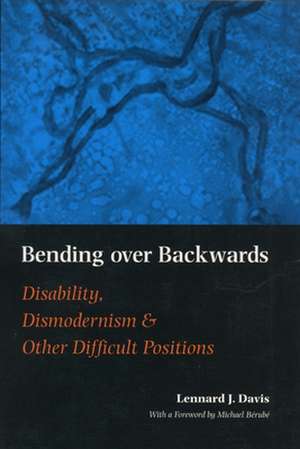
Bending Over Backwards
Autor Lennard J. Davisen Limba Engleză Paperback – sep 2002
Considerăm că volumul Bending Over Backwards reprezintă o resursă fundamentală pentru studiile culturale și sociologia dizabilității, integrându-se în curriculumul academic ce vizează intersecția dintre biopolitică, drept și etică medicală. Lucrarea propune o reevaluare a conceptului de „normalitate” într-un context marcat de progresele geneticii și ale cercetării celulelor stem. Lennard J. Davis utilizează instrumentele teoriei postmoderniste pentru a deconstrui modul în care societatea definește corpul funcțional, analizând impactul unor reglementări precum Americans with Disabilities Act și evoluția istorică a eugeniei. Merită menționat că acest volum extinde cadrul teoretic propus de Disability and Social Theory de D. Goodley, aducând în discuție date noi despre modul în care identitatea este modelată de sistemul juridic și de istoria medicinei. În timp ce Goodley se concentrează pe intersecția cu rasa și clasa socială, Davis pune accentul pe tensiunea dintre biotehnologie și activismul politic. Această abordare continuă linia de cercetare începută de autor în Enforcing Normalcy, unde a explorat pentru prima dată mecanismele opresiunii prin prisma surdității și a corpului, dar aici perspectiva este lărgită pentru a include fenomene contemporane precum genomul uman și politicile de identitate globală. Structura eseistică a cărții facilitează o tranziție fluidă între analiza istorică și critica socială, oferind un ton riguros, dar provocator, care forțează cititorul să regândească fundamentele biopoliticii moderne.
Preț: 260.35 lei
Carte tipărită la comandă
Livrare economică 02-16 decembrie
Specificații
ISBN-10: 0814719503
Pagini: 200
Dimensiuni: 162 x 228 x 14 mm
Greutate: 0.3 kg
Ediția:New.
Editura: NEW YORK UNIVERSITY PRESS
V-ar putea interesa
-
 Emma and ISheila Hocken-20%Preț: 85.80 lei106.73 lei
 -
 Learning DisabilityGordon Grant-26%Preț: 250.94 lei337.35 lei
 -
 Challenging BehaviourEric Emerson-11%Preț: 617.28 lei693.57 lei
 -
 Social Work and DisabilityPeter SimcockPreț: 232.40 lei
 -
 Mean Little Deaf QueerTerry GallowayPreț: 154.46 lei
 -
 Factual FictionsLennard J. DavisPreț: 289.17 lei
 -
 -23%Preț: 651.11 lei845.61 lei
 -
 HomeArien MackPreț: 302.12 lei
 -
 The Radical Lives of Helen KellerKim E NielsenPreț: 231.98 lei
 -
 Saving FaceHeather Laine TalleyPreț: 279.05 lei
 -
 The New Disability HistoryFrances Moran-23%Preț: 636.17 lei826.21 lei
 -
 The New Disability HistoryPaul K LongmorePreț: 299.13 lei
 -
 Disability HarassmentMark C WeberPreț: 447.84 lei
 -
 -23%Preț: 667.42 lei866.78 lei
 -
 Deaf WorldLois BraggPreț: 338.76 lei
 -
 Righting Educational WrongsArlene KanterPreț: 337.31 lei
 -
 The Disability Studies ReaderLennard J. Davis-15%Preț: 663.40 lei780.47 lei
 -
 Keywords for Disability StudiesRachel Adams-23%Preț: 608.28 lei789.98 lei
 -
 -21%Preț: 93.02 lei118.12 lei
 -
 -23%Preț: 683.70 lei887.92 lei
 -
 Deafness in MindSally Austen-9%Preț: 791.14 lei869.39 lei
De ce să citești această carte
Recomandăm această carte studenților și cercetătorilor din științele sociale care doresc să înțeleagă cum este construită politic ideea de „normal”. Cititorul câștigă o perspectivă critică asupra modului în care legile și știința medicală definesc corpul uman. Este un instrument esențial pentru a înțelege provocările etice ale secolului XXI, de la eugenie la drepturile civile ale persoanelor cu dizabilități, oferind argumente solide pentru activismul social.
Despre autor
Lennard J. Davis este o figură centrală în domeniul studiilor despre dizabilitate, ocupând funcția de șef al Departamentului de Engleză la University of Illinois din Chicago, unde este și profesor de Dezvoltare Umană. Opera sa este marcată de o preocupare constantă pentru demontarea stereotipurilor sociale, fapt vizibil în lucrări precum Poor Things, unde analizează reprezentările sărăciei în literatură, sau The Disability Studies Reader, o antologie de referință în domeniu. Expertiza sa îmbină critica literară cu analiza sociopolitică, Davis fiind recunoscut pentru modul în care leagă teoria academică de realitățile activismului politic.
Descriere scurtă
Recenzii
The Minnesota Review [Its] uniqueness of thought is this collections strength as it makes for an interesting and proactive read.
American Journal of Occupational Therapy "Davis's work offers creative and challenging examples that may be useful to our discipline and particularly to Disability historians. Bending Over Backwards remains an important and useful work for historians as a template for examining the myriad ways disability and Deafness infiltrate vital aspects of our identity, including laws, cultural icons, literature, and citizenship."
H-Net Reviews "Taken all together, the chapters offer an important, theoretically rich introduction to disability issues."
Novel "It is crucial, if at times uncomfortable, reading for medical professionals and scholars in the medical humanities alike. . . . Daring to mix the literary and the medical, the symbolic and the instrumental, the interpretive and the interventionist, Davis demonstrates what disability can teach us about the life that awaits any human baby."
Literature and Medicine "This superlative book is highly recommended for undergraduates, scholars, and researchers in the fields of disability studies, sociology, psychology, anthropology, ethics, and cultural studies."Choice "Lennard Davis is history in the making; for he is one of the foremost proponents of "disability studies," the newest theoretical kid on the block, noteworthy in part because it brings together scholars from the humanities and the medical sciences."
Stanley Fish, in Chicago Tribune A collection of essays written over several years for different audiences, it contains fascinating traces of Daviss intellectual journey from novel theorist and Foucauldian to disability studeis scholar and memoirist.
American Literature
"Bending Over Backwards is a welcome dismemberment of all that was unknowingly artificial from the start." --The Minnesota Review "[Its] uniqueness of thought is this collection's strength as it makes for an interesting and proactive read." --American Journal of Occupational Therapy "Davis's work offers creative and challenging examples that may be useful to our discipline and particularly to Disability historians. Bending Over Backwards remains an important and useful work for historians as a template for examining the myriad ways disability and Deafness infiltrate vital aspects of our identity, including laws, cultural icons, literature, and citizenship." --H-Net Reviews "Taken all together, the chapters offer an important, theoretically rich introduction to disability issues." --Novel "It is crucial, if at times uncomfortable, reading for medical professionals and scholars in the medical humanities alike... Daring to mix the literary and the medical, the symbolic and the instrumental, the interpretive and the interventionist, Davis demonstrates what disability can teach us about the life that awaits any human baby." --Literature and Medicine "This superlative book is highly recommended for undergraduates, scholars, and researchers in the fields of disability studies, sociology, psychology, anthropology, ethics, and cultural studies."--Choice "Lennard Davis is history in the making; for he is one of the foremost proponents of "disability studies," the newest theoretical kid on the block, noteworthy in part because it brings together scholars from the humanities and the medical sciences." --Stanley Fish, in Chicago Tribune "A collection of essays written over several years for different audiences, it contains fascinating traces of Davis's intellectual journey from novel theorist and Foucauldian to disability studeis scholar and memoirist." --American Literature