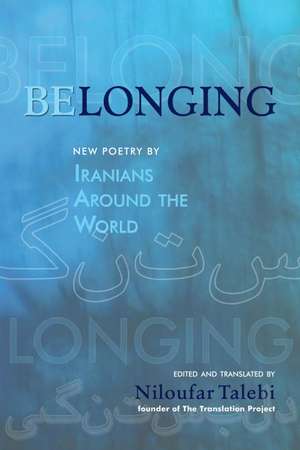
Belonging
Editat de Niloufar Talebien Limba Engleză Paperback – 5 aug 2008
Găsim în Belonging o deschidere necesară către interdisciplinaritatea dintre studiile culturale, istoria politică și critica literară, oferind o perspectivă nuanțată asupra identității iraniene dincolo de conflictele geopolitice recente. Putem afirma că acest volum funcționează ca o punte între tradiția poetică milenară a Iranului și realitățile fragmentate ale exilului contemporan. Spre deosebire de succesul prozei iraniene în Occident, poezia a rămas un teritoriu mai puțin explorat, lacună pe care această antologie o adresează direct prin includerea unor voci diverse din diaspora globală. Merită menționat că volumul completează perspectiva oferită de Persian Language, Literature and Culture de Kamran Talattof, adăugând o dimensiune practică și estetică prin textele poetice propriu-zise, acolo unde lucrarea lui Talattof se concentrează pe abordările critice și evoluția metodologiilor academice. În contextul operei editorului, Belonging continuă efortul început de Niloufar Talebi în Elegies of the Earth (dedicat lui Ahmad Shamlou), extinzând însă atenția de la un singur autor monumental către o colectivitate de poeți care scriu din Suedia, Olanda sau SUA. Structura cărții este organizată riguros, începând cu un aparat critic esențial — introducere și note asupra traducerii — urmat de prezentări individuale ale poeților, ordonate cronologic după anul nașterii. Această progresie permite cititorului să urmărească evoluția tonului narativ, de la lirismul clasic al lui Nader Naderpour la polemicile tăioase ale lui Maryam Huleh, oferind o imagine de ansamblu asupra modului în care limba persană este modelată de experiența dezrădăcinării.
Preț: 107.74 lei
Carte disponibilă
Livrare economică 09-23 noiembrie
Specificații
ISBN-10: 1556437129
Pagini: 256
Dimensiuni: 150 x 231 x 23 mm
Greutate: 0.39 kg
Editura: NORTH ATLANTIC BOOKS
De ce să citești această carte
Această antologie este esențială pentru cititorii interesați de literatura universală și de modul în care trauma exilului transformă limbajul poetic. Belonging oferă acces la o cultură complexă, adesea neînțeleasă, prin traduceri de înaltă calitate care păstrează forța originală a versurilor. Este un instrument valoros pentru studenții de la litere și pentru oricine dorește să exploreze una dintre cele mai bogate tradiții poetice ale lumii în contextul său modern.
Despre autor
Niloufar Talebi este o figură centrală în promovarea literaturii iraniene contemporane pe scena internațională. A fondat The Translation Project, o organizație dedicată traducerii și difuzării operelor literare persane în formate multimedia și limbi diverse. Activitatea sa editorială este marcată de un interes profund pentru conservarea identității culturale în diaspora, coordonând proiecte de anvergură care pun în dialog tradiția cu modernitatea. Stabilită în San Francisco, Talebi colaborează frecvent cu traducători renumiți și poeți premiați pentru a aduce în atenția publicului anglofon bogăția estetică a spațiului cultural iranian.
Notă biografică
Extras
Though his work is not political, it has a social conscience. His profound awareness of his exile does not narrow his poetic potential, but it endows him with a historical context. Rashid is of the generation whose youth was spent on the revolution—without the desired results—but the tumultuous events of his early adulthood do not limit the scope of his work; instead they leave traces for the reader, echoes of historic events in the scenes he creates. Iran’s rich poetic history, both its classical and modern poetry, is a significant tradition for a poet to emerge from. Rashid not only gives us poetic elements such as attention to language, imagery, and symbol, but beyond creating beauty in lyric form, he gives us ideas.
Rashid came of age after he left his country, equipped with references of both his Eastern and Western lives. He claims the Western literary and historical tradition as his own and at his disposal as they shape his work. In his poems, he addresses Dante in a journey to hell, as Dante conjured Virgil as his companion. He writes of Hamlet, Shakespeare and borrows from Hafez, Rimbaud, Marx, Shamlou, the Bible, the Koran, the myth of Sisyphus, the myth of Icarus.
His is a personal-epic poem, a blend of what Eastern-Islamic and Western-Greek cultural imaginations present him to deliver us what speaks to our blended imagination.
“Seasonless Years,” “Downfall on the Horizon,” and “Icarus” are excerpts from three long poems, narratives about falling, both vertically and horizontally.
Seasonless Years
(excerpt)
We have landed from the heights of our flight
And there is no seed by the trap
Neglect and vanity have cultivated our lives
Even our sleep doesn’t benefit from our fatigue
Our mending ways rot under the audacious sun
Charting our separation is an age-old habit.
Sterile wounds, we will not be avenged.
Yesterday
Yesterday
Yesterday
Yesterday has us memorized.
Do you remember
When we blindfolded night
With my purple scarf?
And in our dreams ran toward a sea
Without a shore?
It dawned because of our mischief
five hours early,
Do you remember?
I am not the restraint of forty dervishes
Nor is the earth a meager sheath.
The stars and the senate do not obey us,
For we are not Caesars.
We are the red rose in the wine tavern
On nights of avarice, in hellish cities.
Who made you into such a locust
That you chew yourself, chew,
Chew and spit
Yourself onto passersby
In the stammering day?
In square rooms
Infinitely reflected,
A poet is on fire.
Downfall on the Horizon
(excerpt)
At times, at dusk you see a man
Standing on his terrace
Heavy-headed, with a bitter mouth and lost words
Staring at passing colors
In the impenetrable narcotic air.
Could you, for a second,
In the flustered flow of a fall river,
Address his ceramic eyes?
Could you?
I am tired.
I wish I could become a bench this afternoon
On this thirteenth bright-eyed weariness,
Catch my breath, leave the body
To become a drop of stone, hard, released, cold
And appeal to earth, dreaming of snow.
Something is always forgotten in the empty house.
A little thing like a small mirror,
A freckle-faced doll, a piece of agate,
A line of poetry on the hem of a floral handkerchief.
A small thing,
Keeper of smells and memories.
A few people always remain outside the circle.
There is always one person weeping in the wet abandoned
Fields in the sting of a white December.
There is always one person denying his country
Refusing to be the guardian of a crestfallen land,
Errant on disinherited earth.
There is always one person stretching to smell the red rose
In the steepest slopes, in the state of descent.
All seats are taken
And there is no room to sit.
I will sit on the loins of a stone
Under the shadow of a thistle
On the edge of the pit that separates us
And I will watch the world’s little characters and heroes
In days lost in fog
In nights narrowed by rain,
And I shall weep the flares of your pain
In the verses of a winter’s solstice.
Descriere scurtă
Recenzii
—Carolyn Forché, editor of Against Forgetting: Twentieth Century Poetry of Witness
“In Belonging, with literary skill and passion, Niloufar Talebi has made a major contribution to the recognition of contemporary Iranian literature in the West, to the appreciation of diaspora poetry by Persian speakers everywhere, and to the important project of producing good translations from rich but underrepresented literary canons for the anglophone reader.”
—Nahid Mozaffari, editor of the PEN Anthology of Contemporary Iranian Literature
“Poetry is a world art because of brilliant editors and translators like Niloufar Talebi ... Here are the poets, in all their power, defiance, dignity, wildness, and lyric grace, scattered across the earth, yet united in this book. Here is proof that poetry humanizes: now contemporary Persian culture has a face, and the Persian tongue a voice, for those of us in the English-speaking world, and we are all richer for it.”
—Martín Espada, Pulitzer Prize nominee and author of The Republic of Poetry
“After reading her introduction and the first few sections of Belonging, I realized that Talebi had accomplished perhaps the greatest service that a translator of Iranian poetry for American audiences can provide: she made the Iranian poetic landscape feel familiar. Not only familiar, but modern, full of laughter, rich with wonder, completely joyful and terrible and worthy of revisiting multiple times."
—Peter Conners, Three Percent
“Niloufar Talebi has accomplished the ultimate magic trick in her clean and modern translation. She has made the work of modern Persian poets read like original English ... an unparalled contribution.”
—Willis Barnstone, author of With Borges on an Ordinary Evening in Buenos Aires
“The poems speak of lost places and missing people; of the fear and freedom that come with new surroundings; of love, sex, and passion; of prison and protest; of the commonplace and the universal; and of subjects classical, political, and taboo… In form and imagery these poems often allude to works of Persian classical literature, but they are also the heirs of Rimbaud, Lorca, Dante, Shakespeare, and the literatures of adopted countries… Talebi’s translation process included thorough review and collaboration with the poets themselves… While one can always find phrases with which to quibble, the translations are of consistently high quality… not only do the poems work in English, but they adhere closely to the originals in tone, content, and format.”
—Harvard Review Online Journal
“If you will trust me though, and don't want to read my justification, you can know that this is simply one of those books you need to have on your shelves, one you can look for and find at a party, and hand to one of your closer American friends and smilingly say, ‘Here Bradley, this will explain everything!’”
—Iranian.com
"This collection is impressive by making a good sample of contemporary Iranian poets in the diaspora so beautifully accessible to English readers and by presenting them so deservingly as a part of world literature today."
—World Literature Today Magazine
Cuprins
Notes on Selection xxiii
Notes on Translation xxv
Amir-Hossein Afrasiabi, b. 1934 (The Netherlands)
Red Rose 1
Red Rose 2
The Grayest Port
Ghosts
Two Poems
Mina Assadi, b. 1943 (Sweden)
Yearning for Saari 1
Sketch 4
Sketch 13
Sketch 25
Waking Dreams 3
Waking Dreams 6
Waking Dreams 7
Because of Boredom 21
Nader Naderpour, 1929—2000 (U.S.)
Conversation in the Dark
Point and Line
Yadollah Roya’i, b. 1932 (France)
Name Stone
Bosom Stones (3)
Lipbrimmings (4)
Esma’il Kho’i, b. 1938 (U.K.)
To the Aged Mulberry Branch
In a Thousand Years
Song
Losing
Image of Kindness
Partow Nooriala, b. 1946 (U.S.)
Many Happy Returns
Four Springs
Majid Naficy, b. 1952 (U.S.)
Narcissus Flower
Night
To a Snail
Abbas Saffari, b. 1951 (U.S.)
Tomorrow
A Bird Is a Bird
Saturday Night Dinner
Revenge
Tanka for Loneliness
Reza Farmand, b. 1956 (Denmark)
My Mother Did Not Become Beautiful (excerpt)
Saghi Ghahraman, b. 1957 (Canada)
The Dead Dear One
I Hang Myself
Jamshid Moshkani, b. 1958 (Sweden)
Book of Fears 1
Book of Fears 27
Book of Fears 30
Book of Fears 41
Book of Fears 45
Behzad Keshmiripour, b. 1958 (Germany)
If You Danced the Wind
Barefoot on Nightvelvet
Shahrouz Rashid, b. 1960 (Germany/U.S.)
Seasonless Years (excerpt)
Downfall on the Horizon (excerpt)
Icarus (excerpt)
Letter to Father
Naanaam, b. 1966 (Canada)
Untitled 19
One Must Not Sleep with Juliet and Not Be Romeo 37
AntiPoem 2
Granaz Moussavi, b. 1973 (Australia)
Moving Sale
Post-Cinderella
Half-Bottle
Song of a Forbidden Woman
Ziba Karbassi, b. 1974 (U.K.)
Gravequake
Love Is Lemony
Revolution
Song of Ruin
Maryam Huleh, b. 1978 (Sweden)
The Sticky Dream of a Banished Butterfly (excerpt)
Mana Aghaee, b. 1973 (Sweden)
My Death
Come What May
Woman Seeking Man
Majnun
Tree
Partial List of Iranian Poets around the World
Acknowledgments