Cantitate/Preț
Produs

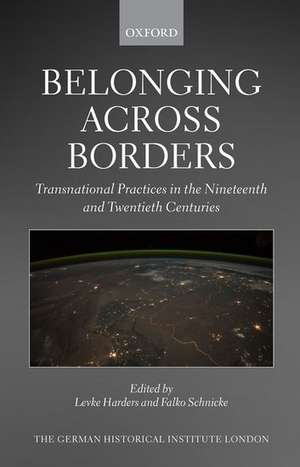
Belonging across Borders: Transnational Practices in the Nineteenth and Twentieth Centuries: Studies of the German Historical Institute, London

Editat de Levke Harders, Falko Schnicke
en Limba Engleză Hardback – 24 oct 2022
În centrul volumului Belonging across Borders, editat de Levke Harders și Falko Schnicke, stă tema modului în care indivizii și-au negociat apartenența într-o epocă marcată de redefinirea constantă a limitelor statale. Considerăm că această lucrare aduce o contribuție esențială prin mutarea focalizării de la marile narațiuni instituționale către practicile cotidiene ale subiecților istorici. Volumul analizează cum frontierele secolelor XIX și XX nu au fost doar linii pe o hartă, ci procese sociale fluide, influențate de structuri imperiale și regionale care au precedat sau au coexistat cu statul-națiune modern.

Apreciem rigoarea metodologică cu care autorii integrează perspective din geografie și antropologie într-un cadru istoric solid, demonstrând că apartenența este un concept dinamic, dependent de contextul temporal. Structura cărții permite o reevaluare a surselor istorice, punând accent pe modul în care actorii individuali au navigat între incluziune și excluziune. Această abordare transformă studiul frontierelor dintr-o analiză a geopoliticii într-o examinare a experienței umane sub presiunea granițelor sociale și spațiale.

Ca alternativă la Migrations and Border Processes de Margit Fauser pentru cursurile de istorie modernă și studii transnaționale, acest titlu oferă avantajul unei analize mai profunde a raportului dintre individ și entitățile pre-naționale (precum imperiile). De asemenea, în timp ce Boundaries and Belonging de Joel S. Migdal se concentrează pe hărți mentale și logici spațiale concurente, volumul de față ancorează aceste concepte în studii de caz istorice concrete din cadrul seriei Studies of the German Historical Institute, London. Recomandăm această ediție pentru capacitatea sa de a oferi un fundament istoric necesar dezbaterilor actuale despre cetățenie și identitate globală.

Citește tot Restrânge

Din seria Studies of the German Historical Institute, London

Preț: 53498 lei

Preț vechi: 77286 lei
-31%

Puncte Express: 802

Carte disponibilă

Livrare economică 26 iunie-01 iulie

Livrare prin curier în România Termenul estimat este afișat lângă disponibilitate.
Transport gratuit pentru acest produs Plată online sau ramburs, în funcție de opțiunile comenzii.
Retur gratuit în 14 zile Comandă securizată și suport în română.

Specificații

ISBN-13: 9780192867490
ISBN-10: 0192867490
Pagini: 360
Ilustrații: 5
Dimensiuni: 147 x 223 x 30 mm
Greutate: 0.7 kg
Editura: OUP OXFORD
Colecția OUP Oxford
Seria Studies of the German Historical Institute, London

Locul publicării:Oxford, United Kingdom

De ce să citești această carte

Această lucrare este esențială pentru cercetătorii și studenții interesați de istoria modernă și sociologia frontierelor. Cititorul câștigă o înțelegere nuanțată a modului în care apartenența a fost construită istoric prin practici transnaționale, depășind simpla binaritate a statului-națiune. Este un instrument teoretic valoros care explică rădăcinile istorice ale dezbaterilor contemporane despre incluziune, migrație și identitate socială.


Despre autor

Levke Harders și Falko Schnicke sunt cercetători afiliați unor instituții de prestigiu, activitatea lor fiind centrală în cadrul studiilor de istorie modernă și transnațională. În calitate de editori pentru acest volum din seria Studies of the German Historical Institute, London, aceștia au coordonat o echipă internațională de experți pentru a aduce în prim-plan o perspectivă istorică asupra conceptelor de frontieră și apartenență. Expertiza lor se reflectă în selecția riguroasă a studiilor de caz care acoperă intervalul critic dintre secolul al XIX-lea și secolul al XX-lea, perioadă marcată de tranziția de la imperii la state-națiune.


Descriere

Borders and belonging are of immense importance as borders are being (re)defined, strengthened, or weakened all around the globe. Brexit, the proposed wall between the USA and Mexico, the India-Pakistan border-the drawing of social and spatial boundaries is at the heart of many current debates, as is the question of what it means to 'belong' somewhere. Unlike the main body of literature, Belonging Across Borders argues that processes which occurred before and beyond the nation state also influence inclusion and exclusion. Focusing on practices and historical subjects, it re-evaluates historical sources and goes beyond the existing research to look at the interplay between different reference points (empire, nation, and region) and at individuals, exploring borders as both territorial and social boundaries. This approach is in line with recent calls to expand border studies by adding a historical perspective and using new methodologies and theories. Geographers and anthropologists have been studying this topic for decades and have produced a range of inspiring research. However, a more historical perspective is also needed: first, to emphasize the existence of different types of borders, bordering, and border actors through historical case studies; second, to underscore the historical specificity of border practices; and third, to highlight their dependence on historical contexts. Belonging Across Borders breaks new ground by applying the concept of belonging to historical studies on borders, empires, nations, and regions. It also links borders and belonging to individual historical actors and their practices, not just to institutions or social groups.

Notă biografică

Dr Levke Harders is Professor of Gender History at the University of Innsbruck. She is currently working on a book project entitled Narratives of Foreignness and Belonging: Migration as a Discursive Process in Western European Border Regions (1815-1871) funded by the German Research Foundation. From 2008 to 2021 she worked at the University of Bielefeld. Dr Harders studied German literature, history, and gender studies, and in 2011 she obtained her Ph.D. with a dissertation on American studies. She has also published on the theory of biography and on gender history. Dr Harders writes about her migration project and her other fields of research on her blog 'Migration and Belonging'.Dr Falko Schnicke is Senior Lecturer in Modern History at the Johannes Kepler University Linz. He specializes in nineteenth and twentieth-century German, British, and international history and has published widely on these topics.