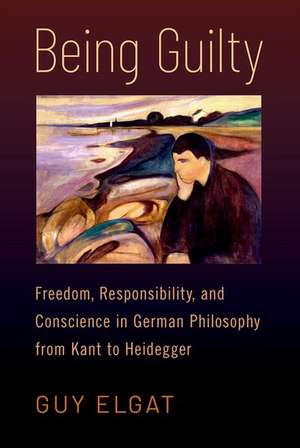
Being Guilty: Freedom, Responsibility, and Conscience in German Philosophy from Kant to Heidegger
Autor Guy Elgaten Limba Engleză Hardback – 27 apr 2022
Preț: 524.71 lei
Preț vechi: 589.57 lei
-11%
Puncte Express: 787
Carte disponibilă
Livrare economică 30 octombrie-10 noiembrie
Livrare prin curier în România Termenul estimat este afișat lângă disponibilitate.
Transport gratuit pentru acest produs Plată online sau ramburs, în funcție de opțiunile comenzii.
Retur gratuit în 14 zile Comandă securizată și suport în română.
Specificații
ISBN-13: 9780197605561
ISBN-10: 0197605567
Pagini: 332
Dimensiuni: 218 x 150 x 31 mm
Greutate: 0.5 kg
Editura: Oxford University Press
Colecția OUP USA
Locul publicării:New York, United States
ISBN-10: 0197605567
Pagini: 332
Dimensiuni: 218 x 150 x 31 mm
Greutate: 0.5 kg
Editura: Oxford University Press
Colecția OUP USA
Locul publicării:New York, United States
Recenzii
Being Guilty is provocative and original, both as intellectual history and as philosophical argument. Elgat has very interesting things to say on a variety of subjects pertaining to guilt, especially in Nietzsche and Heidegger. The book is certain to stimulate vigorous discussion and debate.
This is a wide-ranging and highly informative study of guilt, the feeling of guilt, and conscience, including their relations to freedom and responsibility, through the lens of the German philosophical tradition. The study examines three major approaches—metaphysical (Kant, Schelling, Schopenhauer), naturalistic (Rée, Nietzsche), and phenomenological (Heidegger). Elgat's interpretations are always careful and scholarly, his arguments perceptive and lucid. The readings of Nietzsche and Heidegger in particular are of illuminating originality. Elgat's own critical appraisal of the philosophers studied, as well as his independent reflections, show well-informed and balanced judgement throughout. This book deserves to become a key text on this topic.
Guilt, as Guy Elgat first introduces us to it, is a feeling: "the unpleasant feeling for having done wrong in some sense" (1â2). But this, it quickly becomes clear, is merely guilt as surface phenomenon, and the question that animates Elgat's book is, as its subtitle suggests, whether this surface phenomenon can be grounded on any deeper metaphysical foundations. Is this painful feeling really justified? Are we (ever, always?) actually guilty...And perhaps such an existence, "guilty" in Elgat's sense though it may be, might be a choiceworthy one.
Being Guilty...succeeds in presenting us with a systematic, insightful and valuable account of various ways in which the possibility of moral guilt and the assertion or denial of its justifiability can be explained.
This is a wide-ranging and highly informative study of guilt, the feeling of guilt, and conscience, including their relations to freedom and responsibility, through the lens of the German philosophical tradition. The study examines three major approaches—metaphysical (Kant, Schelling, Schopenhauer), naturalistic (Rée, Nietzsche), and phenomenological (Heidegger). Elgat's interpretations are always careful and scholarly, his arguments perceptive and lucid. The readings of Nietzsche and Heidegger in particular are of illuminating originality. Elgat's own critical appraisal of the philosophers studied, as well as his independent reflections, show well-informed and balanced judgement throughout. This book deserves to become a key text on this topic.
Guilt, as Guy Elgat first introduces us to it, is a feeling: "the unpleasant feeling for having done wrong in some sense" (1â2). But this, it quickly becomes clear, is merely guilt as surface phenomenon, and the question that animates Elgat's book is, as its subtitle suggests, whether this surface phenomenon can be grounded on any deeper metaphysical foundations. Is this painful feeling really justified? Are we (ever, always?) actually guilty...And perhaps such an existence, "guilty" in Elgat's sense though it may be, might be a choiceworthy one.
Being Guilty...succeeds in presenting us with a systematic, insightful and valuable account of various ways in which the possibility of moral guilt and the assertion or denial of its justifiability can be explained.
Notă biografică
Guy Elgat is Lecturer at the School of the Art Institute of Chicago. He has published numerous articles on the thought of Friedrich Nietzsche in various journals and is the author of Nietzsche's Psychology of Ressentiment: Revenge and Justice in "On the Genealogy of Morals" (Routledge, 2017).
Cuprins
- Introduction
- Chapter One: Kant: The Timeless Deed that Makes Guilt Possible
- Chapter Two: Schelling: Evil, Freedom, and Guilt
- Chapter Three: Schopenhauer: The Varieties of Guilt
- Chapter Four: Rée: The Naturalization of Guilt
- Chapter Five: Nietzsche: The Genealogy of Guilt
- Chapter Six: Heidegger: Being-guilty as a Condition of Possibility of Guilt
- Conclusion