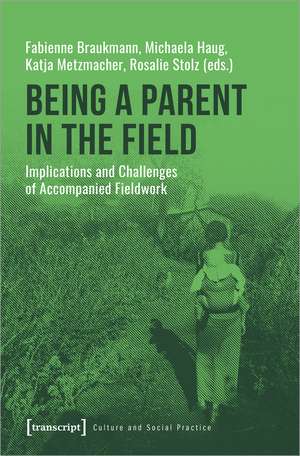
Being a Parent in the Field: Implications and Challenges of Accompanied Fieldwork
Editat de Fabienne Braukmann, Michaela Haug, Katja Metzmacher, Rosalie Stolzen Limba Engleză Paperback – 25 sep 2020
Based on regionally and thematically diverse cases, this collection explores methodological, theoretical, and ethical dimensions of accompanied fieldwork. The authors show how multiple familial relations and the presence of their children, partners, or other family members impact the immersion into the field and the construction of its boundaries.
Female and male authors from various career stages exemplify different research conditions, financial constraints, and family-career challenges which are decisive for academic success.
Preț: 354.81 lei
Preț vechi: 433.09 lei
-18%
Puncte Express: 532
Carte disponibilă
Livrare economică 14-28 noiembrie
Livrare prin curier în România Termenul estimat este afișat lângă disponibilitate.
Transport gratuit de la 400.00 lei Plată online sau ramburs, în funcție de opțiunile comenzii.
Retur gratuit în 14 zile Comandă securizată și suport în română.
Specificații
ISBN-13: 9783837648317
ISBN-10: 3837648311
Pagini: 300
Ilustrații: 16
Dimensiuni: 148 x 225 x 15 mm
Greutate: 0.46 kg
Editura: transcript
Colecția Transcript
Locul publicării:Bielefeld, Germany
ISBN-10: 3837648311
Pagini: 300
Ilustrații: 16
Dimensiuni: 148 x 225 x 15 mm
Greutate: 0.46 kg
Editura: transcript
Colecția Transcript
Locul publicării:Bielefeld, Germany
Recenzii
»[The book] is not only a must-read for young scholars, to prepare them for potential future fieldwork scenarios, but it also contributes to the disciplines joint effort to pave the way for smoother and more flexible life and research styles.«
»Ein zentraler Wert der Publikation liegt darin, die Konzeptualisierung von eigenen Kindern (im Feld) als Störungen infrage zu stellen, welche auf einer konzeptuellen Trennung von privaten (traditionell weiblich konnotierten) und öffentlichen, beruflichen (›männlichen‹) Sphären gründet.«
»The edited volume is an interesting reading for anyone interested in ethnographic research methodology. It is particularly useful for anyone planning to conduct accompanied fieldwork.
Since the book is particularly clearly written, it can be recommended not only to researchers but also to students.«
»›Being a Parent in the Field‹ offers an important reminder and therefore, is a welcomed contribution to the methodological and epistemological discussions around the making of ethnography, one that should be read in ethnographic methods courses.«
»Ein zentraler Wert der Publikation liegt darin, die Konzeptualisierung von eigenen Kindern (im Feld) als Störungen infrage zu stellen, welche auf einer konzeptuellen Trennung von privaten (traditionell weiblich konnotierten) und öffentlichen, beruflichen (›männlichen‹) Sphären gründet.«
»The edited volume is an interesting reading for anyone interested in ethnographic research methodology. It is particularly useful for anyone planning to conduct accompanied fieldwork.
Since the book is particularly clearly written, it can be recommended not only to researchers but also to students.«
»›Being a Parent in the Field‹ offers an important reminder and therefore, is a welcomed contribution to the methodological and epistemological discussions around the making of ethnography, one that should be read in ethnographic methods courses.«